Access and Benefit Sharing in India: Why Communities Miss Out
While commercial extraction of bioresources expands, statutory levies stall in state accounts instead of compensating the local stewards who protect them.
Oct, 2026
•14 min read
Context
India's statutory Access and Benefit Sharing framework was created to secure fair financial returns for local communities conserving genetic resources. Yet administrative bottlenecks, untraceable supply chains, and sweeping legislative exemptions have severed this link between commercial extraction and grassroots claimers.
Commercial enterprises generate considerable revenue from indigenous bioresources, but statutory levies pool within idle state-level accounts rather than flowing to village institutions. The Biological Diversity (Amendment) Act, 2023 sought to simplify business compliance by exempting domestic Indian entities, codified traditional knowledge, and cultivated medicinal plants from prior intimation mandates. This shift risks turning a community-rights framework into a state-retained revenue instrument that leaves local stewards financially marginalised.
Why in the News: The Push to Monetise Biodiversity Under the 2023 Law
The National Biodiversity Authority released Rs 1.19 crore under the Access and Benefit Sharing mechanism to 29 State Biodiversity Boards in October 2026. This administrative milestone spotlighted deep structural friction inside India's bio-governance pipeline.
According to a Press Information Bureau release from the Ministry of Environment, Forest and Climate Change, the National Biodiversity Authority disbursed Rs 1,18,61,655 across 29 State Biodiversity Boards and one Union Territory Biodiversity Council on 17 October 2026. Maharashtra received the highest allocation at Rs 19,46,149, followed closely by Rajasthan and Madhya Pradesh.
| Pipeline Stage | Operational Status | System Bottleneck |
|---|---|---|
| Central Pool (NBA) | Collects access levies from commercial users | Mandatory devolution of 85% to 90% to states |
| State Accounts (SBBs) | Receives disbursed central funds | Levies pool in state-level bank accounts |
| Transmission Break | Open market sourcing obscures provenance | Direct village claimers cannot be identified |
| Local Funds (BMCs) | Starved of statutory revenue shares | Panchayats receive zero direct compensation |
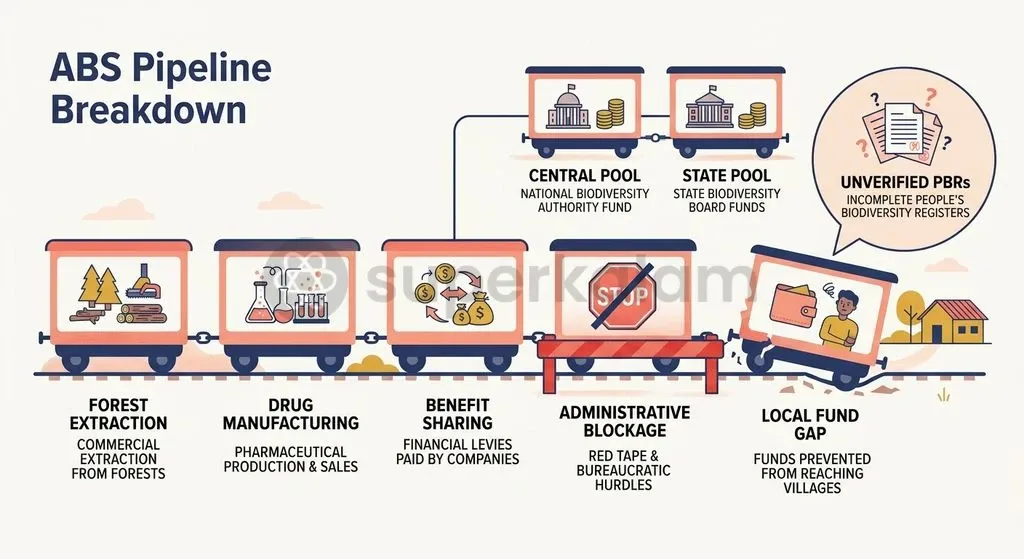
This disbursement revealed a deep administrative compromise. Manufacturers procured these agricultural biological resources through open markets and intermediary traders. As a result, the National Biodiversity Authority could not identify direct community benefit claimers.
The central authority bypassed village-level custodians entirely. It allocated the proceeds to State Biodiversity Boards in proportion to estimated crop cultivation areas sourced from Ministry of Agriculture data.
This episode reflects the central paradox of India's Access and Benefit Sharing regime. While the country maintains an elaborate statutory apparatus, institutional inertia, untraceable market chains, and expanding statutory exemptions have turned a grassroots rights instrument into an administrative mechanism where revenue gathers at state level while primary guardians remain uncompensated.
What is Access and Benefit Sharing: From the Nagoya Protocol to Indian Law
Access and Benefit Sharing originated under Article 15 of the United Nations Convention on Biological Diversity, adopted in 1992. The Convention on Biological Diversity formally recognised the sovereign rights of nation-states over their natural biological resources. This discarded the historical notion that genetic wealth formed a "common heritage of humankind" open to unhindered commercial exploitation.
Article 15 mandated that access to genetic resources must rest upon Prior Informed Consent negotiated on Mutually Agreed Terms. This ensures fair and equitable distribution of benefits between commercial users and indigenous providers.
To operationalise these commitments, the international community adopted the Nagoya Protocol on Access and Benefit Sharing in 2010, which entered into force in October 2014. The Nagoya Protocol established binding compliance architectures for both provider and user jurisdictions. These rules set international legal standards to deter biopiracy and safeguard uncodified traditional knowledge held by local communities.
India translated these multilateral obligations into domestic statutory mandates through the Biological Diversity Act, 2002. The domestic framework establishes legal mechanisms ensuring that commercial users of biological wealth deposit a share of their turnover or purchase price into public funds, with the primary legislative aim of returning these resources directly to traditional custodians.
Discuss with Superkalam
When did the Nagoya Protocol on Access and Benefit Sharing officially enter into force?
Ask NowHow the ABS Framework Works: The Three-Tier Architecture from Centre to Village
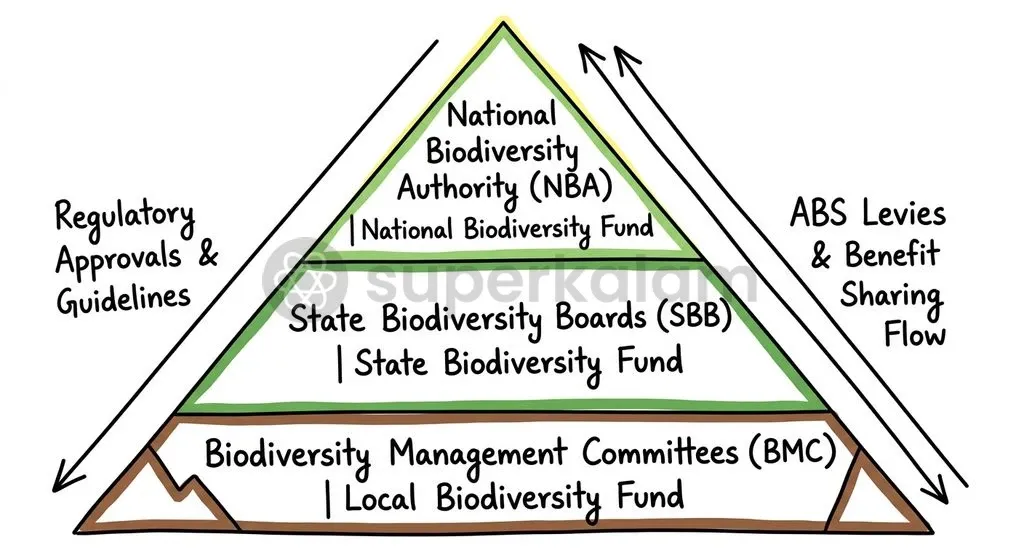
The Biological Diversity Act, 2002 establishes a decentralised, three-tier regulatory apparatus to govern access approvals and monitor commercial benefit-sharing arrangements across India. Each tier exercises distinct statutory jurisdictions tailored to the origin of the entity seeking access.
| Regulatory Tier | Primary Statutory Authority | Jurisdiction and Mandate | Statutory Fund |
|---|---|---|---|
| National Level | National Biodiversity Authority (NBA) | Regulates access by foreign entities, non-resident Indians, and intellectual property transfers under Section 3 and Section 19. | National Biodiversity Fund (Section 27) |
| State Level | State Biodiversity Boards (SBBs) | Regulates commercial access by domestic Indian entities through prior intimation under Section 7 and Section 24. | State Biodiversity Fund (Section 32) |
| Local Level | Biodiversity Management Committees (BMCs) | Promotes conservation, drafts People's Biodiversity Registers, and levies collection charges under Section 41. | Local Biodiversity Fund (Section 43) |
Under Section 3 and Section 19 of the Act, foreign individuals, non-resident Indians, and foreign-controlled corporations must obtain mandatory prior approval directly from the National Biodiversity Authority before securing biological resources or associated traditional knowledge. Domestic Indian commercial entities, by contrast, fall under Section 7, which requires prior intimation to the concerned State Biodiversity Board before accessing bioresources for commercial utilisation. The State Biodiversity Board retains statutory authority under Section 24 to prohibit, restrict, or regulate such activities.
At the grassroots level, Section 41 mandates that every local panchayat and municipality must constitute a Biodiversity Management Committee within its territorial boundaries. Section 41(2) specifically empowers these local committees to levy collection fees from any commercial entity accessing biological resources within their village or municipal limits. Section 43 and Section 44 stipulate that all collection fees, state grants, and benefit-sharing receipts must be credited into a dedicated Local Biodiversity Fund and deployed solely for community conservation and local development.
Discuss with Superkalam
How does the three-tier framework (NBA, SBB, BMC) distribute regulatory responsibility between foreign and domestic entities under the Biological Diversity Act?
Ask NowThe Great ABS Paradox: Idle State Corpuses Versus Starved Local Committees
State Biodiversity Boards hold substantial accumulated access levies in bank accounts while village-level institutions remain almost completely unfunded. Although Section 32(2) of the Act mandates that State Biodiversity Funds must be used for conservation and community development in consultation with local committees, vast sums remain trapped at the state tier.
Under the Biological Diversity Rules, 2024, the National Biodiversity Authority must transfer 85% to 90% of collected access proceeds down to State Biodiversity Boards for eventual distribution to local claimers. However, as reported by the National Biodiversity Authority Current Affairs Pulse and Ministry reviews in mid-2026, cumulative access funds realised centrally since 2008 crossed Rs 266 crore, yet less than 60% of these resources had reached registered grassroots beneficiaries due to severe administrative transmission delays at the state board tier.
This bottleneck stems from structural shortcomings across the bio-governance pipeline:
- Untraceable Supply Chains: Raw medicinal herbs pass through multiple layers of wholesale traders, aggregators, and mandis, obscuring the village of origin.
- Unverified Biodiversity Registers: While official dashboard records showed over 2.76 lakh (276,553) local committees formed across India by mid-2025, their capacity to identify and enforce claims remains fragile.
- Documentation Gaps: As highlighted during the Ministry's national verification campaign in July 2024, out of more than 2.67 lakh People's Biodiversity Registers drafted nationwide, only an estimated 11,951 had undergone scientific validation, leaving the documentation supporting community claims legally unverified.
- Administrative Interception: State authorities frequently redirect unallocated commercial levies toward institutional overheads or general forestry budgets rather than disbursing them to local bodies.
To counter these technical deficits, the National Biodiversity Authority released Rs 6.09 crore in February 2026 to state boards and Union Territory councils for fiscal year 2025–26. This allocation targeted register updation, digital validation, and committee capacity building.
The 2023 Amendment Debate: Does Exempting AYUSH Practitioners Dilute ABS Rights?
The Biological Diversity (Amendment) Act, 2023 received Presidential assent on 3 August 2023 and officially came into force on 1 April 2024. The amendment introduced profound changes to the domestic bio-governance framework, sparking heated legal and constitutional debate.
The most contentious revision altered the proviso to Section 7. The amended law explicitly exempts registered AYUSH practitioners, codified traditional knowledge systems, cultivated medicinal plants, and traditional folk healers from providing prior intimation to State Biodiversity Boards when accessing resources for commercial utilisation.
In parallel, amended Section 40 empowers the Central Government, in consultation with the National Biodiversity Authority, to declare via official gazette notification that the Act shall not apply to cultivated medicinal plants or normally traded commodities accessed by domestic entities.
Supporters of the amendment, including traditional medicine manufacturing associations, argued that the pre-2023 regime subjected domestic classical practitioners to excessive compliance burdens, delays, and litigation from state boards. They contended that exempting codified traditional Indian systems of medicine lowers healthcare costs and incentivises commercial cultivation over wild harvesting.
Environmental jurists and tribal rights advocates, however, raise sharp counter-arguments:
- Commercial Exploitation Loophole: Modern Ayurvedic and herbal manufacturers operate large-scale pharmaceutical enterprises. Exempting them under the banner of traditional AYUSH practice removes a substantial domestic revenue source that previously supported local conservation funds.
- Erosion of Local Rights: Bypassing state board intimation strips local committees of notice when biological wealth leaves their forests, undermining the constitutional vision of local self-governance.
- Decriminalisation Risks: The 2023 Amendment repealed Section 55 criminal imprisonment, substituting it with civil penalties ranging from Rs 1 lakh to Rs 50 lakh, and up to Rs 1 crore for continuing violations. While Section 55A established designated government inquiry officers to adjudicate these fines, critics argue that purely financial penalties represent a manageable business cost for large pharmaceutical conglomerates.
Discuss with Superkalam
If a commercial company procures cultivated herbs from an open wholesale mandi, how does that supply chain reality challenge the NBA's ability to transfer benefits to specific village claimers?
Ask NowPrecedent and Practice: Lessons from the Kani Tribe Model to the Divya Pharmacy Ruling
Judicial rulings and historical field models illustrate both the promise and the institutional pitfalls of access and benefit sharing mechanisms in India.
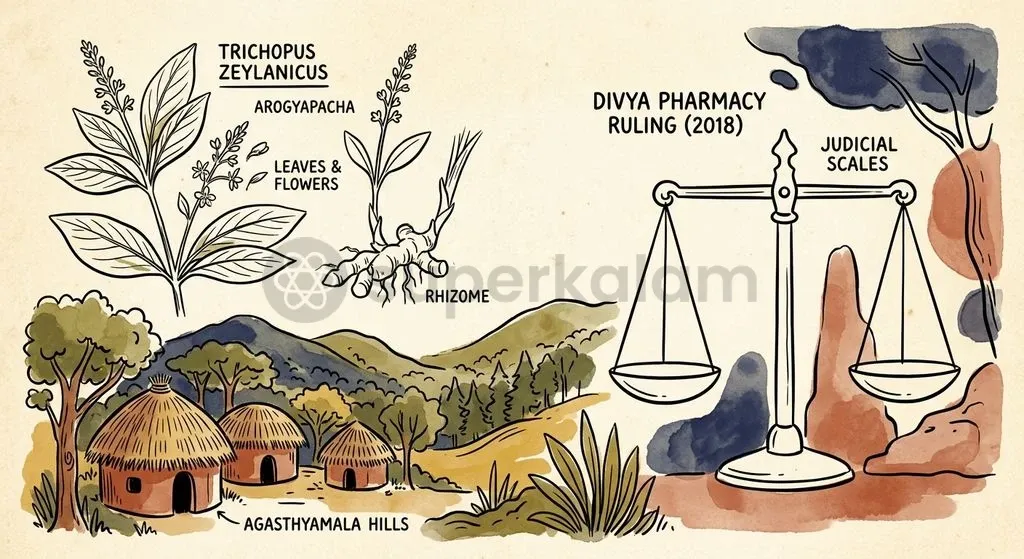
The Kani Tribe-TBGRI model of 1995–1997 in Kerala stands as India's pioneering voluntary benefit-sharing arrangement. The Tropical Botanic Garden and Research Institute developed the restorative drug 'Jeevani' from the medicinal plant Trichopus zeylanicus travancoricus based on traditional knowledge shared by Kani elders. Under this landmark agreement, documented in a World Intellectual Property Organization case study, the research institute pledged 50% of licence fees and royalties to the Kani community.
Despite global recognition, the model collapsed over time. Investigative reporting by Down To Earth and The Hindu revealed that the community trust became dysfunctional, sustainable cultivation contracts lapsed, and the original indigenous informants who shared the knowledge lived in severe deprivation. The Kani experience showed that intellectual property royalties alone cannot sustain community welfare without durable local institutions, equitable benefit distribution, and secure forest access.
| Chronological Step | Institutional Action | Community Outcome |
|---|---|---|
| 1. Knowledge Transfer (1995) | Kani elders shared restorative properties of Trichopus zeylanicus travancoricus | Documented formally by TBGRI scientists |
| 2. Commercial Drug Formulation | TBGRI formulated and licensed 'Jeevani' to private manufacturers | Manufacturing rights monetised commercially |
| 3. Royalty Agreement | 50% of licence fees and royalties pledged to the Kani community | Trust constituted to administer local receipts |
| 4. Institutional Failure | Administrative paralysis set in and cultivation contracts lapsed | Knowledge holders left without sustained income |
Two decades later, the Uttarakhand High Court delivered a landmark ruling on statutory domestic liability in Divya Pharmacy v. Union of India & Ors. (2018). In its December 2018 judgment, the High Court affirmed that domestic Indian commercial entities are legally bound to share benefits under the Biological Diversity Act, 2002.
The court ruled that the Uttarakhand State Biodiversity Board held statutory authority to enforce collection levies against domestic manufacturers under the 2014 ABS Guidelines. The judgment emphasised that fair benefit sharing is rooted in environmental justice, holding that exempting domestic companies would defeat the core purpose of the Convention on Biological Diversity. The 2023 legislative amendments, which exempted broad categories of domestic AYUSH processors, stand in direct tension with this judicial principle.
Comparing Regimes: Key Access and Benefit Sharing Changes Before and After 2023
The 2023 amendments reshaped statutory enforcement, domestic liabilities, and the role of local biodiversity institutions across India.
| Core Dimension | Original Regime (Biological Diversity Act, 2002) | Amended Regime (Biological Diversity Amendment Act, 2023) |
|---|---|---|
| Domestic Indian Commercial Liability | Required mandatory prior intimation to State Biodiversity Boards under Section 7 for all commercial bioresource extraction. | Proviso to Section 7 exempts registered AYUSH practitioners, codified knowledge, and cultivated plants from intimation. |
| Exemption for Traded Commodities | Exemptions limited to specific Central Government notifications under Section 40, primarily for conventional agricultural produce. | Section 40 expanded to empower government exemption for cultivated medicinal plants used by Section 7 entities. |
| Penal Framework for Violations | Imprisonment up to 5 years, fines, or both under Section 55 for commercial access non-compliance. | Section 55 decriminalised offences, establishing civil monetary penalties from Rs 1 lakh to Rs 50 lakh. |
| Adjudication Mechanism | Criminal complaints tried through jurisdictional Judicial Magistrate Courts. | Central or state government inquiry officers (Joint Secretary/Secretary rank) adjudicate civil fines under Section 55A. |
| PBR Documentation Role | Maintained as an unstandardised municipal or panchayat record with variable legal weight. | Emphasised as a verified digital baseline to establish provenance and protect traditional knowledge. |
Discuss with Superkalam
Assess whether exempting domestic entities and codified traditional knowledge under the 2023 Amendment prioritises industrial ease of doing business at the cost of community rights.
Ask NowFixing the Flow: How to Ensure Fair Benefit Sharing Reaches the Forest Floor
Reforming India's bio-governance pipeline requires modernising supply chain tracking, strengthening local institutions, and establishing transparent fund transfer mechanisms. Target 13 of the Kunming-Montreal Global Biodiversity Framework, adopted at CBD COP 15, obligates India to take effective legal, administrative, and capacity-building measures to ensure fair and equitable benefit sharing from genetic resources.
India's updated National Biodiversity Strategy and Action Plan (2024–2030), submitted to the CBD Secretariat in September 2024, explicitly prioritises expanding benefit-sharing agreements and strengthening direct transfers to local committees.
| Reform Pillar | Technical Mechanism | Statutory and Operational Target |
|---|---|---|
| 1. Traceability | Digital registry & QR-tagged batches | Links consignments back to originating gram panchayats |
| 2. Validation | Scientific vetting by barefoot ecologists | Converts 2.67 lakh draft PBRs into legally enforceable records |
| 3. Treasury Reform | Mandatory annual escrow audits | Prevents levies from lingering indefinitely in SBB accounts |
| 4. Direct Benefit | Electronic benefit transfers to LBFs | Disburses statutory funds within a fixed 12-month window |
To achieve these commitments, policy interventions must focus on four areas:
- Direct Electronic Benefit Transfers: Unspent balances in State Biodiversity Funds should be distributed to village Local Biodiversity Funds via electronic transfers, ending the administrative practice of pooling money in state-level accounts.
- Supply-Chain Blockchain Tracking: Every commercial consignment of raw herbs should carry digital provenance tags, linking factory gate deliveries back to the gram panchayat where cultivation or wild collection occurred.
- Independent SBB Fund Audits: State governments must conduct mandatory annual audits of accumulated access funds, requiring State Biodiversity Boards to disburse idle reserves to local committees within fixed 12-month statutory windows.
- Empowering Local Committees: Grassroots bodies require professional barefoot ecologist assistance to complete the scientific validation of the 2.67 lakh unverified biodiversity registers, ensuring communities hold enforceable legal evidence of their biological resources.
Discuss with Superkalam
How would you design a digital tracking or register-validation mechanism to ensure ABS revenue deposited with State Boards reaches local panchayat funds without administrative interception?
Ask NowKey Takeaways
- Under Article 15 of the Convention on Biological Diversity and the Nagoya Protocol, sovereign nations must ensure that access to genetic resources rests on Prior Informed Consent and Mutually Agreed Terms.
- The Biological Diversity Act, 2002 established a three-tier regulatory framework: the National Biodiversity Authority regulates foreign entities, State Biodiversity Boards oversee domestic commercial users, and local Biodiversity Management Committees levy collection fees.
- Out of more than 2.67 lakh People's Biodiversity Registers drafted across India, only an estimated 11,951 have been scientifically validated, leaving traditional community knowledge vulnerable to uncompensated commercial use.
- The Biological Diversity (Amendment) Act, 2023 exempted registered AYUSH practitioners, codified traditional knowledge, and cultivated medicinal plants from prior intimation to state boards, raising concerns over the dilution of grassroots benefit sharing.
- The 2023 amendments decriminalised contraventions by replacing imprisonment under Section 55 with civil monetary penalties ranging from Rs 1 lakh to Rs 50 lakh, adjudicated by executive inquiry officers under Section 55A.
- Cumulative access and benefit sharing funds realised by the National Biodiversity Authority crossed Rs 266 crore since 2008, yet less than 60% reached local beneficiaries due to transmission bottlenecks at the state board tier.
Mains Question
"While the Biological Diversity Act maintains an elaborate three-tier apparatus, structural bottlenecks have turned a grassroots rights instrument into an administrative mechanism where revenue gathers at the state level." Critically analyse. (15 Marks)
Evaluate NowMains Question
The Biological Diversity (Amendment) Act, 2023 sought to simplify business compliance by exempting certain domestic entities and cultivated medicinal resources from prior intimation mandates. Evaluate the implications of these changes on the Access and Benefit Sharing rights of local communities. (10 Marks)
Evaluate NowPractice MCQs
QUESTION 1
With reference to the Access and Benefit Sharing (ABS) framework under the Biological Diversity Act, 2002, consider the following statements:
- Foreign entities and non-resident Indians must obtain prior approval directly from the National Biodiversity Authority before securing biological resources.
- Domestic Indian commercial entities are required to give prior intimation to the concerned State Biodiversity Board before accessing biological resources for commercial utilisation.
- Biodiversity Management Committees at the local level are statutorily empowered to levy collection fees from commercial entities accessing bioresources within their jurisdiction. Which of the statements given above are correct?
QUESTION 2
Consider the following statements regarding the regulatory apparatus and financial provisions under India's bio-governance regime:
- Under the Biological Diversity Rules, 2024, the National Biodiversity Authority must transfer 85% to 90% of collected access proceeds to State Biodiversity Boards.
- The Biological Diversity (Amendment) Act, 2023 officially came into force on 1 April 2024.
- All collection fees and benefit-sharing receipts at the grassroots tier are credited to the State Biodiversity Fund under Section 32 of the Act. Which of the statements given above is/are correct?
QUESTION 3
Regarding the international conventions and legal frameworks governing genetic resources mentioned in the text, consider the following statements:
- The Convention on Biological Diversity (CBD) formally discarded the notion that genetic resources constitute a 'common heritage of humankind'.
- Article 15 of the CBD mandates that access to genetic resources must be based on Prior Informed Consent on Mutually Agreed Terms.
- The Nagoya Protocol on Access and Benefit Sharing entered into force in 1992 alongside the adoption of the CBD. Which of the statements given above is/are correct?
QUESTION 4
In the context of the implementation of the Biological Diversity Act, what major challenge was highlighted during the Ministry's national verification campaign in July 2024 regarding People's Biodiversity Registers (PBRs)?
QUESTION 5
Consider the following statements regarding the distribution of Access and Benefit Sharing (ABS) funds by the National Biodiversity Authority in October 2026:
- Over Rs 1.18 crore was disbursed across 29 State Biodiversity Boards and one Union Territory Biodiversity Council.
- Due to intermediary supply chains obscuring provenance, proceeds were allocated to State Boards in proportion to estimated crop cultivation areas rather than direct community claims.
- Maharashtra received the highest allocation among all beneficiary states. Which of the statements given above are correct?