GS 2: GovernanceGS 2: PolityPrelimsGS 2: Government policies and interventions for development in various sectorsGS 2: Important Aspects of Governance, Transparency and Accountability
Jail up to 10 years, Rs 10-cr fine for exam leak: Nod for tough new law, Pg3
Union Cabinet approves stringent anti-exam leak law with 10-year jail, Rs 10 crore fine; Delhi Police forms STF.
Practice MCQs
767 Students attempted
Key Highlights:
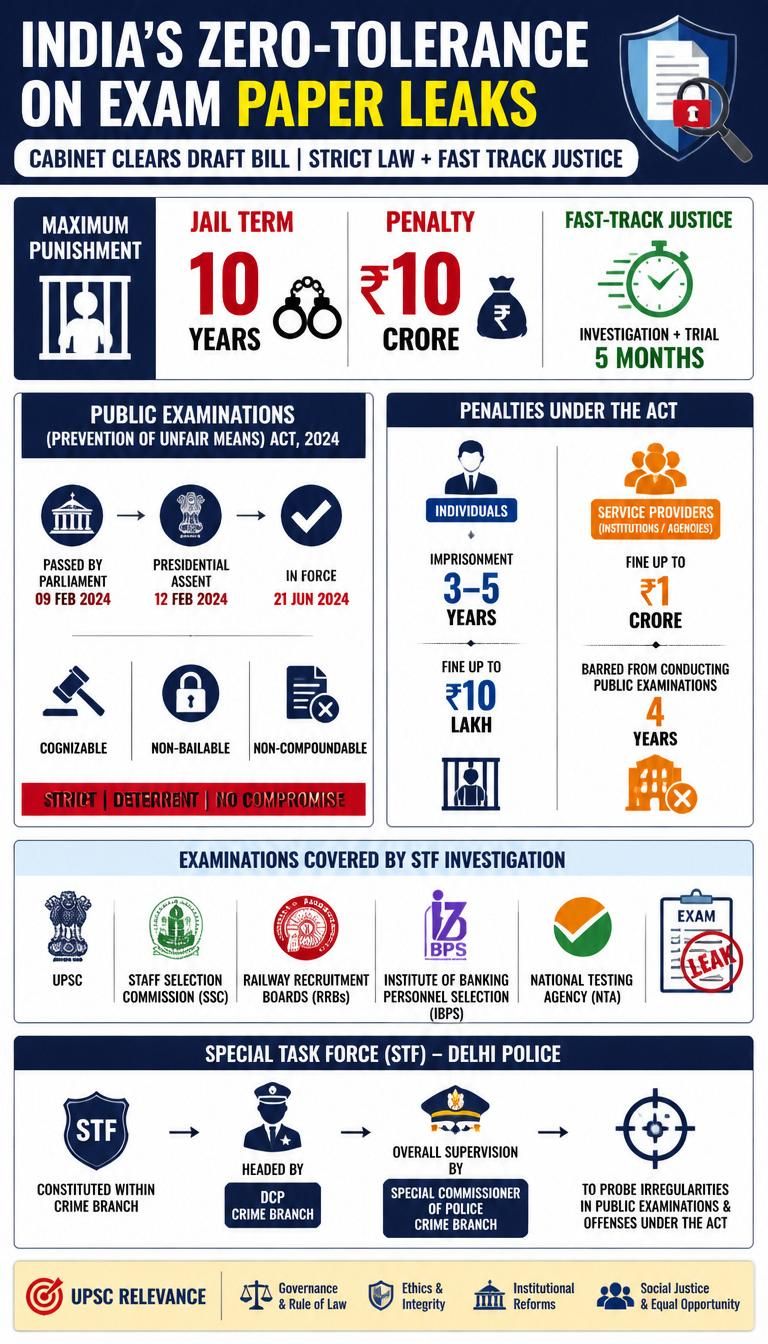
- The Union Cabinet has approved a draft Bill with stringent provisions to combat exam paper leaks, including a jail term of up to 10 years and a penalty of up to ₹10 crore.
- The proposed law, which includes statutory backing for fast-track courts, aims for a five-month timeline for investigation and trial of cases.
- The Delhi Police has constituted a Special Task Force (STF) within its Crime Branch to investigate paper leaks and other offenses under the Public Examinations (Prevention of Unfair Means) Act, 2024.
- The STF will probe irregularities in public examinations conducted by agencies such as UPSC, Staff Selection Commission (SSC), Railway Recruitment Boards (RRBs), Institute of Banking Personnel Selection (IBPS), and National Testing Agency (NTA).
Zero Tolerance.jpg
Detailed Insights:
- The Public Examinations (Prevention of Unfair Means) Act, 2024, was passed by Parliament on February 9, 2024, received Presidential assent on February 12, 2024, and came into force on June 21, 2024.
- For individuals, the Act prescribes imprisonment from three to five years and a fine up to ₹10 lakh, with harsher penalties for organized crime.
- Service providers involved in malpractices can face a fine up to ₹1 crore and be barred from conducting public examinations for four years.
- All offenses under the Act are classified as cognizable, non-bailable, and non-compoundable, ensuring strict legal action.
- The STF will be headed by a DCP, Crime Branch, with overall supervision by the Special Commissioner of Police, Crime Branch.
- The formation of the STF and the new law underscore the government's commitment to ensuring fairness and transparency in public examinations.
Key Concepts Involved:
- Public Examinations (Prevention of Unfair Means) Act, 2024: A law enacted to prevent malpractices and unfair means in public examinations across India.
- Fast-track courts: Specialized courts designed to expedite the trial process for specific types of cases, ensuring quicker justice delivery.
- Special Task Force (STF): A dedicated police unit formed to investigate specific, often complex, criminal activities.

SuperKalam is your personal mentor for UPSC preparation, guiding you at every step of the exam journey.
Download the App


STUDY RESOURCES
CONTACT US
ⓒ Snapstack Technologies Private Limited