GS 2: International RelationsGS 3: EconomyPrelimsGS 2: Government policies and interventions for development in various sectorsGS 2: Bilateral, Regional and Global Groupings and Agreements
India attracts 10% US tariff, lower rate after policy shift, Pg3
US imposes 10% tariffs on India under Section 301 over forced labor, impacting trade dynamics and global supply chains amidst policy shifts.
Practice MCQs
767 Students attempted
Key Highlights:
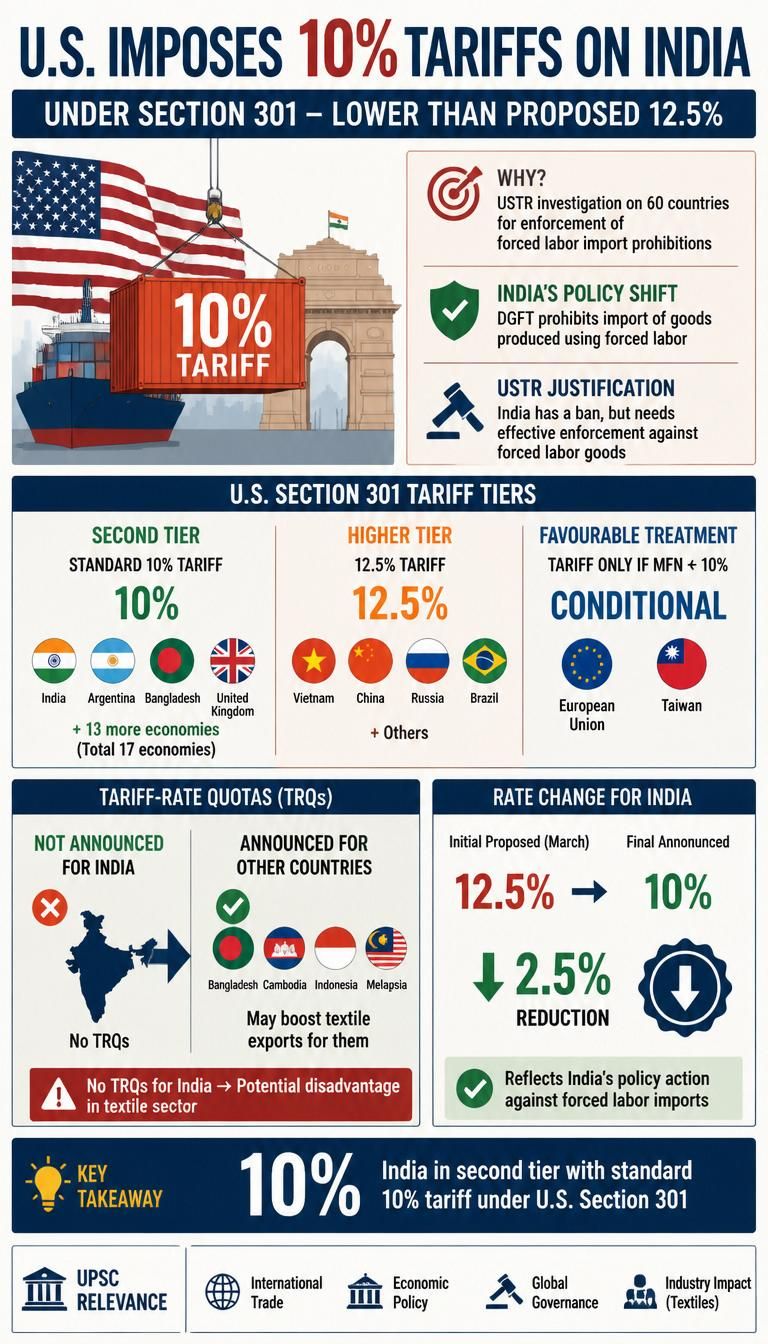
- The U.S. has imposed 10% tariffs on India under Section 301 of the US Trade Act, a lower rate than the initially proposed 12.5%.
- This decision follows India's policy shift, where the Directorate General of Foreign Trade (DGFT) prohibited the import of goods produced using forced labor.
- The tariffs are a result of a United States Trade Representative (USTR) investigation into 60 countries regarding their enforcement of forced labor import prohibitions.
- India is placed in a "second tier" of 17 economies facing a standard 10% tariff, alongside countries like Argentina, Bangladesh, and the United Kingdom.
- The USTR has not announced Tariff-Rate Quotas (TRQs) for India, unlike for Bangladesh, Cambodia, Indonesia, and Malaysia, which could impact India's textile exports.
US Tariff.jpg
Detailed Insights:
- The 10% tariff on India is a reduction from the 12.5% rate initially proposed in March, reflecting India's recent policy changes.
- The USTR justified the tariffs by stating that India, despite its recent prohibition, still needs to effectively enforce the ban on forced labor goods.
- The European Union and Taiwan received more favorable tariff rates, where the Section 301 tariff is applied only if their existing Most Favoured Nation (MFN) tariff is less than 10%.
- Countries like Vietnam, China, Russia, and Brazil face the higher 12.5% tariff rate, indicating a tiered approach by the U.S.
- The absence of TRQs for India, while granted to competitors like Bangladesh, could potentially shift sourcing of cotton and textile inputs from India to the U.S. for these countries.
- Certain goods, including aircraft, specific agricultural products, and some materials like pig iron, are exempted from these Section 301 additional tariffs.
Key Concepts Involved:
- Section 301 of the US Trade Act: A U.S. trade law authorizing the President to take action, including tariffs, against foreign trade practices deemed unfair or discriminatory.
- Forced Labor: Work or service exacted from any person under the menace of any penalty and for which the person has not offered himself voluntarily.
- Most Favoured Nation (MFN): A principle in international trade ensuring that a country treats all its trading partners equally, extending the same trade advantages to all.
- Tariff-Rate Quota (TRQ): A two-tiered tariff system allowing a specified quantity of a product to be imported at a lower tariff rate, with imports exceeding that quantity facing a higher rate.
- Directorate General of Foreign Trade (DGFT): An agency of the Indian Ministry of Commerce and Industry responsible for implementing and managing India's foreign trade policy.
- United States Trade Representative (USTR): A U.S. government agency responsible for developing and coordinating U.S. international trade policy and negotiations.

SuperKalam is your personal mentor for UPSC preparation, guiding you at every step of the exam journey.
Download the App


STUDY RESOURCES
CONTACT US
ⓒ Snapstack Technologies Private Limited