GS 2: GovernanceGS 2: PolityGS 3: Science & TechnologyPrelimsGS 2: Important Aspects of Governance, Transparency and Accountability
SC bars court hearing clips on social media without approval, Pg3
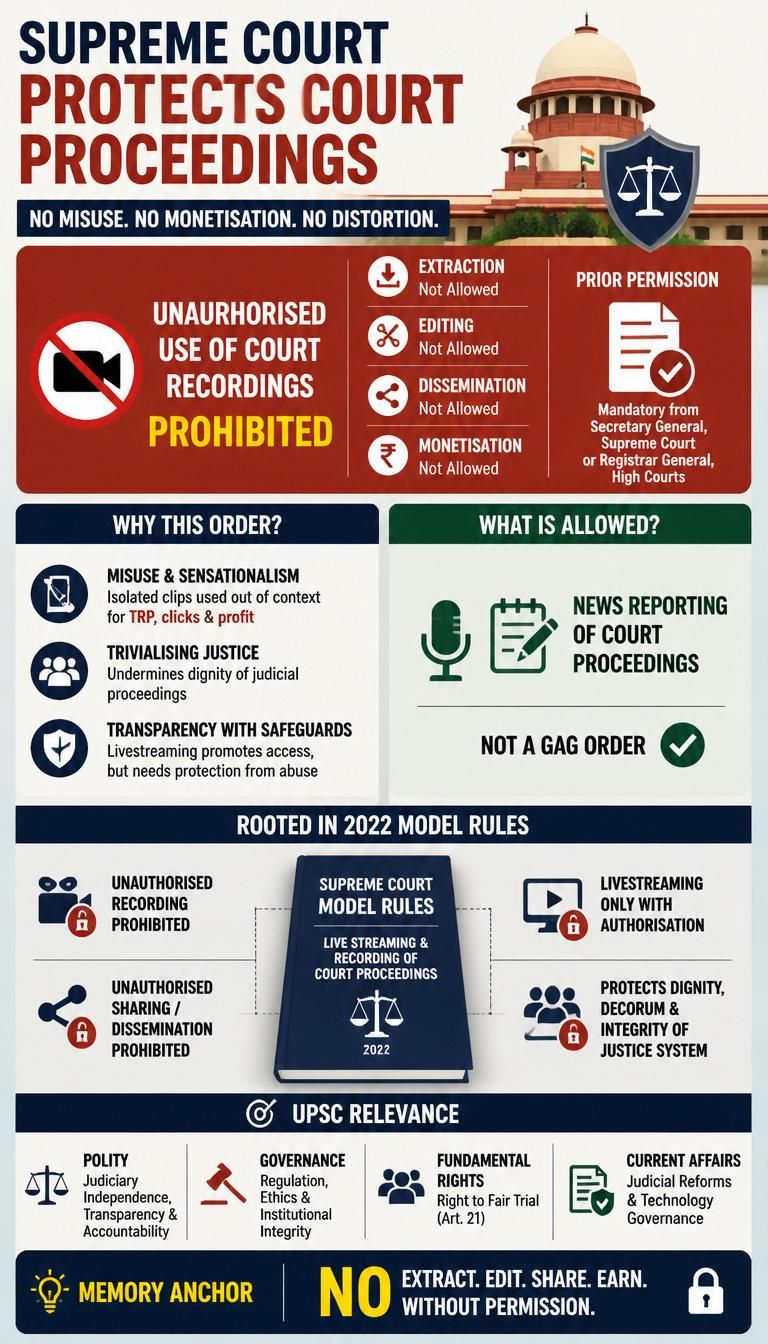
Supreme Court issues interim order banning unapproved social media sharing of courtroom proceedings, citing misuse and undermining public trust, while exempting news reporting.
Practice MCQs
767 Students attempted
Key Highlights:
- The Supreme Court of India issued an interim order prohibiting the recording and circulation of courtroom proceedings on social media without prior permission.
- A three-judge bench, led by Chief Justice of India Surya Kant, mandated approval from the Secretary General of the Supreme Court or Registrar General of High Courts for such activities.
- The order explicitly clarifies that it will not affect news reporting.
- This decision addresses concerns over the alleged misuse, selective clipping, and decontextualization of judicial proceedings on digital platforms.
SC Proceedings.jpg
Detailed Insights:
- The interim order was passed while hearing a Public Interest Litigation (PIL) filed by journalist Harshita Grover.
- The PIL highlighted that isolated courtroom exchanges are often circulated with misleading captions, leading to reputational harm.
- Unchecked circulation of such content risks undermining public confidence in the administration of justice.
- The bench also directed various High Courts to submit reports on the adoption of their live-streaming guidelines.
- Concerns were raised about the challenges of regulating digital content and the potential for AI tools to alter spoken words.
- The court emphasized that live streams should not become "24/7 entertainment channels," which could belittle the justice system.
Key Concepts Involved:
- Supreme Court of India: The apex judicial body and the final court of appeal in India.
- High Courts: The principal civil courts of original jurisdiction in each state and union territory of India.
- Public Interest Litigation (PIL): A legal action initiated in a court of law for the enforcement of public interest, often by a public-spirited individual or organization.
- Chief Justice of India: The head of the Indian judiciary and the Supreme Court of India, responsible for case allocation and administrative oversight.
- Secretary General of the Supreme Court: The highest-ranking administrative official of the Supreme Court registry, responsible for court administration and procedures.
- Registrar General of High Courts: The chief administrative officer of a High Court registry, overseeing its internal functioning and administrative matters.

SuperKalam is your personal mentor for UPSC preparation, guiding you at every step of the exam journey.
Download the App


STUDY RESOURCES
CONTACT US
ⓒ Snapstack Technologies Private Limited