GS 2: International RelationsGS 3: EconomyPrelims
America's tariff state is expanding. India must be patient, Pg 15
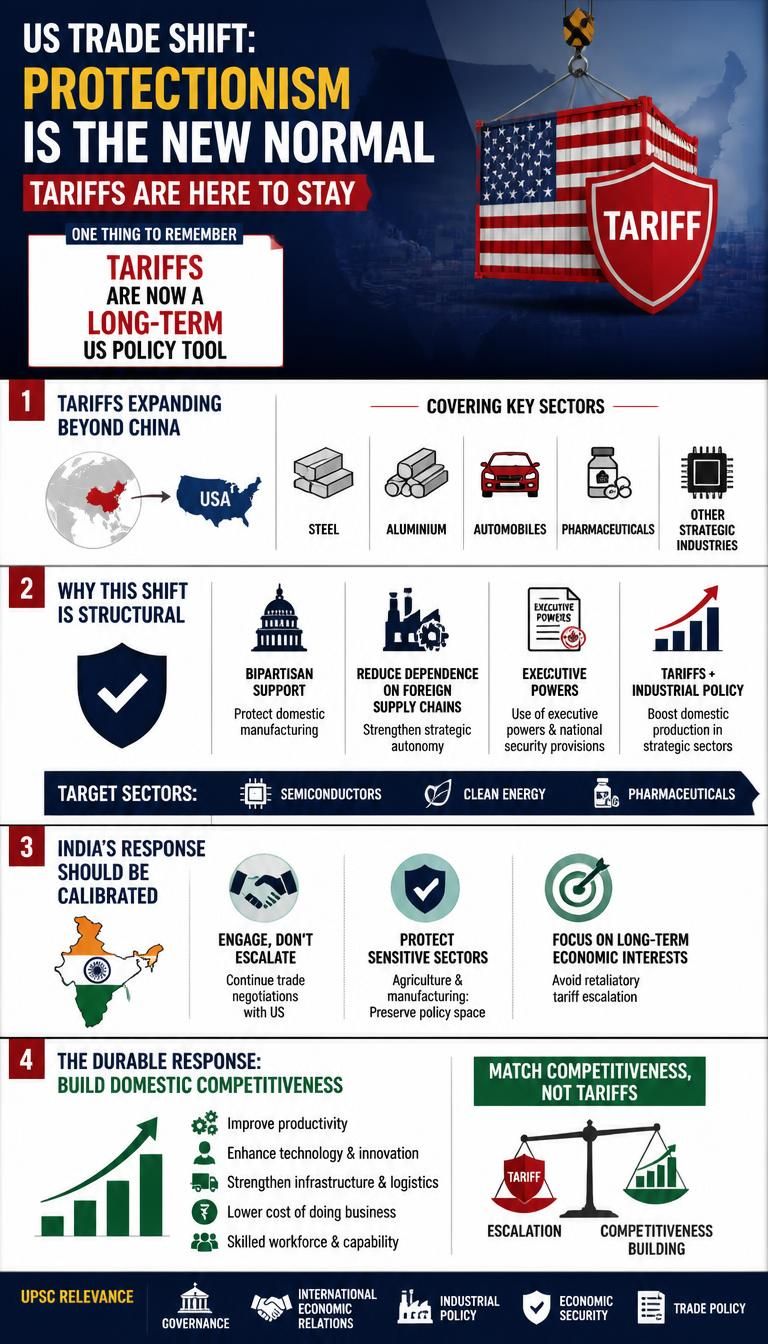
Recent US tariff measures extend beyond China to cover sectors such as steel, aluminium, automobiles, pharmaceuticals and other strategic industries.
Practice MCQs
782 Students attempted
Key Highlights:
- The article argues that the United States is undergoing a structural shift towards protectionism, making tariffs a long-term policy tool rather than a temporary measure.
- Recent US tariff measures extend beyond China to cover sectors such as steel, aluminium, automobiles, pharmaceuticals and other strategic industries.
- The growing use of tariffs reflects bipartisan support for protecting domestic manufacturing and reducing dependence on foreign supply chains.
- India should avoid retaliatory tariff escalation and instead pursue calibrated negotiations while protecting its long-term economic interests.
- The article suggests that improving domestic competitiveness will be a more durable response than matching US tariffs.
US protectionism.jpg
Detailed Insights:
- The US has increasingly relied on executive powers and national security provisions to impose tariffs, indicating that trade protection is likely to persist across administrations.
- Tariffs are now being combined with industrial policy to encourage domestic production and strengthen strategic sectors such as semiconductors, clean energy and pharmaceuticals.
- India should continue engaging the US through trade negotiations while preserving policy space in sensitive sectors like agriculture and manufacturing.
- Diversifying exports towards emerging markets and integrating into Global Value Chains (GVCs) can reduce India's dependence on any single export destination.
- Improving logistics, infrastructure, ease of doing business and manufacturing productivity will enhance India's competitiveness despite rising global trade barriers.
- A balanced strategy of economic resilience, market diversification and domestic reforms will better position India in an increasingly fragmented global trading system.
Key Concepts Involved:
- Tariff: A tax imposed on imported goods to protect domestic industries or generate government revenue.
- Protectionism: An economic policy that restricts imports through tariffs or other trade barriers to support domestic producers.
- Global Value Chains (GVCs): International production networks where different stages of manufacturing occur across multiple countries.
- Reciprocal Tariffs: Import duties imposed by one country in response to similar tariffs levied by another country.

SuperKalam is your personal mentor for UPSC preparation, guiding you at every step of the exam journey.
Download the App


STUDY RESOURCES
CONTACT US
ⓒ Snapstack Technologies Private Limited