GS 2: International Relations
In Indo-Pacific, a steady projection of power, Pg 15
India has significantly expanded its strategic engagement in the Indo-Pacific under Prime Minister Narendra Modi, positioning itself as a major regional power.
Practice MCQs
782 Students attempted
Key Highlights:
- The article argues that India has significantly expanded its strategic engagement in the Indo-Pacific under Prime Minister Narendra Modi, positioning itself as a major regional power.
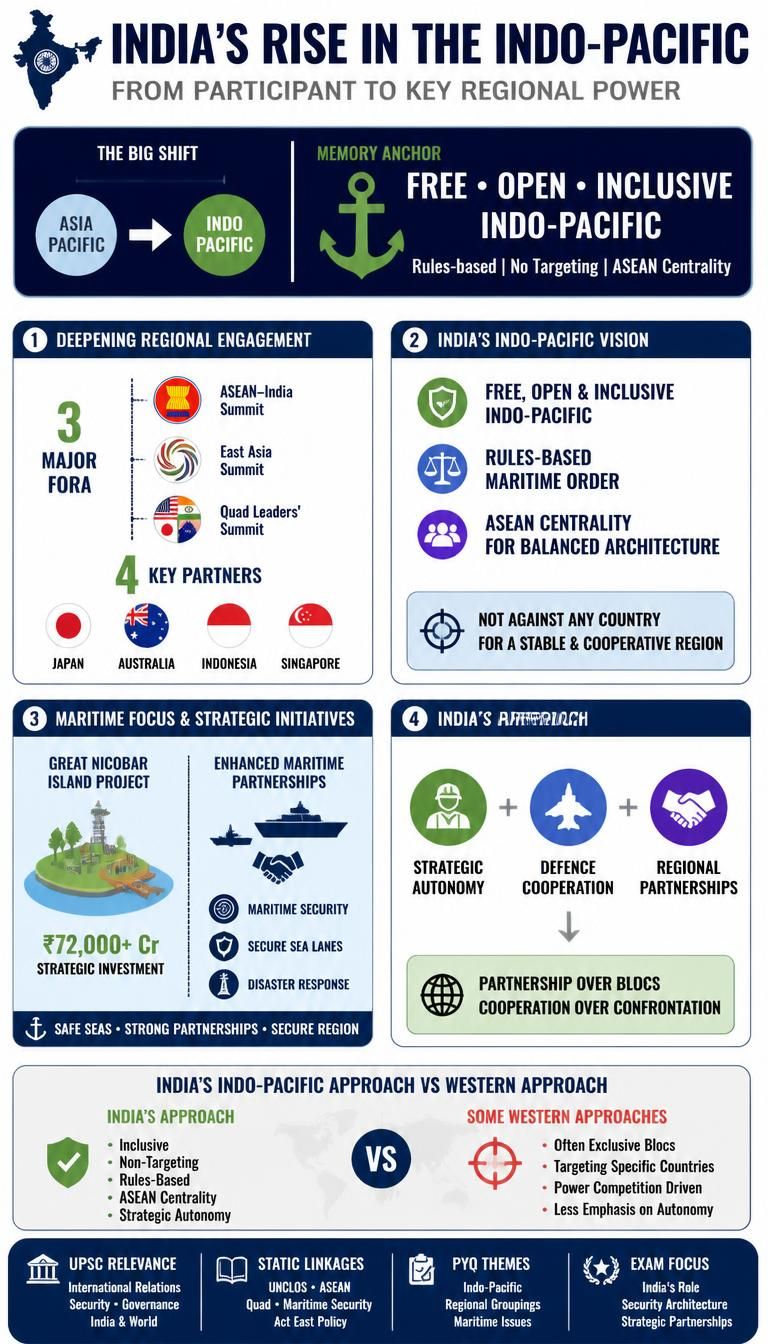
- India has actively participated in regional forums such as the ASEAN-India Summit, East Asia Summit and Quad Leaders' Summit, while deepening ties with Japan, Australia, Indonesia and Singapore.
- India has adopted the concept of a Free, Open and Inclusive Indo-Pacific, while emphasising ASEAN Centrality to ensure a balanced regional architecture.
- Recent initiatives, including the Great Nicobar Island Development Project and enhanced maritime partnerships, reflect India's growing focus on maritime security.
- The article suggests that India's approach combines strategic autonomy, defence cooperation and regional partnerships rather than bloc politics.
Indo-Pacific.jpg
Detailed Insights:
- The term Indo-Pacific has replaced the earlier "Asia-Pacific" construct, recognising the growing strategic linkage between the Indian and Pacific Oceans.
- Unlike some Western approaches, India's Indo-Pacific vision avoids explicitly targeting any country and instead promotes a rules-based maritime order.
- The Great Nicobar Island Development Project, located near the Strait of Malacca, aims to strengthen India's maritime logistics, connectivity and strategic presence in the eastern Indian Ocean.
- India has expanded defence cooperation through joint exercises, logistics agreements and technology partnerships with countries such as Japan, Australia, the United States and the Philippines.
- China's growing military and maritime presence in the South China Sea and the broader Indo-Pacific has accelerated regional security cooperation among like-minded countries.
- India's continued emphasis on strategic autonomy enables it to strengthen partnerships while maintaining an independent foreign policy and avoiding formal military alliances.
Key Concepts Involved:
- Indo-Pacific: A strategic and geopolitical region linking the Indian and Pacific Oceans, central to global trade and security.
- ASEAN Centrality: The principle that ASEAN should remain at the core of the Indo-Pacific's regional security and economic architecture.
- Quad: A strategic partnership comprising India, the United States, Japan and Australia that promotes a free, open and resilient Indo-Pacific.
- Strategic Autonomy: India's foreign policy approach of safeguarding national interests through independent decision-making without joining military blocs.

SuperKalam is your personal mentor for UPSC preparation, guiding you at every step of the exam journey.
Download the App


STUDY RESOURCES
CONTACT US
ⓒ Snapstack Technologies Private Limited