Whether the National Commission for Scheduled Castes (NCSC) can enforce the implementation of constitutional reservation for the Scheduled Castes in the religious minority institutions? Examine.
Whether the National Commission for Scheduled Castes (NCSC) can enforce the implementation of constitutional reservation for the Scheduled Castes in the religious minority institutions? Examine.
Recent constitutional debates highlight the complex intersection between minority rights and SC reservation policies. The NCSC's enforcement authority in minority institutions remains constitutionally limited yet evolving.
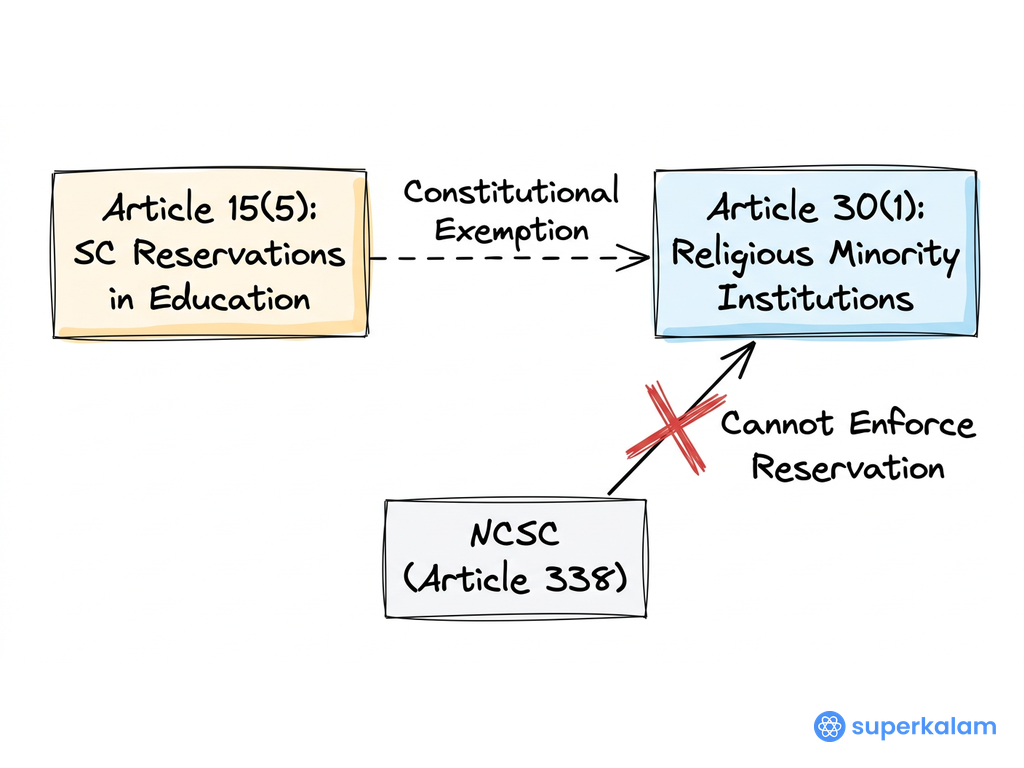
Article 15 SC Reservations Block Diagram
Constitutional Framework and NCSC Powers
- Article 338 empowers NCSC to investigate, monitor, and evaluate implementation of constitutional safeguards for SCs
- NCSC can issue summons, examine witnesses, and requisition public records under quasi-judicial powers
- Protection of Civil Rights Act, 1955 and SC/ST (Prevention of Atrocities) Act, 1989 provide statutory backing
- Article 17 abolishes untouchability, creating constitutional obligation for all institutions
- Commission can recommend policy measures to Central and State governments
Minority Institution Protections vs SC Rights
| Aspect | Minority Institutions | SC Reservation Rights |
|---|---|---|
| Constitutional Basis | Article 30(1) - Right to establish and administer | Article 15(4), 16(4) - Special provisions |
| Reservation Mandate | Exempted under Article 15(5) | Mandatory in public institutions |
| Autonomy Level | Complete administrative control | Subject to constitutional obligations |
| NCSC Authority | Limited to recommendations | Full enforcement powers |
Limitations on NCSC Enforcement
- Article 30(1) supremacy: Religious minorities' fundamental right to institutional autonomy overrides reservation mandates
- TMA Pai Foundation case (2002): Supreme Court affirmed minority institutions' exemption from general reservation policies
- Article 15(5) explicit protection: Constitutional amendment specifically excludes minority institutions from reservation requirements
- Federal structure: NCSC cannot override state-level minority institution regulations
- Voluntary compliance principle: Enforcement limited to persuasion rather than compulsion
Recent Developments and Judicial Trends
- AMU case (2024): Supreme Court's 4:3 majority reaffirmed minority status, strengthening institutional autonomy
- Kerala Education Bill controversy (2023): State attempts to enforce reservations in minority colleges faced constitutional challenges
- NCSC Annual Report 2023-24: Highlighted gaps in SC representation across educational sectors including minority institutions
- Right to Education Act implementation: Ongoing debates about 25% reservation applicability in aided minority schools
The constitutional balance prioritizes minority institutional autonomy while enabling NCSC to advocate for inclusive policies through dialogue and recommendations, reflecting Article 46's directive for educational advancement of weaker sections within India's plural democratic framework.
Answer Length
Model answers may exceed the word limit for better clarity and depth. Use them as a guide, but always frame your final answer within the exam’s prescribed limit.
Evaluate this PYQ now
Write your answer & evaluate in just 60 seconds




500+ students evaluated
Model Answers from
- 2018Indian Polity15 MarksView Answer
Multiplicity of various commissions for the vulnerable sections of the society leads to problems of overlapping jurisdiction and duplication of functions. Is it better to merge all commissions into an umbrella Human Rights Commission? Argue your case.
- 2018Indian Polity15 MarksView Answer
Assess the importance of the Panchayat system in India as a part of local government. Apart from government grants, what sources can the Panchayats look out for financing developmental projects?
- 2018Indian Polity15 MarksView Answer
How is the Finance Commission of India constituted? What do you know about the terms of reference of the recently constituted Finance Commission? Discuss.
- 2018Indian Polity15 MarksView Answer
India and the USA are two large democracies. Examine the basic tenets on which the two political systems are based.
- 2018Indian Polity15 MarksView Answer
How far do you agree with the view that tribunals curtail the jurisdiction of ordinary courts? In view of the above, discuss the constitutional validity and competency of the tribunals in India.
- 2018Indian Polity15 MarksView Answer
Whether the Supreme Court Judgement (July 2018) can settle the political tussle between the Lt. Governor and elected government of Delhi? Examine.
Model Answers by Subject


Crack UPSC with your
Personal AI Mentor
An AI-powered ecosystem to learn, practice, and evaluate with discipline



