What is the economic significance of the discovery of oil in the Arctic Sea and its possible environmental consequences?
What is the economic significance of the discovery of oil in the Arctic Sea and its possible environmental consequences?
The discovery of oil in the Arctic Sea presents both significant economic opportunities and environmental challenges, requiring careful evaluation of its implications for global energy security and ecological preservation.
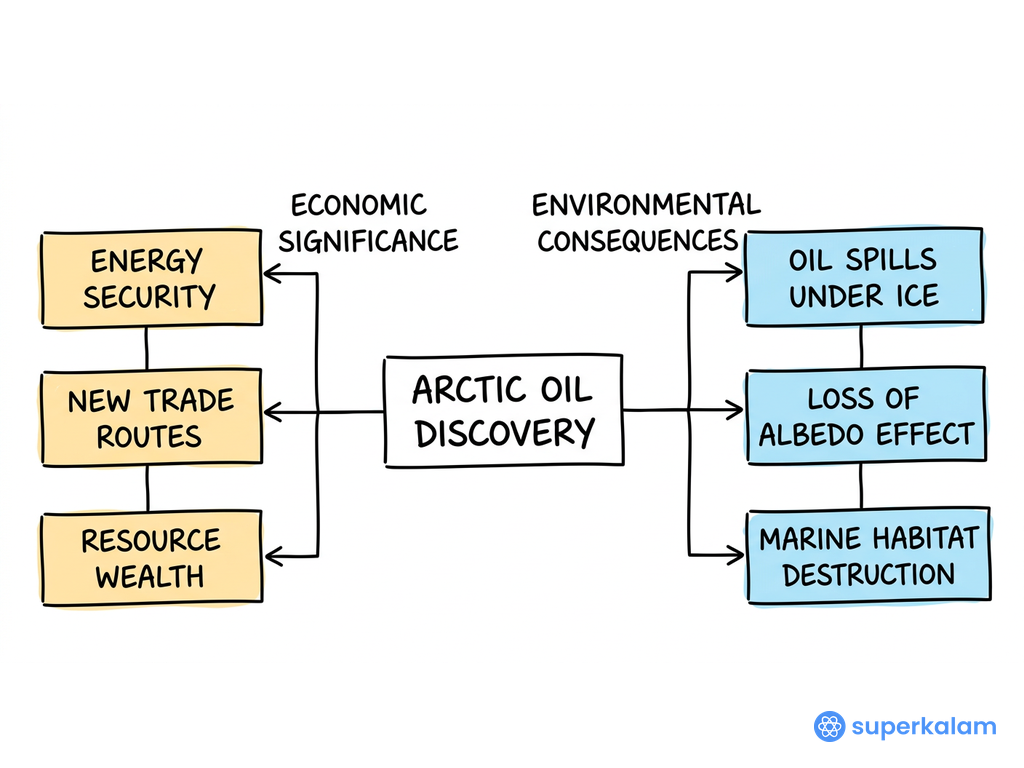
Arctic Oil Discovery Dual Branch Flowchart
Economic Significance of Arctic Oil Discovery
-
Massive Energy Reserves: The Arctic region holds an estimated 90 billion barrels of technically recoverable oil reserves according to the USGS, representing approximately 13% of global undiscovered oil resources.
-
Energy Security Enhancement:
- Potential to reduce dependency of oil-importing nations like India, which currently imports 90.6% of its crude oil requirements
- Could stabilize global oil prices and diversify supply sources away from geopolitically sensitive regions
-
Economic Development Opportunities:
- Creation of new employment in oil exploration, extraction, and supporting industries
- Development of Arctic shipping infrastructure and the Northern Sea Route, reducing shipping distances by up to 40%
- Technological advancement in Arctic drilling and extraction capabilities
-
Regional Economic Growth:
- Significant revenue generation for Arctic nations like Norway, Russia, and Canada
- Development of remote Arctic communities through industrial activities
- Investment in research and development of cold-weather technologies
-
Strategic Geopolitical Advantages: Enhanced energy independence and bargaining power in international relations for resource-holding nations
Environmental Consequences of Arctic Oil Extraction
| Environmental Impact | Specific Consequences |
|---|---|
| Climate Change | Accelerated Arctic ice melting, release of trapped methane from permafrost |
| Marine Ecosystems | Oil spill risks, disruption of Arctic marine food chains |
| Wildlife Impact | Threat to polar bears, seals, Arctic birds migration patterns |
| Ocean Chemistry | Potential acidification, temperature changes affecting marine life |
| Global Weather | Disruption of Arctic's role in global climate regulation |
-
Regulatory Framework Challenges:
- UNCLOS establishes Exclusive Economic Zones (EEZs) but enforcement remains complex
- Need for enhanced international cooperation through bodies like the Arctic Council
-
Sustainable Development Conflict: Balance between SDG 7 (Affordable Energy) and SDG 13 (Climate Action) objectives
The Arctic oil discovery represents a critical juncture where economic imperatives must be balanced with environmental stewardship. The Paris Agreement commitments and COP28 outcomes should guide responsible extraction practices while ensuring this fragile ecosystem's preservation for future generations.
Answer Length
Model answers may exceed the word limit for better clarity and depth. Use them as a guide, but always frame your final answer within the exam’s prescribed limit.
Evaluate this PYQ now
Write your answer & evaluate in just 60 seconds




500+ students evaluated
Model Answers from
- 2015Modern History12.5 MarksView Answer
It would have been difficult for the Constituent Assembly to complete its historic task of drafting the Constitution for Independent India in just three years, but its experience gained with the Government of India Act, 1935 .Discuss.
- 2015Modern History12.5 MarksView Answer
Mahatma Gandhi and Dr. B R Ambedkar, despite having divergent approaches and strategies, had a common goal of amelioration of the downtrodden. Elucidate.
- 2015Modern History12.5 MarksView Answer
How difficult would have been the achievement of Indian independence without Mahatma Gandhi? Discuss.
Model Answers by Subject


Crack UPSC with your
Personal AI Mentor
An AI-powered ecosystem to learn, practice, and evaluate with discipline



