WTO is an important international institution where decisions taken affect countries in a profound manner. What is the mandate of WTO and how binding are their decisions? Critically analyse India’s stand on the latest round of talks on Food security.
WTO is an important international institution where decisions taken affect countries in a profound manner. What is the mandate of WTO and how binding are their decisions? Critically analyse India’s stand on the latest round of talks on Food security.
The World Trade Organization (WTO) stands as a critical global institution whose decisions profoundly impact international trade and domestic policies. India's recent assertive stance on food security negotiations highlights the complex interplay between global trade rules and national sovereignty.
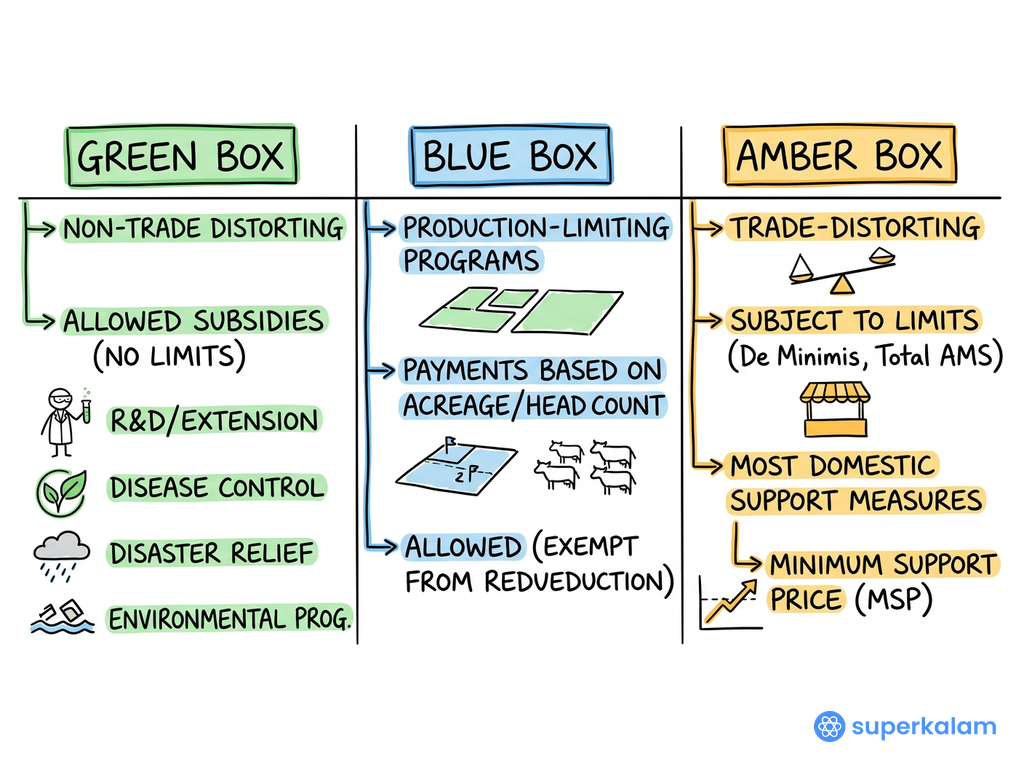
WTO Agricultural Subsidy Boxes Comparative Chart
WTO's Mandate and Authority
Core Functions
- Trade Liberalization: Facilitates reduction of tariffs, quotas, and non-tariff barriers through multilateral negotiations
- Rule Formation: Establishes binding international trade agreements covering goods, services, and intellectual property
- Dispute Resolution: Operates Dispute Settlement Body (DSB) providing legally binding arbitration for trade conflicts
- Policy Monitoring: Conducts Trade Policy Reviews ensuring member compliance with WTO commitments
- Technical Assistance: Supports developing nations in trade capacity building and WTO integration
Binding Nature of Decisions
| Aspect | Binding Mechanism |
|---|---|
| Legal Status | Decisions are internationally binding under Vienna Convention on Law of Treaties |
| Enforcement | Non-compliance leads to authorized trade retaliation and economic sanctions |
| Domestic Implementation | Members must align national laws with WTO rulings within specified timeframes |
| Appellate Process | Appellate Body crisis since 2019 has created enforcement gaps and legal uncertainties |
India's Position on Food Security Negotiations
Strategic Objectives
- Permanent Solution Demand: Advocates for removing Agreement on Agriculture (AoA) constraints on Public Stockholding programs
- Peace Clause Protection: Secured interim protection allowing subsidy limit breaches for food security purposes
- Developing Nation Leadership: Champions G-33 coalition representing food-importing developing countries
- Domestic Policy Space: Defends right to implement National Food Security Act 2013 without WTO interference
Current Challenges
- Technical Barriers: WTO's Aggregate Measurement of Support (AMS) calculations based on 1986-88 reference prices create artificial subsidy inflation
- Developed Nation Resistance: US and EU opposition to permanent solutions limits negotiating progress
- Implementation Concerns: MC12 outcomes in 2022 provided only limited exemptions for humanitarian food programs
India's food security stance reflects broader tensions between global trade liberalization and national development priorities, emphasizing the need for reformed multilateral trade governance that accommodates diverse developmental needs while maintaining open markets.
Answer Length
Model answers may exceed the word limit for better clarity and depth. Use them as a guide, but always frame your final answer within the exam’s prescribed limit.
Evaluate this PYQ now
Write your answer & evaluate in just 60 seconds




500+ students evaluated
Model Answers from
- 2014International Relations12.5 MarksView Answer
India has recently signed to become a founding member of New Development Bank (NDB) and also the Asian Infrastructure Investment Bank (AIIB). How will the role of the two Banks be different? Discuss the strategic significance of these two Banks for India.
- 2014International Relations12.5 MarksView Answer
Some of the International funding agencies have special terms for economic participation stipulating a substantial component of the aid used for sourcing equipment from the leading countries. Discuss the merits of such terms and there exists a strong case not to accept such conditions in the Indian context.
- 2014International Relations12.5 MarksView Answer
The aim of Information Technology Agreements (ITAs) is to lower all taxes and tariffs on Information technology products by signatories to zero. What impact would such agreements have on India’s interests?
- 2014International Relations12.5 MarksView Answer
With respect to the South China sea, maritime territorial disputes and rising tension affirm the need for safeguarding maritime security to ensure freedom of navigation and ever flight throughout the region. In this context, discuss the bilateral issues between India and China.
Model Answers by Subject


Crack UPSC with your
Personal AI Mentor
An AI-powered ecosystem to learn, practice, and evaluate with discipline



