What do you understand by the Umpire decision review in cricket? Discuss its various components. Explain how silicon tape on the edge of a bat may fool the system.
What do you understand by the Umpire decision review in cricket? Discuss its various components. Explain how silicon tape on the edge of a bat may fool the system.
The Umpire Decision Review System (DRS) is a technological framework in cricket that allows teams to challenge on-field umpiring decisions using multiple technological tools. Introduced to enhance decision accuracy, DRS has become integral to modern cricket's fairness and precision.
Cricket bat edge striking a ball
Components of DRS
Ball Tracking Technology
- Hawk-Eye System: Uses 6-8 high-speed cameras positioned around the ground to track ball trajectory
- 3D Visualization: Creates precise three-dimensional path predictions for LBW decisions
- Impact Point Analysis: Determines where ball hits pad and predicts wicket-hitting probability
- Pitching Location: Accurately identifies where ball bounces on the pitch
- Margin of Error: Incorporates ±3mm uncertainty zone for borderline decisions
Audio Detection Systems
- Ultra-Edge/Snickometer: Detects sound frequencies when ball contacts bat or glove
- Stump Microphones: Sensitive audio equipment captures minute sound variations
- Oscilloscope Display: Shows sound wave patterns synchronized with ball movement
- Noise Filtering: Distinguishes between bat-ball contact and ambient sounds
- Real-time Analysis: Processes audio data within seconds of delivery
Thermal Imaging Technology
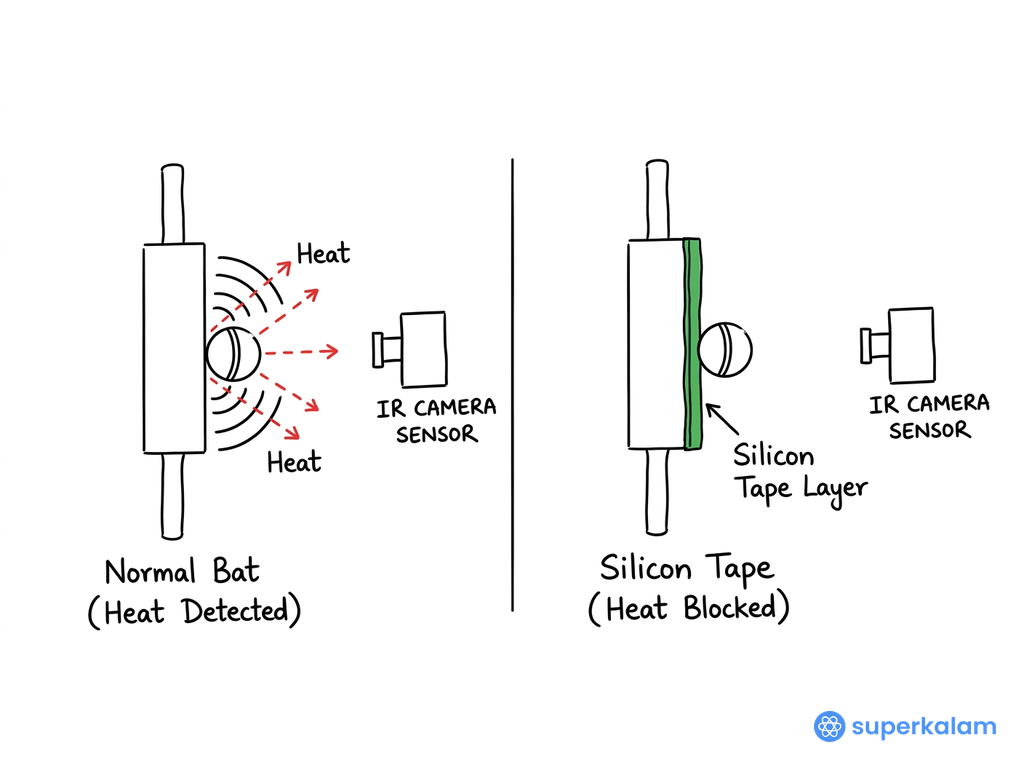
- Hot Spot Camera: Infrared imaging detects friction-generated heat at contact points
- Temperature Mapping: Shows heat signatures lasting 3-4 seconds after contact
- Edge Detection: Identifies faint touches invisible to naked eye
- Glove Contact: Differentiates between bat and glove contact with ball
Silicon Tape Exploitation
System Vulnerabilities
- Sound Dampening: Silicon tape reduces vibration intensity, potentially fooling Ultra-Edge detection
- Heat Absorption: Tape material may absorb friction heat, creating weaker Hot Spot signatures
- False Negatives: Genuine edges might not register clearly on technological systems
Detection Challenges
- Material Limitations: Current technology cannot distinguish between bat wood and silicon tape contact
- Tactical Usage: Teams may strategically apply tape to bat edges before crucial matches
- Protocol Gaps: Limited pre-match equipment inspection allows potential system manipulation
The ICC's 2024 DRS guidelines show 85% accuracy in overturning incorrect decisions. However, silicon tape incidents in domestic cricket highlight ongoing challenges. Future developments must address these vulnerabilities while maintaining cricket's technological evolution and competitive integrity.
Answer Length
Model answers may exceed the word limit for better clarity and depth. Use them as a guide, but always frame your final answer within the exam’s prescribed limit.
Evaluate this PYQ now
Write your answer & evaluate in just 60 seconds




500+ students evaluated
Model Answers from
- 2013Science & Technology10 MarksView Answer
What are social networking site and what security implications do these sites present?
- 2013Science & Technology5 MarksView Answer
What do you understand by a run-of-the-ride hydroelectricity project? How is it different from any other hydroelectricity project?
- 2013Science & Technology5 MarksView Answer
What is an FRP composite material? How are they manufactured? Discuss their applications in the aviation and automobile industry
- 2013Science & Technology5 MarksView Answer
How does the 3D printing technology work? List out the advantages and disadvantages of the technology.
- 2013Science & Technology5 MarksView Answer
What is a digital signature? What does its authentication mean? Giver various salient built-in features of a digital signature.
- 2013Science & Technology10 MarksView Answer
What do you understand by fixed-dose drug combinations (FDCs)? Discuss their merits and demerits.
Model Answers by Subject


Crack UPSC with your
Personal AI Mentor
An AI-powered ecosystem to learn, practice, and evaluate with discipline