How does the 3D printing technology work? List out the advantages and disadvantages of the technology.
How does the 3D printing technology work? List out the advantages and disadvantages of the technology.
3D printing, or Additive Manufacturing, creates three-dimensional objects by depositing materials layer-by-layer from digital models. India's 3D printing market is projected to reach $4.33 billion by 2033, making it a crucial Industry 4.0 technology.
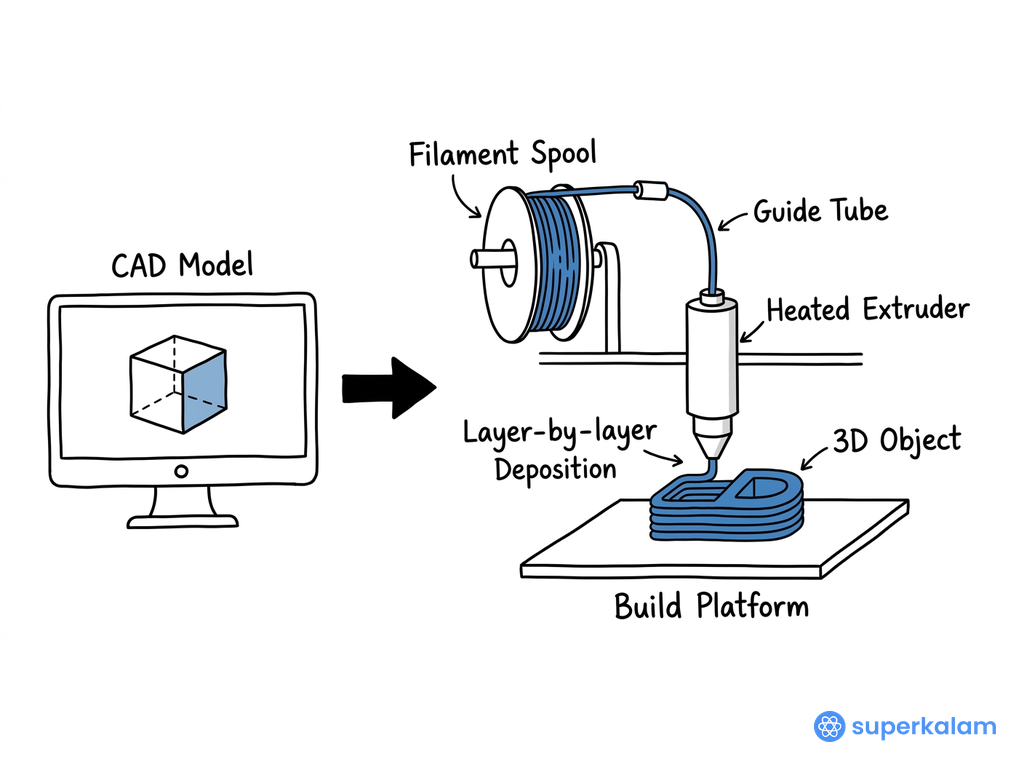
3D Printing Process Schematic Diagram
Working Mechanism of 3D Printing
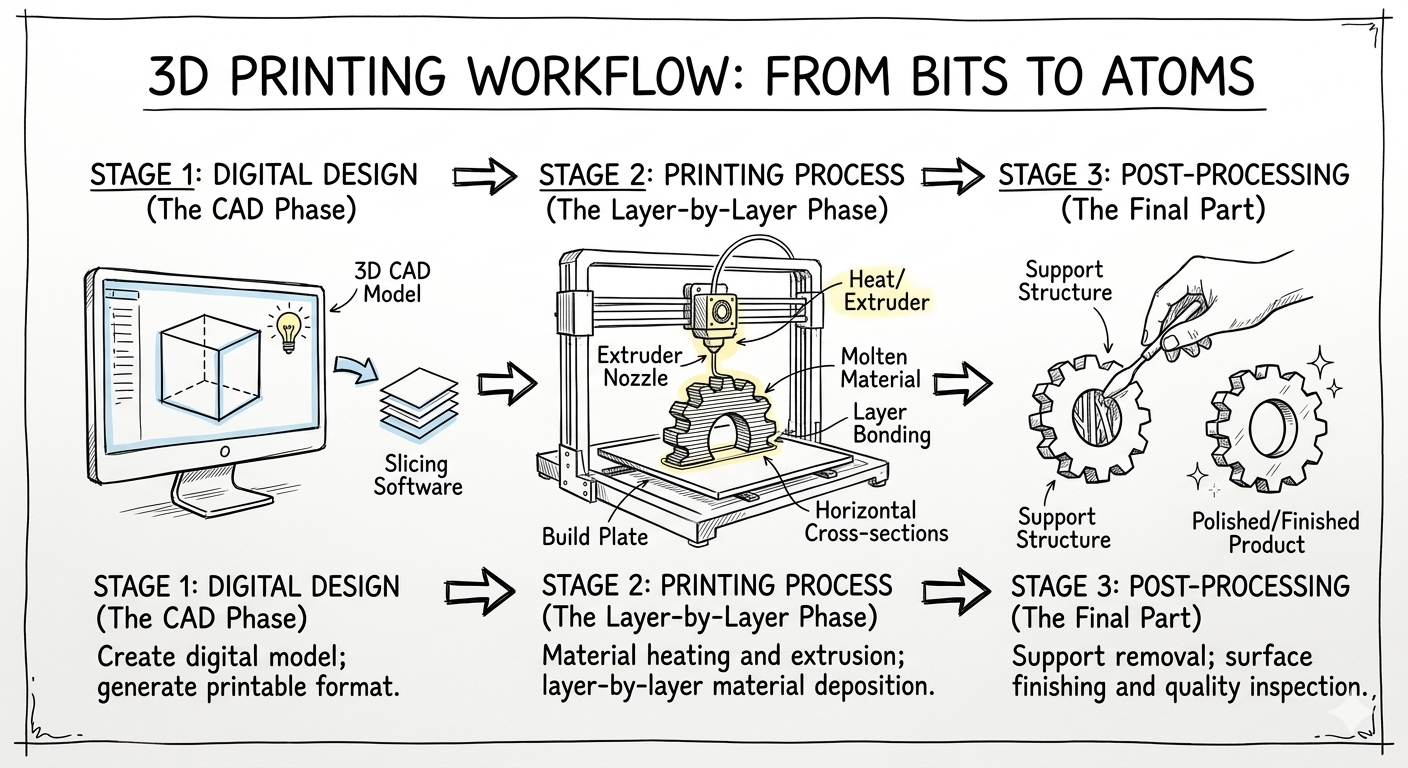
Layer-by-Layer 3D Printing Process showing digital model to final object transformation
-
Digital Design Phase
- Create Computer-Aided Design (CAD) models or use 3D scanning technology
- Convert 3D model into printable format using specialized software
- Generate support structures for complex geometries
- Optimize design for material efficiency and structural integrity
- Quality check digital model before printing initiation
-
Printing Process
- Slicing software divides model into thousands of horizontal cross-sections
- Printer heats materials (plastics, metals, ceramics, bio-materials) to optimal temperature
- Extruder nozzle deposits molten material following programmed path
- Each layer bonds with previous layer through controlled cooling
- Layer thickness typically ranges from 0.1mm to 0.3mm for precision
-
Post-Processing Operations
- Remove support structures and excess material carefully
- Surface finishing through sanding, polishing, or chemical smoothing
- Heat treatment for metal parts to enhance mechanical properties
- Quality inspection and dimensional accuracy verification
- Apply protective coatings or paints as required
Advantages of 3D Printing Technology
-
Manufacturing Revolution
- Rapid prototyping reduces product development time from months to days
- Enables on-demand production eliminating inventory costs
- Zero tooling costs unlike traditional manufacturing requiring molds/dies
- Supports distributed manufacturing reducing transportation costs
- Material waste reduction up to 90% compared to subtractive methods
-
Customization and Innovation
- Mass customization enables personalized products at scale
- Complex geometries impossible through conventional manufacturing
- Lightweight structures with internal honeycomb patterns for aerospace
- Bioprinting applications for custom prosthetics and surgical models
- Enables rapid iteration for design improvements
Disadvantages of 3D Printing Technology
-
Economic and Technical Limitations
- High initial investment for industrial-grade equipment and materials
- Slow production speed unsuitable for mass manufacturing
- Limited material options compared to traditional manufacturing
- Size constraints due to printer build volume limitations
- Post-processing requirements add time and costs
-
Quality and Regulatory Challenges
- Layer adhesion issues can create structural weak points
- Surface finish quality often inferior to machined parts
- Dimensional accuracy variations affecting precision applications
- Regulatory compliance challenges in aerospace and medical sectors
- Intellectual property concerns with easy design replication
Government initiatives like Make in India and ₹500 crore National Mission on Interdisciplinary Cyber-Physical Systems are accelerating 3D printing adoption across healthcare, aerospace, and automotive sectors, positioning India as a global manufacturing hub.
Answer Length
Model answers may exceed the word limit for better clarity and depth. Use them as a guide, but always frame your final answer within the exam’s prescribed limit.
Evaluate this PYQ now
Write your answer & evaluate in just 60 seconds




500+ students evaluated
Model Answers from
- 2013Science & Technology10 MarksView Answer
What are social networking site and what security implications do these sites present?
- 2013Science & Technology5 MarksView Answer
What do you understand by a run-of-the-ride hydroelectricity project? How is it different from any other hydroelectricity project?
- 2013Science & Technology5 MarksView Answer
What is an FRP composite material? How are they manufactured? Discuss their applications in the aviation and automobile industry
- 2013Science & Technology5 MarksView Answer
What is a digital signature? What does its authentication mean? Giver various salient built-in features of a digital signature.
- 2013Science & Technology10 MarksView Answer
What do you understand by the Umpire decision review in cricket? Discuss its various components. Explain how silicon tape on the edge of a bat may fool the system.
- 2013Science & Technology10 MarksView Answer
What do you understand by fixed-dose drug combinations (FDCs)? Discuss their merits and demerits.
Model Answers by Subject


Crack UPSC with your
Personal AI Mentor
An AI-powered ecosystem to learn, practice, and evaluate with discipline