Discuss the aim and goals of the Kunming-Montreal Global Biodiversity Framework. Mention India's commitments and initiatives to achieve the goals and targets of this framework, giving suitable examples.
Discuss the aim and goals of the Kunming-Montreal Global Biodiversity Framework. Mention India's commitments and initiatives to achieve the goals and targets of this framework, giving suitable examples.
Adopted at COP15, the Kunming-Montreal Global Biodiversity Framework (KMGBF) provides a strategic roadmap to halt nature loss. India updated its National Biodiversity Strategy and Action Plan (NBSAP) in 2024 to align with these global mandates.
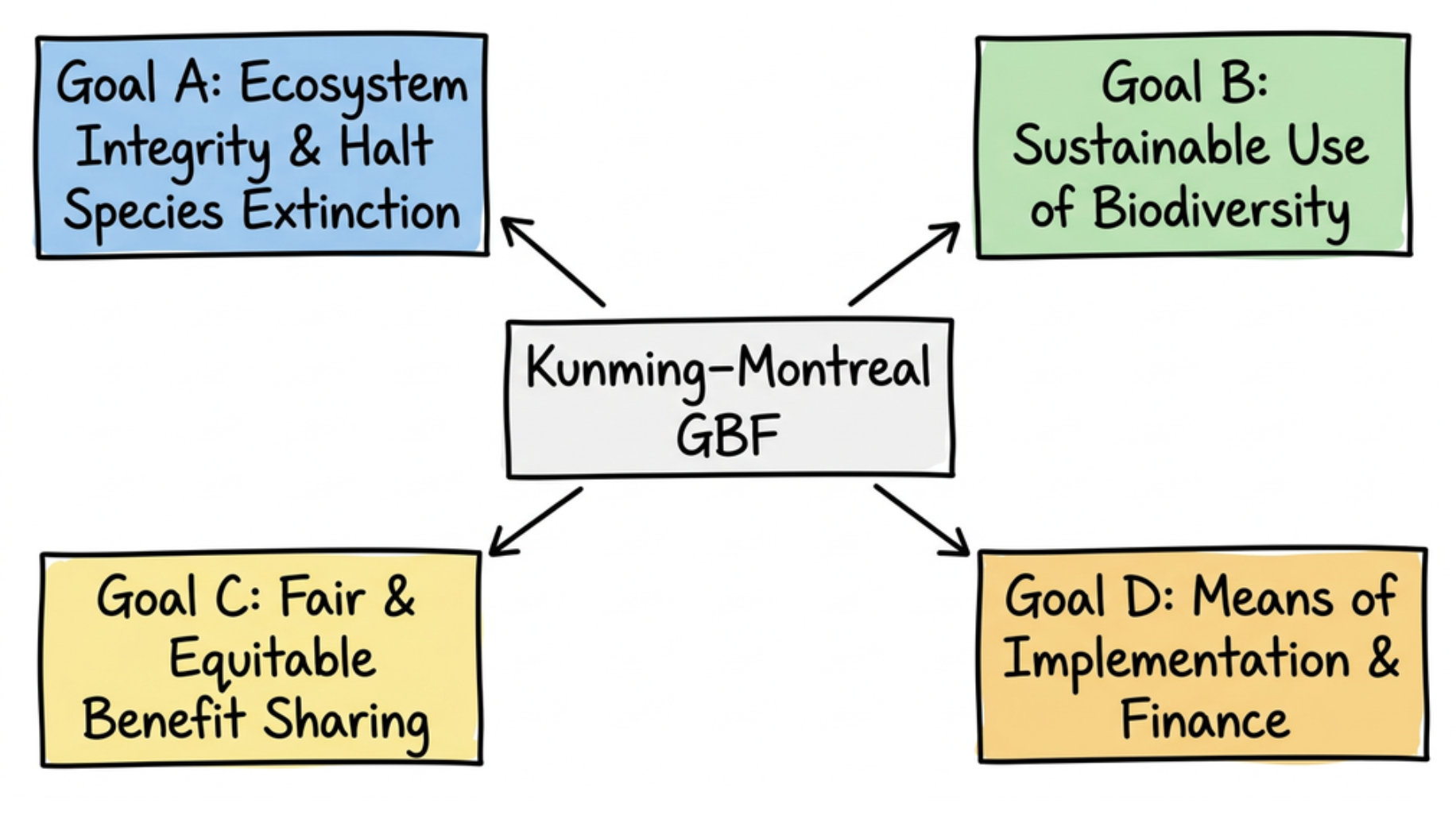
Four Goals of the Kunming-Montreal Global Biodiversity Framework
Aim and Goals of the KMGBF
-
Vision for 2050: aiming for a world living in harmony with nature by protecting critical ecosystems.
-
Halting Human-Induced Extinction: focusing on reducing species extinction rates and risk tenfold by mid-century.
-
Closing Finance Gaps: mobilizing resources to address the global biodiversity finance gap of 700 billion dollars annually.
-
Fair Benefit Sharing: ensuring equitable sharing of benefits from genetic resources and digital sequence information.
-
Targeted Conservation Areas: protecting 30 percent of terrestrial and marine areas by the year 2030 globally.
India's Commitments and Initiatives
-
Updated Policy Framework: launching the NBSAP 2024 at COP16 in Cali to integrate biodiversity into national decision-making.
- Eg: The plan requires an annual expenditure of Rs. 81,664 crores through 2030.
-
Institutional Capacity Building: empowering Panchayati Raj Institutions through national projects to secure local biodiversity commitments.
- Eg: A five-year project (2025-2030) aims to integrate conservation into local governance.
-
Access and Benefit Sharing: implementing the Biological Diversity Act, 2002 through local committees to benefit communities.
- Eg: As of May 2026, Rs. 145 crore was disbursed to 11,000 committees.
-
Species Recovery Planning: establishing a coordinated system for assessing threatened taxa through new national roadmaps.
- Eg: The National Red List Roadmap (2025-2030) led by the Zoological Survey of India.
-
Ecosystem Restoration: increasing forest cover as reported by official biennial assessments to enhance carbon sinks.
- Eg: The ISFR 2023 highlights a consistent increase in India's overall green cover.
India's proactive implementation of the Biological Diversity Act, 2002 and the National Red List Roadmap ensures ecological security. Strengthening Biodiversity Management Committees remains vital for achieving long-term conservation targets.
Answer Length
Model answers may exceed the word limit for better clarity and depth. Use them as a guide, but always frame your final answer within the exam’s prescribed limit.
Evaluate this PYQ now
Write your answer & evaluate in just 60 seconds




500+ students evaluated
Model Answers from
Model Answers by Subject


Crack UPSC with your
Personal AI Mentor
An AI-powered ecosystem to learn, practice, and evaluate with discipline



