What do you understand by ‘values’ and ‘ethics’? In what way is it important to be ethical along with being professionally competent?
What do you understand by ‘values’ and ‘ethics’? In what way is it important to be ethical along with being professionally competent?
Values represent fundamental beliefs guiding behavior, while ethics constitute moral principles governing conduct. Aristotle's virtue ethics and Kant's categorical imperative emphasize their foundational role in human character.
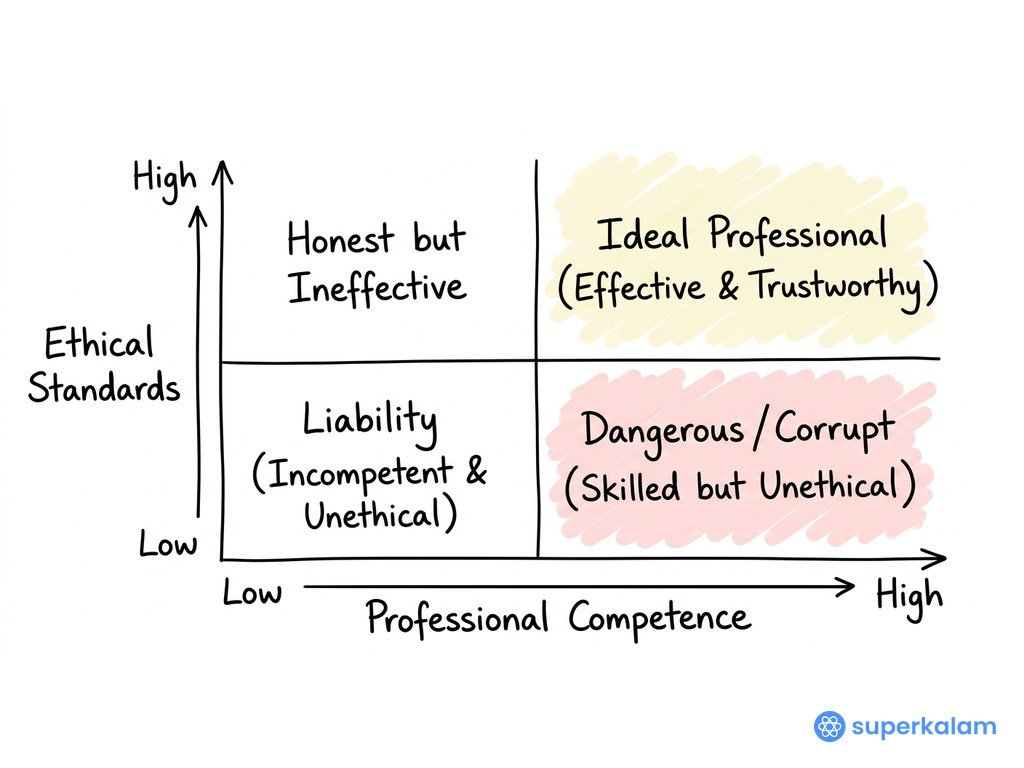
Professional competence in a 2x2 matrix
Understanding Values
• Core Beliefs System: Values like honesty, integrity, and compassion form the foundation of individual character, influencing decision-making processes across personal and professional spheres.
• Cultural and Universal Dimensions: Values encompass both universal principles (human dignity) and cultural specifics (dharma in Indian philosophy), creating diverse ethical frameworks globally.
• Motivational Force: Values serve as internal compass directing behavior, as emphasized by Swami Vivekananda's teachings on character building and moral development.
• Hierarchical Nature: Rokeach's Value Survey demonstrates how individuals prioritize values differently, creating unique moral frameworks for ethical decision-making.
• Dynamic Evolution: Values evolve through experience and reflection, influenced by social learning theory and Kohlberg's stages of moral development.
• Behavioral Manifestation: Values translate into observable actions, forming the basis for ethical leadership and public service motivation in governance.
Understanding Ethics
• Normative Framework: Ethics provide systematic approaches to moral reasoning through deontological (duty-based), consequentialist (outcome-based), and virtue ethics perspectives.
• Professional Standards: Applied ethics in fields like medicine, law, and civil services establish specific codes governing professional conduct and accountability.
• Moral Philosophy Integration: Utilitarian principles of John Stuart Mill and Rawls' theory of justice offer frameworks for resolving ethical dilemmas in governance.
• Cultural Synthesis: Indian ethical traditions like ahimsa, satyagraha, and seva complement Western philosophical approaches in contemporary ethical discourse.
• Practical Application: Ethics translate abstract values into concrete guidelines, as seen in RTI Act implementation and whistleblower protection mechanisms.
• Conflict Resolution: Ethical frameworks help navigate prima facie duties conflicts, balancing competing moral obligations in complex situations.
Importance of Ethical Professional Competence
• Public Trust Foundation: E. Sreedharan's integrity in Konkan Railway project demonstrates how ethical competence builds lasting public confidence in institutions.
• Decision-Making Quality: Ethical professionals consider broader stakeholder impacts, leading to sustainable solutions as exemplified by Aruna Roy's transparency advocacy.
• Organizational Culture: Ethical leadership creates positive work environments, reducing corruption and enhancing organizational effectiveness in public service delivery.
• Long-term Sustainability: Kiran Bedi's prison reforms show how ethical approaches create lasting institutional changes beyond immediate technical solutions.
• Crisis Management: Ethical competence enables principled responses during crises, maintaining institutional credibility as demonstrated during COVID-19 pandemic governance.
• Global Standards: International cooperation requires ethical credibility, enhancing India's soft power and diplomatic effectiveness in multilateral engagements.
Integrating ethical reasoning with professional expertise creates transformative leaders capable of addressing complex governance challenges while maintaining moral integrity and public accountability.
Answer Length
Model answers may exceed the word limit for better clarity and depth. Use them as a guide, but always frame your final answer within the exam’s prescribed limit.
Evaluate this PYQ now
Write your answer & evaluate in just 60 seconds




500+ students evaluated
Model Answers from
- 2013Ethics: Theory10 MarksView Answer
It is often said that ‘politics’ and ‘ethics’ do not go together. What is your opinion in this regard? Justify your answer with illustrations.
- 2013Ethics: Theory10 MarksView Answer
The good of an individual is contained in the good of all.” What do you understand by this statement? How can this principle be implemented in public life?
- 2013Ethics: Theory10 MarksView Answer
What does this quotation mean to you in present context
"I count him braver who overcomes his desires than him who overcomes his enemies.”—Aristotle. - 2013Ethics: Theory10 MarksView Answer
What does this quotation mean to you in present context
"Nearly all men can withstand adversity, but if you want to test a man’s character, give him power.”—Abraham Lincoln. - 2013Ethics: Theory10 MarksView Answer
What does this quotation mean to you in present context
There is enough on this earth for everyone’s need but for no one’s greed.- Mahatma Gandhi - 2013Ethics: Theory10 MarksView Answer
What is meant by ‘crisis of conscience’? Narrate one incident in your life when you were faced with such a crisis and how you resolved the same.
Model Answers by Subject


Crack UPSC with your
Personal AI Mentor
An AI-powered ecosystem to learn, practice, and evaluate with discipline



