The protests in Shahbag Square in Dhaka in Bangladesh reveal a fundamental split in society between the nationalists and Islamic forces. What is its significance for India?
The protests in Shahbag Square in Dhaka in Bangladesh reveal a fundamental split in society between the nationalists and Islamic forces. What is its significance for India?
The Shahbag Square protests in 2013, demanding capital punishment for war criminals from Bangladesh's 1971 Liberation War, exposed deep ideological fissures between secular-nationalist and Islamist forces, creating significant implications for India's regional security and diplomatic interests.
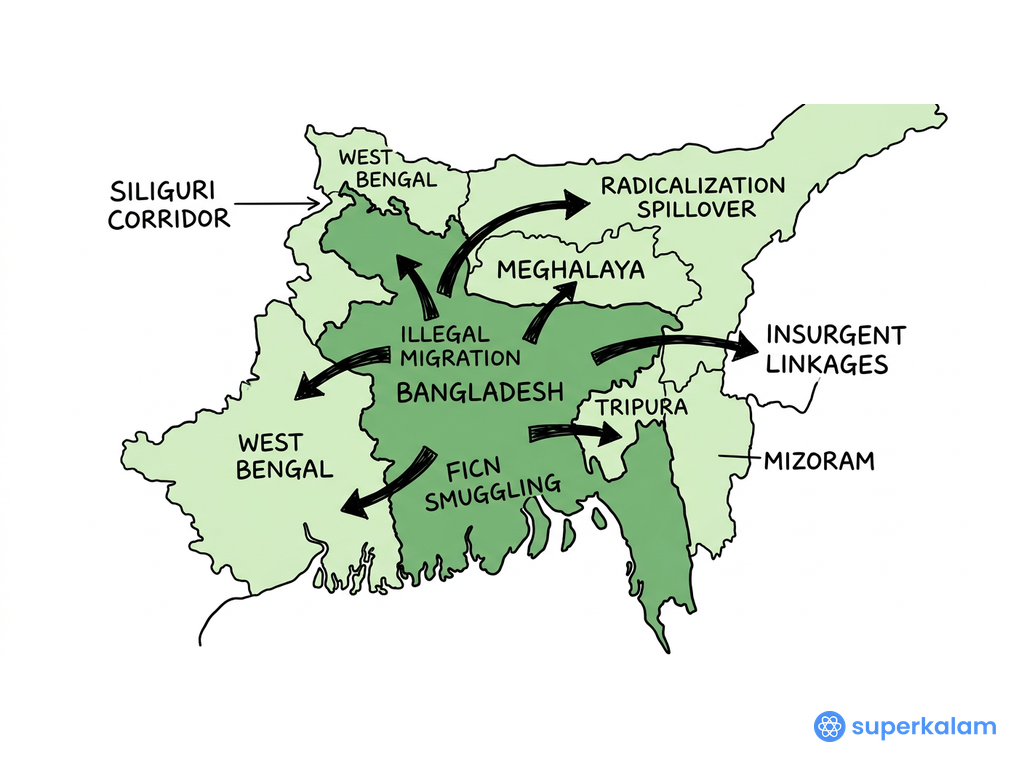
2013 Thematic Map of Bangladesh and India
Nature of Bangladesh's Ideological Split
- Secular-Nationalist Forces: Support Bangladesh's founding principles of secularism, democracy, and Bengali cultural identity rooted in the Liberation War
- Islamic Fundamentalist Groups: Advocate for Sharia-based governance and pan-Islamic identity, opposing war crimes trials
- Minority Targeting: Systematic attacks on Hindu minorities (comprising 8% of population) and secular intellectuals
- Political Polarization: Split between Awami League's secular nationalism and BNP-Jamaat alliance's Islamic orientation
- Youth Mobilization: Generational divide with youth supporting secular values versus conservative religious elements
| Secular-Nationalist Position | Islamic Fundamentalist Position |
|---|---|
| Support war crimes trials | Oppose trials as "victor's justice" |
| Promote Bengali cultural identity | Emphasize pan-Islamic brotherhood |
| Secular constitution and governance | Sharia-based legal system |
| Protection of minority rights | Religious majoritarian policies |
Strategic Implications for India
- Border Security Challenges: Increased infiltration attempts with 2,400+ individuals crossing illegally in 2024, straining BSF resources
- Internal Security Concerns: Harkat-ul-Jihad-al-Islami Bangladesh (HuJI-B) and other extremist groups attempting radicalization in West Bengal and Assam
- Economic Disruptions: Bilateral trade worth $18 billion faces uncertainty due to political instability
- Connectivity Projects: India-Bangladesh Protocol on Inland Water Transit and road connectivity initiatives under threat
- Regional Balance: China's growing influence through Belt and Road Initiative investments exploiting Bangladesh's instability
Impact on India's Neighborhood Policy
- Diplomatic Balancing: India must support democratic forces while maintaining neutrality to avoid being labeled as interfering
- Minority Protection: 3 crore Hindus in Bangladesh face increasing persecution, creating humanitarian and diplomatic pressure on India
- Strategic Partnerships: Cooperation in counter-terrorism, particularly regarding Northeast insurgent groups using Bangladesh territory
- Development Cooperation: $8 billion in committed aid and investments require stable political environment
The ideological contest in Bangladesh directly affects India's Act East Policy and regional integration goals. India's response involves strengthening border security while supporting Bangladesh's democratic institutions through continued economic cooperation and cultural exchanges.
Answer Length
Model answers may exceed the word limit for better clarity and depth. Use them as a guide, but always frame your final answer within the exam’s prescribed limit.
Evaluate this PYQ now
Write your answer & evaluate in just 60 seconds




500+ students evaluated
Model Answers from
- 2013International Relations10 MarksView Answer
The World Bank and the IMF, collectively known as the Bretton Woods Institutions, are the two inter-governmental pillars supporting the structure of the world’s economic and financial order. Superficially, the World Bank and the IMF exhibit many common characteristics, yet their role, functions, and mandate are distinctly different. Elucidate.
- 2013International Relations10 MarksView Answer
What is meant by the Gujral doctrine? Does it have any relevance today? Discuss.
- 2013International Relations10 MarksView Answer
In respect of India — Sri Lanka relations, discuss how domestic factors influence foreign policy.
- 2013International Relations10 MarksView Answer
Discuss the political developments in Maldives in the last two years. Should they be of any cause of concern to India?
- 2013International Relations10 MarksView Answer
Economic ties between India and Japan while growing in recent years are still far below their potential. Elucidate the policy constraints that are inhibiting this growth
- 2013International Relations10 MarksView Answer
What do you understand by ‘The String of Pearls’? How does it impact India? Briefly outline the steps taken by India to counter this.
Model Answers by Subject


Crack UPSC with your
Personal AI Mentor
An AI-powered ecosystem to learn, practice, and evaluate with discipline



