What are asteroids? How real is the threat of them causing extinction of life? What strategies have been developed to prevent such a catastrophe?
What are asteroids? How real is the threat of them causing extinction of life? What strategies have been developed to prevent such a catastrophe?
Subject: Science & Technology
Asteroids are rocky, airless remnants left over from the Solar System’s formation ≈ 4.6 billion years ago. Ranging from meter-sized boulders to dwarf-planet–scale Ceres (≈940 km), most orbit in the main belt between Mars and Jupiter, though thousands follow Earth-crossing paths and are classified as near-Earth objects (NEOs)
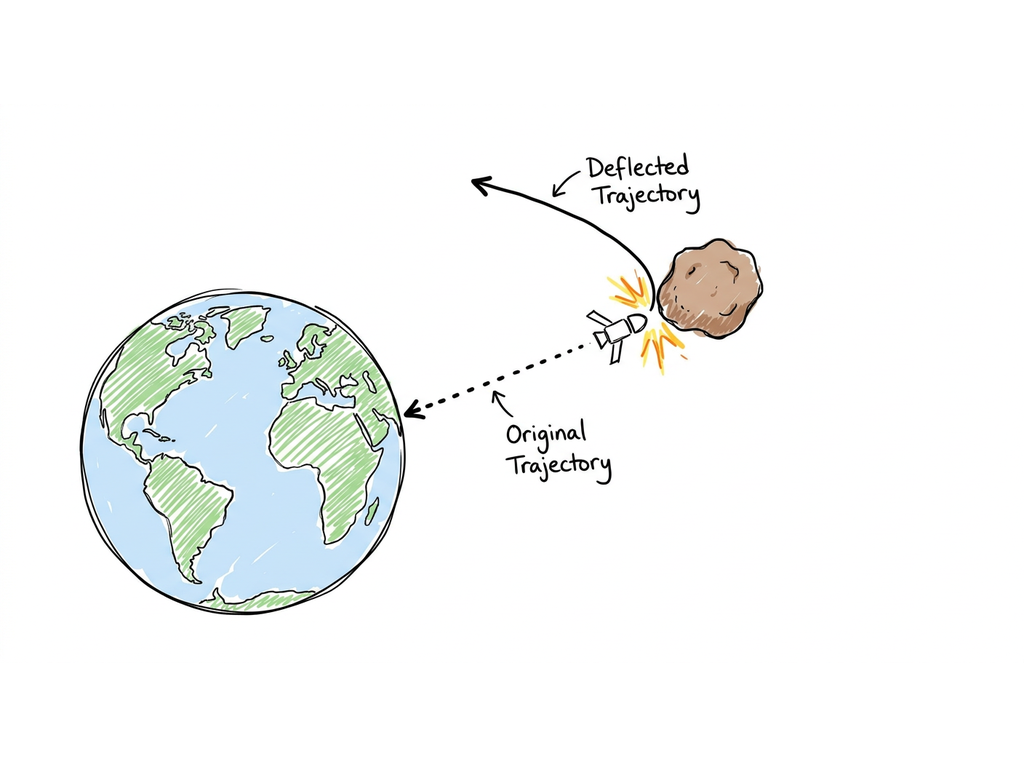
Deflecting Asteroid from Earth Trajectory
Assessment of Extinction-Level Threats
- The discovery of 2,818 near-Earth asteroids in 2023 highlights the ongoing identification of potential threats.
- Asteroids larger than 1 kilometer can cause global catastrophes through:
- Impact winter causing prolonged darkness and cooling.
- Massive tsunamis and earthquakes.
- Release of harmful gases and debris into the atmosphere.
Planetary-defense strategies
| Approach | Principle & status | Merits | Limitations |
|---|---|---|---|
| Early detection | Global surveys such as NASA’s NEO Observations Program, ESA’s Flyeye, LSST, and India’s NETRA track orbits years–decades in advance. | Buys time; low cost per life saved | Coverage gaps for small, faint objects |
| Kinetic impactor | Hit the asteroid with a high-speed spacecraft to nudge its orbit; proven by NASA’s DART (2022), which shortened Dimorphos’ orbital period by 33 min. | Technology-ready; scalable for 50 m–500 m targets | Less effective on rubble-pile or very large bodies |
| Gravity tractor | Station a massive spacecraft nearby; mutual gravity slowly drags the asteroid off course (concept tested in simulations). | Gentle, precise; preserves object intact | Requires years–decades of lead time |
| Nuclear standoff blast | Detonate device near surface to vaporize material, creating a rocket-like plume that alters trajectory; modeled extensively, retained as last resort. | Works on large or short-warning threats | Political, legal, and debris-fragmentation risks |
| Civil-defense planning | Evacuation drills, impact-forecast communication protocols under UN-backed International Asteroid Warning Network (IAWN). | Saves lives if deflection fails | Only mitigates, doesn’t prevent impact |
Continued investment in sky surveys, technology demonstration missions, and multinational response frameworks will convert a low-probability but high-consequence danger into a manageable natural hazard rather than an existential threat.
Answer Length
Model answers may exceed the word limit for better clarity and depth. Use them as a guide, but always frame your final answer within the exam’s prescribed limit.
Evaluate this PYQ now
Write your answer & evaluate in just 60 seconds




500+ students evaluated
Model Answers from
- 2024Science & Technology10 MarksView Answer
What is the technology being employed for electronic toll collection on highways? What are its advantages and limitations? What are the proposed changes that will make this process seamless? Would this transition carry any potential hazards?
- 2024Science & Technology10 MarksView Answer
What is the present world scenario of intellectual property rights with respect to life materials? Although India is second in the world to file patents, still only a few have been commercialized. Explain the reasons behind this less commercialization.
Model Answers by Subject


Crack UPSC with your
Personal AI Mentor
An AI-powered ecosystem to learn, practice, and evaluate with discipline



