Account for legal and political factors responsible for the reduced frequency of using article 356 by the union government mid-1990s.
Account for legal and political factors responsible for the reduced frequency of using article 356 by the union government mid-1990s.
The significant decline in the invocation of Article 356 since the mid-1990s can be attributed to a watershed moment in Indian constitutional history - the S.R. Bommai judgment (1994). This landmark case fundamentally transformed the federal dynamics between the Union and States by establishing robust safeguards against the arbitrary imposition of President's Rule.
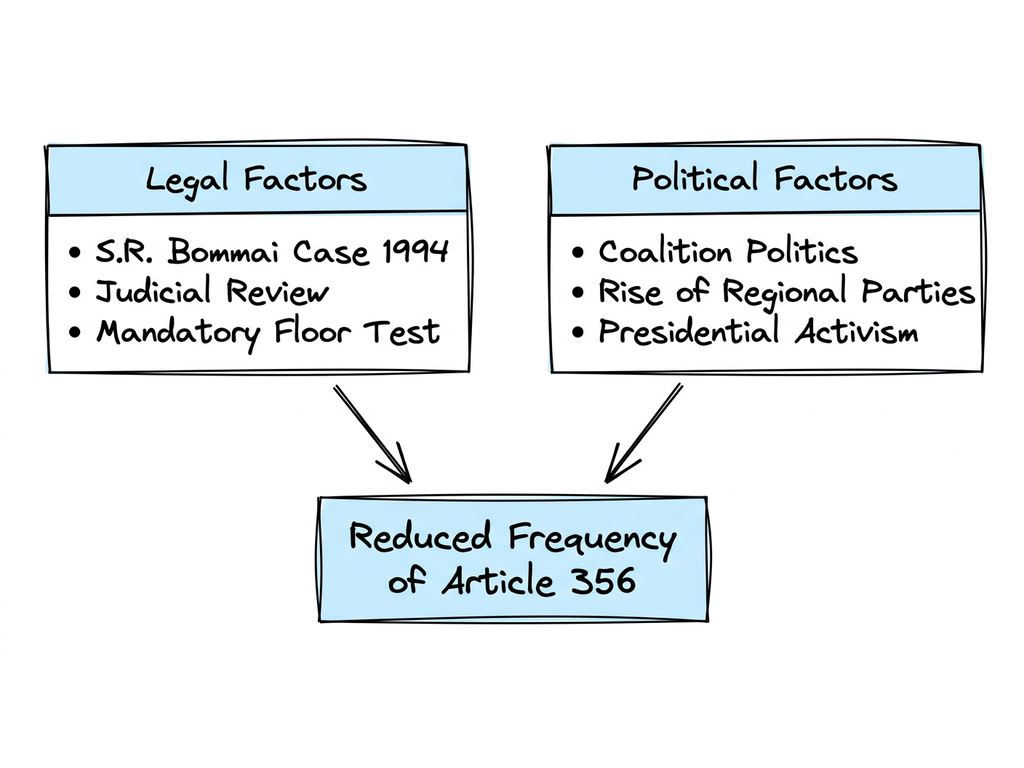
Factors Reducing Frequency of Article 356
Legal Factors
-
The Supreme Court's judgment in S.R. Bommai case established clear judicial parameters:
- Made President's Rule subject to judicial review.
- Mandated that the material basis for imposing Article 356 must be made available to courts.
- Required floor test to prove majority in the assembly before dissolution.
-
The Court emphasized that Article 356 can only be invoked in cases of:
- Complete breakdown of constitutional machinery.
- Not merely for law and order issues or political instability.
- Failure to comply with constitutional obligations.
-
The interpretation of Article 365 was refined:
- Made President's power discretionary rather than obligatory.
- Required reasonable and circumspect application of the provision.
- Established clearer definition of "constitutional breakdown".
Political Factors
-
The emergence of coalition politics at the national level:
- Regional parties gained more bargaining power.
- Created political checks against misuse of Article 356.
- Fostered federal cooperation rather than confrontation.
-
Emergence of Strong Regional Parties:
- Rise of regional political power in states like West Bengal, Tamil Nadu, and Andhra Pradesh.
- These parties wielded significant national influence, making central overreach politically costly.
-
Evolution of cooperative federalism:
- Formation of Inter-State Council for better Centre-State coordination.
- Regular meetings of NITI Aayog promoting collaborative governance.
- Strengthened institutional mechanisms for dispute resolution.
-
Public and Political Pressure
- Media, civil society, and judiciary began criticizing misuse of Article 356 as undemocratic.
- A growing federal political culture promoted respect for state mandates.
The decline in the use of Article 356 reflects the maturation of Indian democracy. Legal safeguards post S.R. Bommai and evolving coalition-era politics have together ensured that Article 356 is used sparingly and constitutionally, reinforcing the principles of cooperative federalism and democratic governance.
Answer Length
Model answers may exceed the word limit for better clarity and depth. Use them as a guide, but always frame your final answer within the exam’s prescribed limit.
Evaluate this PYQ now
Write your answer & evaluate in just 60 seconds




500+ students evaluated
Model Answers from
- 2023Indian Polity10 MarksView Answer
“The constitution of India is a living instrument with capabilities of enormous dynamism. It is a constitution made for a progressive society.” Illustrate with special reference to the expanding horizons of the right to life and personal liberty.
- 2023Indian Polity10 MarksView Answer
Compare and contrast the British and Indian approaches to parliamentary sovereignty.
- 2023Indian Polity10 MarksView Answer
Explain the structure of the Parliamentary Committee system. How far have the financial committee helped in the institutionalisation of Indian Parliament.
- 2023Indian Polity10 MarksView Answer
Explain the significance of the 101st constitutional amendment act. To what extent does it reflect the accommodative spirit of federalism.
- 2023Indian Polity10 MarksView Answer
Discuss the role of presiding officers of state legislatures in maintaining order and impartiality in conducting legislative work and in facilitating best democratic practices.
- 2023Indian Polity10 MarksView Answer
The states in India seem reluctant to empower urban local bodies both functionally as well as financially. Comment.
Model Answers by Subject


Crack UPSC with your
Personal AI Mentor
An AI-powered ecosystem to learn, practice, and evaluate with discipline