Explain the significance of the 101st constitutional amendment act. To what extent does it reflect the accommodative spirit of federalism.
Explain the significance of the 101st constitutional amendment act. To what extent does it reflect the accommodative spirit of federalism.
The 101st Constitutional Amendment Act represents a landmark reform in India's fiscal federalism through the introduction of Goods and Services Tax (GST), marking a paradigm shift from the complex multi-layered indirect tax system to a unified tax regime.
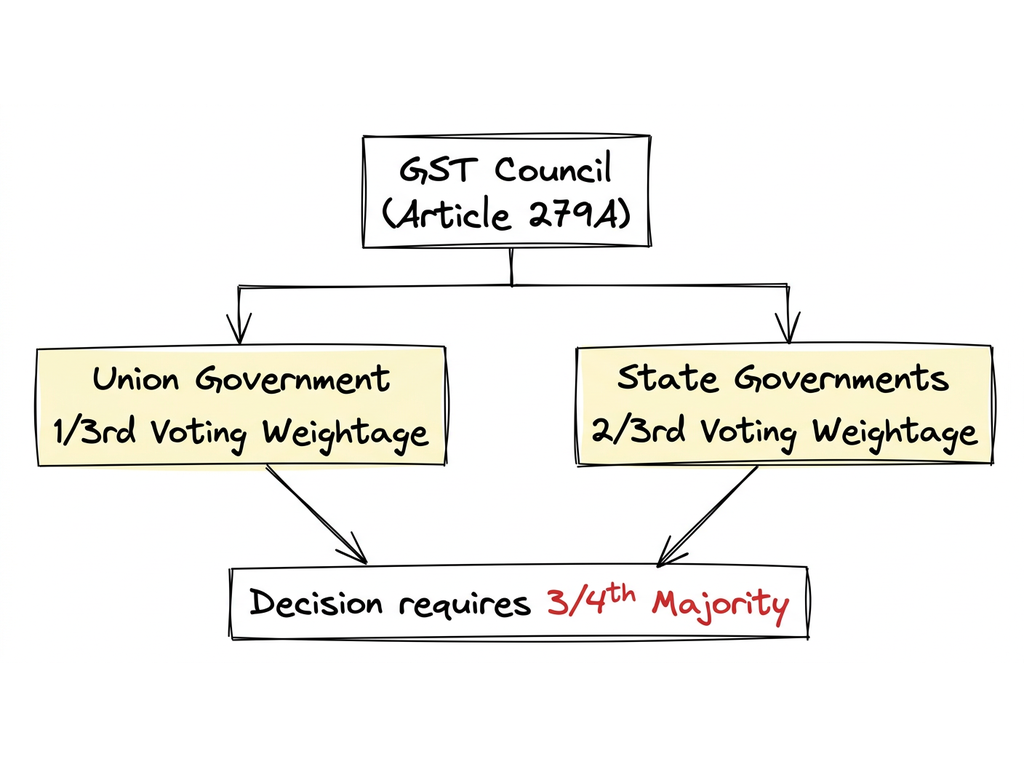
GST Council: Voting Weightage Distribution Process
Key Features and Significance
-
Constitutional Provisions: The amendment introduced Article 246A which confers concurrent taxing powers to both Parliament and State legislatures for levying GST.
-
Institutional Framework: Establishment of the GST Council under Article 279A as a federal body with representation from both Centre and States, embodying cooperative federalism.
-
Tax Harmonization: Replaced multiple taxes like VAT, Service Tax, and Central Excise with a unified GST structure, creating a common national market.
-
Economic Integration: Elimination of cascading effect of taxes and reduction in compliance burden, promoting ease of doing business.
Reflection of Accommodative Federalism
-
Shared Sovereignty:
- Both Centre and States share concurrent powers to levy GST, respecting federal autonomy.
- Revenue sharing mechanism ensures fiscal stability of states through compensation.
-
Collaborative Decision Making:
- The GST Council's structure (Centre-33%, States-67% voting share) ensures balanced representation.
- Decisions are taken by three-fourth majority, promoting consensus-building.
-
Constitutional Safeguards for States:
- Compensation to States Act, 2017 ensured revenue protection for 5 years to help states adjust to the new system.
Limitations / Challenges
- Some states have expressed concerns over loss of fiscal autonomy.
- GST compensation issues during COVID-19 strained Centre-State trust.
- Over-centralization of rate-setting could weaken true federal balance.
Way Forward
- Strengthening Federal Framework:
- Need for regular review of compensation mechanism.
- Enhanced role of states in decision-making process.
- Resolution of jurisdictional disputes through constitutional mechanisms.
The 101st Amendment exemplifies the evolution of Indian federalism from rigid demarcation to cooperative federalism, as evidenced by the successful implementation of "One Nation, One Tax" through consensus-building between Centre and States, though challenges remain in achieving perfect federal harmony.
Answer Length
Model answers may exceed the word limit for better clarity and depth. Use them as a guide, but always frame your final answer within the exam’s prescribed limit.
Evaluate this PYQ now
Write your answer & evaluate in just 60 seconds




500+ students evaluated
Model Answers from
- 2023Indian Polity10 MarksView Answer
“The constitution of India is a living instrument with capabilities of enormous dynamism. It is a constitution made for a progressive society.” Illustrate with special reference to the expanding horizons of the right to life and personal liberty.
- 2023Indian Polity10 MarksView Answer
Compare and contrast the British and Indian approaches to parliamentary sovereignty.
- 2023Indian Polity10 MarksView Answer
Explain the structure of the Parliamentary Committee system. How far have the financial committee helped in the institutionalisation of Indian Parliament.
- 2023Indian Polity10 MarksView Answer
Account for legal and political factors responsible for the reduced frequency of using article 356 by the union government mid-1990s.
- 2023Indian Polity10 MarksView Answer
Discuss the role of presiding officers of state legislatures in maintaining order and impartiality in conducting legislative work and in facilitating best democratic practices.
- 2023Indian Polity10 MarksView Answer
The states in India seem reluctant to empower urban local bodies both functionally as well as financially. Comment.
Model Answers by Subject


Crack UPSC with your
Personal AI Mentor
An AI-powered ecosystem to learn, practice, and evaluate with discipline



