Discuss the recent measures initiated in disaster management by the Government of India departing from the earlier reactive approach.
Discuss the recent measures initiated in disaster management by the Government of India departing from the earlier reactive approach.
Recent data shows India's disaster management approach has transformed from reactive relief-focused strategies to proactive risk reduction measures, aligning with global frameworks like the Sendai Framework.
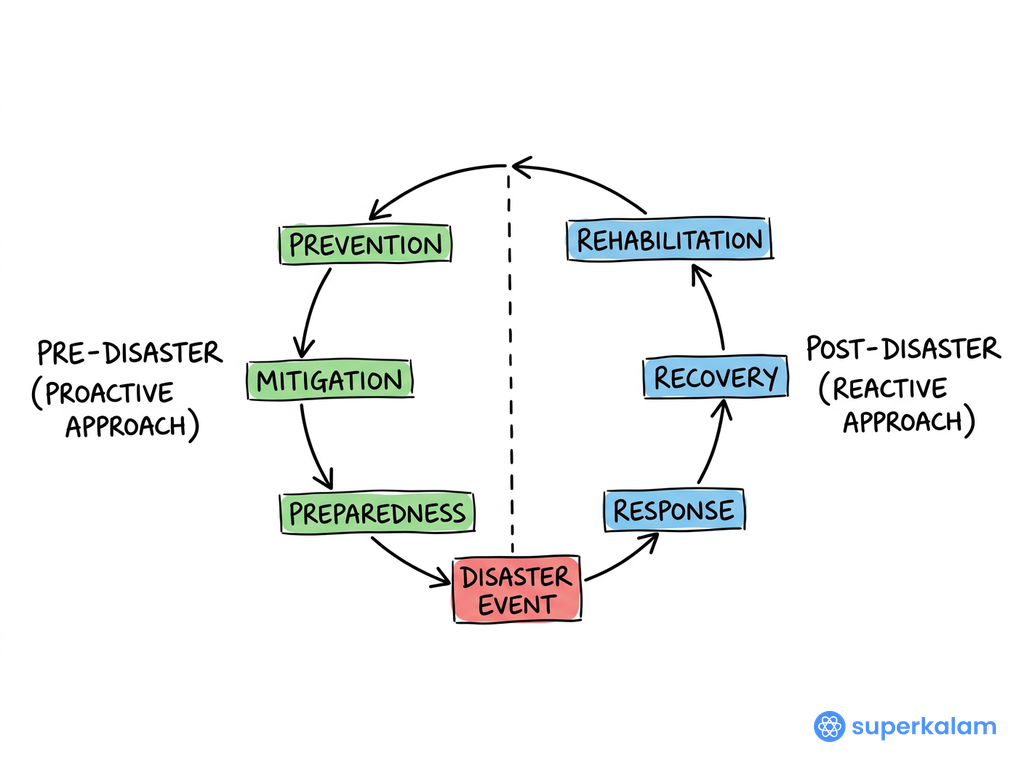
Disaster Management Cycle Circular Diagram Overview
Legislative and Institutional Framework
- Disaster Management Act, 2005: Established comprehensive legal framework with NDMA as apex body replacing earlier ad-hoc arrangements
- National Disaster Management Plan 2019: Aligned with Sendai Framework 2015-2030 focusing on disaster risk reduction rather than just response
- State Disaster Response Forces (SDRF): Created alongside NDRF for decentralized disaster response covering all 28 states
- District Disaster Management Authorities: Empowered local bodies for grassroots-level preparedness and response
- National Crisis Management Committee: Reformed for better inter-ministerial coordination during emergencies
Early Warning and Technology Integration
| System | Coverage | Key Features |
|---|---|---|
| IDRN (Integrated Disease Surveillance) | Pan-India | Real-time disease outbreak monitoring |
| Cyclone Warning Division | Coastal areas | 72-hour advance cyclone predictions |
| IMD Weather Alerts | National | Color-coded warnings via mobile/TV |
| SACHET platform | Multi-hazard | AI-based risk assessment tool |
- Common Alerting Protocol (CAP): Standardized alert messaging across 12 languages through mobile networks
- ISRO's MOSDAC: Satellite-based real-time disaster monitoring and damage assessment
Community-Based Risk Reduction
- Aapda Mitra Scheme (2016): Trained over 1 lakh community volunteers across 350 disaster-prone districts
- School Safety Programme: Implemented in 32,000+ schools focusing on earthquake and fire safety drills
- Community-Based Disaster Risk Management: Operational in 169 most vulnerable districts with local participation
- Tsunami Ready Programme: UNESCO recognition for 4 Indian communities (Odisha, Andhra Pradesh)
- Self-Help Group Integration: 63 lakh SHGs mobilized for disaster preparedness activities
Infrastructure and Preparedness Measures
- National Emergency Response Centres: Established in all 28 states with 24x7 operations capability
- Pre-positioned Relief Materials: Strategic reserves maintained at 71 locations nationwide
- Disaster-Resilient Infrastructure: National Infrastructure Pipeline incorporating climate-resilient design standards
- Building Codes 2016: Mandatory seismic and wind-resistant construction norms for all new buildings
- Multi-Hazard Early Warning Systems: Integrated approach covering floods, cyclones, heatwaves, and landslides
This paradigm shift reflects India's commitment to "Build Back Better" philosophy, emphasizing prevention over cure through the PM-STIAC recommendations and National Disaster Management Plan 2019 guidelines.
Answer Length
Model answers may exceed the word limit for better clarity and depth. Use them as a guide, but always frame your final answer within the exam’s prescribed limit.
Evaluate this PYQ now
Write your answer & evaluate in just 60 seconds




500+ students evaluated
Model Answers from
- 2020Economy15 MarksView Answer
What are the major factors responsible for making the rice-wheat system a success? In spite of this success, how has this system become bane in India?
- 2020Economy15 MarksView Answer
Explain the rationale behind the Goods and Services Tax (Compensation to States) Act of 2017. How has COVID-19 impacted the GST compensation fund and created new federal tensions?
- 2020Economy15 MarksView Answer
Explain the meaning of investment in an economy in terms of capital formation. Discuss the factors to be considered while designing a concession agreement between a public entity and a private entity.
- 2020Economy10 MarksView Answer
What are the challenges and opportunities of the food processing sector in the country? How can income of the farmers be substantially increased by encouraging food processing?
- 2020Economy10 MarksView Answer
What are the main constraints in transport and marketing of agricultural produce in India?
- 2020Economy10 MarksView Answer
Define potential GDP and explain its determinants. What are the factors that have been inhibiting India from realising its potential GDP?
Model Answers by Subject


Crack UPSC with your
Personal AI Mentor
An AI-powered ecosystem to learn, practice, and evaluate with discipline



