Examine the role of supermarkets in supply chain management of fruits, vegetables and food items. How do they eliminate the number of intermediaries?
Examine the role of supermarkets in supply chain management of fruits, vegetables and food items. How do they eliminate the number of intermediaries?
Supermarkets have revolutionized food retail by creating efficient supply chains that directly connect producers to consumers, reducing intermediaries and improving value delivery across the entire food distribution network.
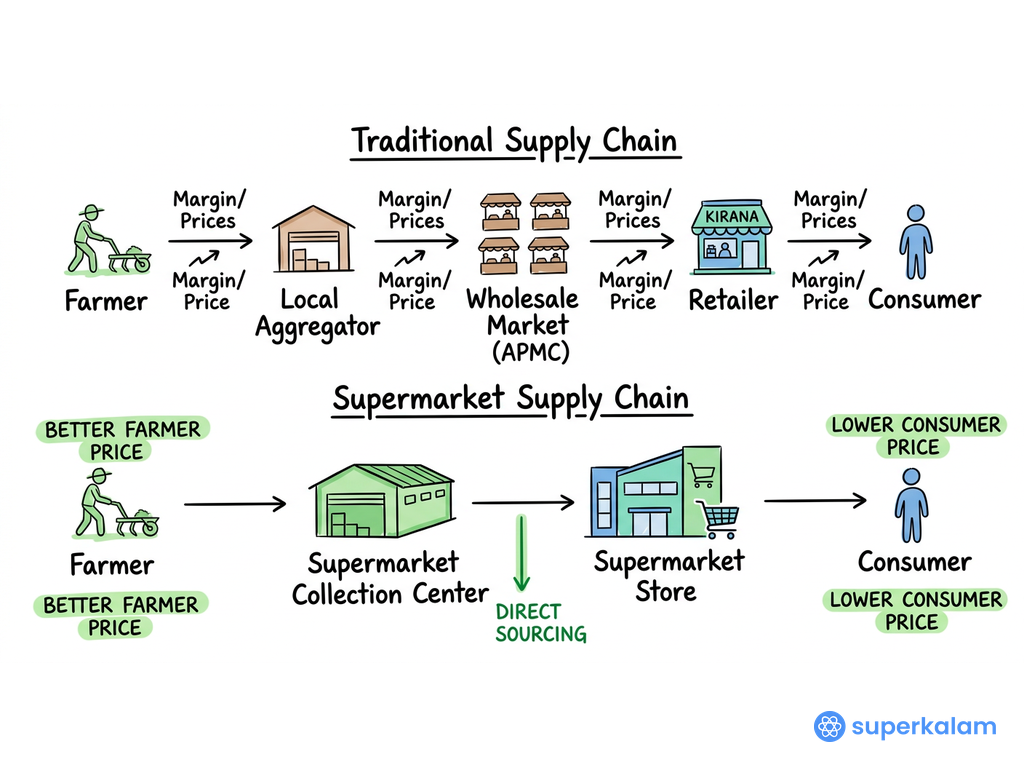
Comparing traditional and alternative supply chains
Supply Chain Management Functions
-
Direct Sourcing Networks
- Establishment of Contract Farming arrangements with farmer groups and FPOs
- Creation of dedicated procurement centers at farm gates eliminating middlemen
- Implementation of e-NAM platform integration for transparent price discovery
- Development of Farmer Producer Organizations (FPOs) partnerships for bulk procurement
- Introduction of quality-based pricing mechanisms ensuring better farmer returns
-
Infrastructure Development
- Investment in cold chain infrastructure through NCCD support reducing post-harvest losses
- Establishment of regional distribution centers with advanced storage facilities
- Implementation of RFID technology for real-time inventory tracking
- Development of temperature-controlled transportation networks
- Creation of ripening chambers and processing units for value addition
Intermediary Elimination Process
| Traditional Chain | Supermarket Chain |
|---|---|
| Farmer → Commission Agent → Wholesaler → Distributor → Retailer → Consumer | Farmer → Collection Center → Distribution Center → Supermarket → Consumer |
| 4-5 intermediaries | 1-2 intermediaries |
| Price markup: 200-300% | Price markup: 50-80% |
- Direct Procurement Models
- Elimination of commission agents (arthiyas) through farm-gate purchasing
- Bypassing traditional wholesale markets (mandis) via direct contracts
- Reduction of multiple handling points minimizing damage and costs
- Implementation of Private Label programs for processed foods
- Integration with digital payment systems for transparent transactions
Efficiency Improvements and Impact
-
Technology Integration
- Deployment of AI-based demand forecasting reducing inventory wastage
- Implementation of blockchain technology for traceability and food safety
- Use of IoT sensors in storage facilities maintaining optimal conditions
- Integration with UPI payment systems for seamless farmer payments
- Development of mobile apps connecting farmers directly to retail chains
-
Market Transformation
- Reduction of food wastage from 40% to 5-10% through professional handling
- Better price realization for farmers (20-30% higher than traditional channels)
- Improved food safety standards through FSSAI compliance
- Enhanced consumer access to fresh produce year-round
- Creation of employment opportunities in rural areas through collection centers
Supermarkets are transforming India's food distribution landscape through initiatives like PM-KISAN FPO scheme and Agriculture Infrastructure Fund, creating more resilient and efficient supply chains for sustainable food security.
Answer Length
Model answers may exceed the word limit for better clarity and depth. Use them as a guide, but always frame your final answer within the exam’s prescribed limit.
Evaluate this PYQ now
Write your answer & evaluate in just 60 seconds




500+ students evaluated
Model Answers from
- 2018Economy15 MarksView Answer
With growing energy needs should India keep on expanding its nuclear energy programme? Discuss the facts and fears associated with nuclear energy.
- 2018Economy15 MarksView Answer
How has the emphasis on certain crops brought about changes in cropping patterns in the recent past? Elaborate the emphasis on millet production and consumption.
- 2018Economy15 MarksView Answer
Assess the role of the National Horticulture Mission (NHM) in boosting the production, productivity and income of horticulture farms. How far has it succeeded in increasing the income of farmers?
- 2018Economy15 MarksView Answer
How would the recent phenomena of protectionism and currency manipulations in world trade affect the macroeconomic stability of India?
- 2018Economy15 MarksView Answer
How are the principles followed by NITI Aayog different from those followed by the erstwhile planning commission in India?
- 2018Economy10 MarksView Answer
Sikkim is the first ‘Organic State’ in India. What are the ecological and economic benefits of an Organic State?
Model Answers by Subject


Crack UPSC with your
Personal AI Mentor
An AI-powered ecosystem to learn, practice, and evaluate with discipline



