Terrorism is emerging as a competitive
industry over the last few decades.”
Analyse the above statement.
Terrorism is emerging as a competitive
industry over the last few decades.”
Analyse the above statement.
Terrorism has evolved from ideologically driven violence to a sophisticated competitive industry with complex financial networks, recruitment strategies, and market-driven operational models.
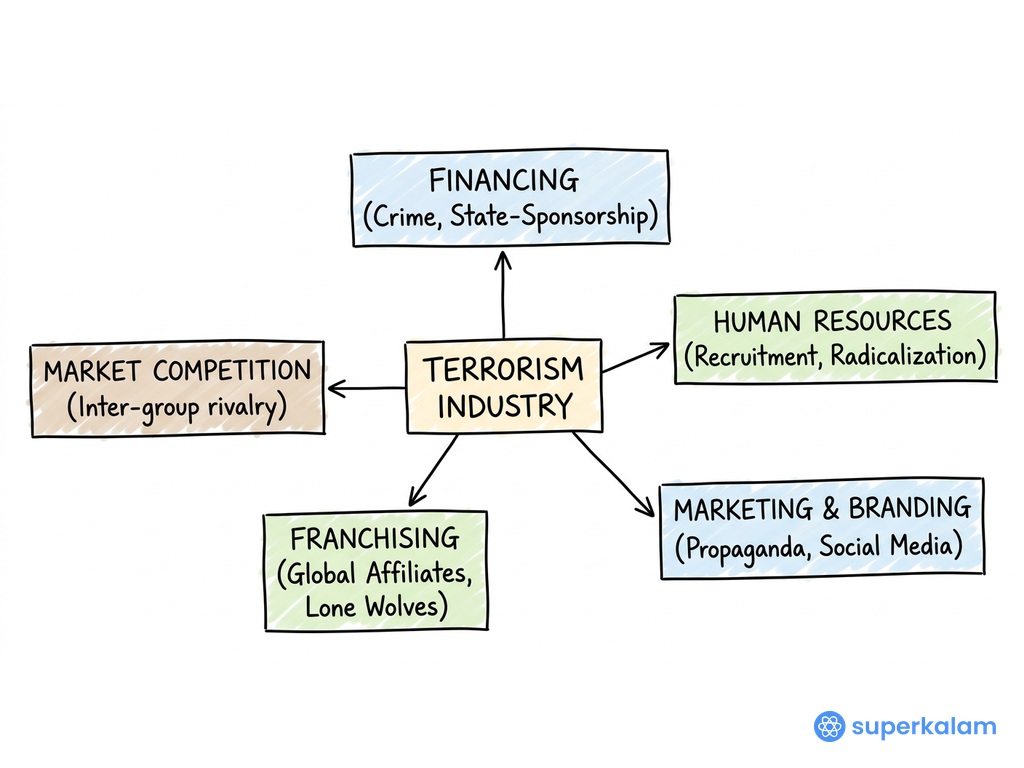
Business Model of Modern Terrorism
Characteristics of Terrorism as Industry
- Financial Sophistication: Modern terror groups operate through hawala systems, cryptocurrency networks, and shell companies for seamless fund transfers
- Revenue Diversification: Multiple income streams including state sponsorship, drug trafficking, human smuggling, and cyber crimes
- Franchise Models: Organizations like ISIS and Al-Qaeda license their brand to local affiliates, creating decentralized operational networks
- Professional Recruitment: Systematic talent acquisition through social media, dark web platforms, and radicalization centers
- Supply Chain Management: Sophisticated procurement networks for weapons, explosives, and communication equipment
| Traditional Terrorism | Modern Terror Industry |
|---|---|
| Ideological motivation | Market-driven competition |
| Limited funding sources | Diversified revenue streams |
| Hierarchical structure | Network-based operations |
| Regional focus | Global reach |
Competitive Dynamics in Terror Industry
- Market Competition: Groups compete for funding, recruits, and media attention, leading to escalating violence
- Innovation Drive: Constant adaptation of tactics, from vehicle ramming (Nice 2016) to drone attacks (Jammu 2021)
- Branding Strategies: Terror organizations invest in propaganda videos, social media presence, and ideological products
- Performance Metrics: Success measured by casualty numbers, media coverage, and economic disruption
- Strategic Alliances: Partnerships between groups like Lashkar-e-Taiba and Jaish-e-Mohammed in Kashmir
Implications for Counter-Terrorism
- Economic Approach: Targeting financial networks through FATF guidelines and UN sanctions
- Technology Integration: Enhanced cyber surveillance and AI-powered threat detection
- Multi-Agency Coordination: Institutions like NIA, IB, and RAW working in synergy
- International Cooperation: Platforms like Shanghai Cooperation Organization for intelligence sharing
The industrialization of terrorism demands sophisticated counter-strategies that address both operational capabilities and business models, requiring sustained international cooperation and technological innovation to effectively combat this evolving threat.
Answer Length
Model answers may exceed the word limit for better clarity and depth. Use them as a guide, but always frame your final answer within the exam’s prescribed limit.
Evaluate this PYQ now
Write your answer & evaluate in just 60 seconds




500+ students evaluated
Model Answers from
- 2016Internal Security12.5 MarksView Answer
The use of the internet and social media
by non-state actors for subversive
activities is a major security concern.
How have these been misused in the
recent past? Suggest effective guidelines
to curb the above threat. - 2016Internal Security12.5 MarksView Answer
Border management is a complex
task due to difficult terrain and hostile
relations with some countries.
Elucidate the challenges and strategies
for effective border management. - 2016Internal Security12.5 MarksView Answer
The terms ‘Hot Pursuit’ and ‘Surgical
Strikes’ are often used in connection
with armed action against terrorist
attacks. Discuss the strategic impact of
such actions.
Model Answers by Subject


Crack UPSC with your
Personal AI Mentor
An AI-powered ecosystem to learn, practice, and evaluate with discipline