What is the Greenhouse Effect? – UPSC Environment Notes
The greenhouse effect is the natural process where greenhouse gases trap heat in Earth’s atmosphere. Learn its causes, impacts, types, and more for the UPSC Environment syllabus. Click now!
Feb, 2026
•7 min read
The Greenhouse Effect is a natural process by which certain gases in the Earth’s atmosphere trap heat and keep the planet warm enough to sustain life. However, human activities have intensified this effect, leading to global warming and climate change.
For UPSC aspirants, understanding the greenhouse effect is important for GS Paper 1 (Geography), GS Paper 3 (Environment & Climate Change), Prelims, and Essay.
Let's study this topic!
What is the Greenhouse Effect?
The Greenhouse Effect is a natural atmospheric process in which certain gases, known as greenhouse gases (GHGs), trap heat in the Earth’s lower atmosphere.
Greenhouse gases such as carbon dioxide (CO₂), methane (CH₄), water vapour, and nitrous oxide (N₂O) absorb this outgoing heat and re-emit it in all directions, including back toward the Earth’s surface. This process warms the troposphere and helps maintain a stable and life-supporting climate.
Key Features of the Greenhouse Effect
1. Maintains Habitable Temperature: Without the greenhouse effect, Earth’s average temperature would be about –18°C instead of the current ~15°C, making life impossible.
2. Works Through Infrared Radiation: The process involves trapping of long-wave (infrared) radiation, not direct solar radiation.
3. Occurs in the Troposphere: The warming effect mainly takes place in the lowest layer of the atmosphere.
4. Natural vs Enhanced Effect:
- Natural greenhouse effect → Essential for life.
- Enhanced (anthropogenic) greenhouse effect → Caused by increased GHGs due to human activities.
5. Major Contributors to Enhanced Effect: Burning fossil fuels, deforestation, industrial emissions, agriculture, and urbanisation.
6. Linked to Global Warming: Increased concentration of GHGs intensifies heat trapping, leading to rising global temperatures and climate change.
How Does the Greenhouse Effect Work?
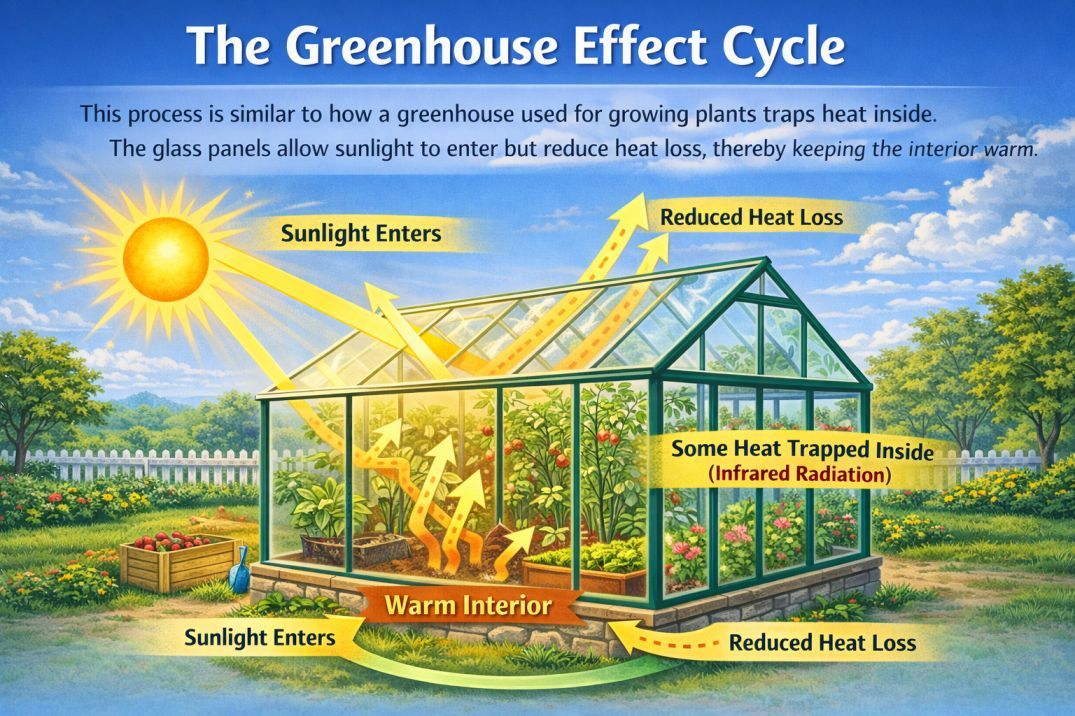
The greenhouse effect operates through a continuous exchange of energy between the Sun, Earth’s surface, and the atmosphere. The process can be understood in the following steps:
1. Incoming Solar Radiation (Shortwave Energy)
The Sun emits energy in the form of shortwave radiation (visible light and ultraviolet rays). This solar radiation passes through the Earth’s atmosphere and reaches the surface.
2. Absorption by the Earth’s Surface
The Earth’s land and oceans absorb a significant portion of this incoming solar energy. This absorption warms the surface. Some portion of the radiation is reflected into space by clouds, ice caps, and reflective surfaces (a phenomenon known as albedo).
3. Emission of Infrared Radiation (Longwave Energy)
After being heated, the Earth’s surface releases energy back toward the atmosphere in the form of infrared longwave radiation. This is essentially heat energy trying to escape into space.
4. Absorption by Greenhouse Gases
Greenhouse gases (GHGs) such as carbon dioxide (CO₂), methane (CH₄), water vapour, and nitrous oxide (N₂O) absorb a large portion of this outgoing infrared radiation. These gases have molecular structures capable of trapping heat.
5. Re-Radiation of Heat
After absorbing heat, greenhouse gases re-emit it in all directions, including back toward the Earth’s surface. This process prevents all the heat from escaping into space.
6. Warming of the Lower Atmosphere
The re-radiated heat warms the troposphere (the lowest layer of the atmosphere), maintaining a stable and life-supporting average global temperature.
Major Greenhouse Gases (GHGs)
The main greenhouse gases include:
- Carbon Dioxide (CO₂) – Released from fossil fuel combustion, deforestation, and cement production.
- Methane (CH₄) – Emitted from livestock, rice cultivation, and landfills.
- Nitrous Oxide (N₂O) – Produced from fertilisers and industrial activities.
- Water Vapour – Naturally occurring and the most abundant GHG.
- Ozone (O₃) – Present in the troposphere and acts as a greenhouse gas.
- Chlorofluorocarbons (CFCs) – Synthetic gases responsible for both the greenhouse effect and ozone depletion.
Important Points for Prelims
|
Cover this key topic for UPSC syllabus: 17 Sustainable Development Goals (SDGs): Objectives, Significance, India’s Progress, and SDG Report 2025 for UPSC
Types of Greenhouse Effect
The greenhouse effect can be classified into two types based on its origin and impact.
1. Natural Greenhouse Effect
The Natural Greenhouse Effect refers to the heat-trapping process that occurs naturally due to the presence of greenhouse gases in the atmosphere.
- Regulates Earth’s average temperature at around 15°C (instead of –18°C).
- Occurs due to naturally occurring gases such as water vapour, carbon dioxide, methane, and nitrous oxide.
- Maintains liquid water on Earth — a key condition for life.
- Essential for ecosystems, agriculture, and biodiversity.
Examples:
- Natural water vapour cycle contributing to atmospheric warming.
- Carbon dioxide released from volcanic eruptions and respiration.
- Methane released from wetlands.
2. Enhanced (Anthropogenic) Greenhouse Effect
The Enhanced Greenhouse Effect refers to the additional warming caused by increased concentrations of greenhouse gases due to human activities.
- Caused by excessive emissions from fossil fuel combustion.
- Increases radiative forcing and traps more heat.
- Leads to global warming and climate change.
- Alters weather patterns and increases extreme events.
Examples:
- CO₂ emissions from coal-based power plants and vehicles.
- Methane emissions from livestock farming and landfills.
- Nitrous oxide from chemical fertilisers.
- Deforestation reducing carbon absorption capacity.
Must read: UN Framework Convention on Climate Change (UNFCCC): UPSC Notes
Difference Between Greenhouse Effect and Global Warming
The greenhouse effect and global warming are closely related but conceptually different. The greenhouse effect is a natural process, while global warming is a consequence of its excessive intensification.
| Greenhouse Effect | Global Warming |
|---|---|
| A natural process in which greenhouse gases trap heat in the atmosphere. | A long-term rise in Earth’s average surface temperature. |
| Essential for maintaining a habitable temperature (~15°C). | Results from the enhanced (anthropogenic) greenhouse effect. |
| Occurs due to naturally present gases like CO₂, methane, and water vapour. | Caused mainly by increased human-induced greenhouse gas emissions. |
| Necessary for sustaining life on Earth. | Leads to climate change, sea-level rise, and extreme weather events. |
Also read: Understanding the Environmental Impact Assessment (EIA) for UPSC
UPSC Prelims PYQs on Greenhouse Effect
QUESTION 1
Consider the following statements:
Statement-I: The atmosphere is heated more by incoming solar radiation than by terrestrial radiation. Statement-II: Carbon dioxide and other greenhouse gases in the atmosphere are good absorbers of long wave radiation.
Which one of the following is correct in respect of the above statements?
QUESTION 2
Consider the following statements:
- Agricultural soils release nitrogen oxides into the environment.
- Cattle release ammonia into the environment.
- Poultry industry releases reactive nitrogen compounds into environment.
Which of the statements given above is/are correct?
QUESTION 3
Among the following crops, which one is the most important anthropogenic source of both methane and nitrous oxide?
Consequences of the Greenhouse Effect
The enhanced greenhouse effect has far-reaching environmental, economic, and social consequences. Let's understand!
1. Global Warming: Global warming refers to the long-term rise in Earth’s average surface temperature due to increased greenhouse gas concentrations.
- The planet has already warmed by more than 1°C above pre-industrial levels.
- Warmer temperatures intensify heatwaves and increase evaporation rates.
- Higher temperatures disrupt ecosystems and biodiversity.
Example: Rapid warming in the Arctic has led to record-breaking temperature increases and shrinking sea ice, affecting global climate systems.
2. Climate Change & Extreme Weather Events: Climate change includes broader changes in weather patterns such as altered rainfall, storms, and seasonal shifts.
- Increased frequency and intensity of cyclones.
- Prolonged droughts and sudden heavy rainfall.
- Shifts in monsoon patterns.
- More frequent heatwaves and cold waves.
Example: The 2018 floods in Kerala were linked to unusually intense rainfall events, consistent with changing climate patterns.
3. Melting of Glaciers and Ice Caps: Rising temperatures accelerate the melting of glaciers and polar ice sheets.
- Contributes to sea-level rise.
- Reduces freshwater availability in glacier-fed rivers.
- Disrupts polar ecosystems.
Example: Melting ice in the Arctic contributes to global sea-level rise, threatening low-lying nations like the Maldives.
4. Sea Level Rise & Coastal Vulnerability: Thermal expansion of seawater and melting glaciers increase sea levels.
- Coastal erosion and flooding.
- Salinisation of groundwater.
- Displacement of coastal populations (climate refugees).
Example: The Sundarbans face severe land loss and habitat destruction due to rising sea levels.
5. Ocean Acidification: Oceans absorb nearly 25–30% of atmospheric CO₂. When CO₂ dissolves in seawater, it forms carbonic acid, reducing ocean pH.
- Affects coral reefs and shell-forming organisms.
- Disrupts marine food chains.
- Impacts fisheries and coastal livelihoods.
Example: The Great Barrier Reef has experienced repeated coral bleaching events due to warming and acidifying oceans.
6. Impact on Agriculture & Food Security: Climate variability affects crop production and food systems.
- Erratic monsoons reduce agricultural predictability.
- Heat stress lowers crop yields.
- Increased pest infestations.
- Reduced nutritional quality of crops.
Example: Irregular monsoon patterns in India have impacted rice and wheat production, affecting farmer incomes and national food security.
7. Loss of Biodiversity: Changing climate conditions alter habitats and migration patterns.
- Species extinction risks increase.
- Forest ecosystems face stress from heat and wildfires.
- Coral reef ecosystems decline rapidly.
Example: Frequent wildfires in the Amazon forests have destroyed forest ecosystems and wildlife habitats.
8. Public Health Risks: Rising temperatures and changing climate patterns affect human health.
- Spread of vector-borne diseases (e.g., malaria, dengue).
- Heat-related illnesses.
- Air pollution-related respiratory disorders.
- Malnutrition due to food shortages.
Example: Extended heatwaves in South Asia have led to increased cases of heatstroke and dehydration.
UPSC Mains PYQ on Greenhouse Effect
Discuss global warming and mention its effects on the global climate. Explain the control measures to bring down the level of greenhouse gases which cause global warming, in the light of the Kyoto Protocol, 1997. [250 Words] [15 Marks] [2022]
Evaluate your Answer within 60 SecondsWay Forward
“We do not have a Plan B because there is no Planet B.” — Ban Ki-moon
Addressing the enhanced greenhouse effect requires coordinated global action, strong policy frameworks, and responsible individual behaviour. Climate mitigation and adaptation must go hand in hand to ensure sustainable development.
- Transition to Renewable Energy: Shift from coal and fossil fuels to solar, wind, hydro, and green hydrogen.
- Afforestation and Reforestation: Increase forest cover to enhance carbon sequestration.
- Sustainable Agriculture: Adopt climate-smart agricultural practices such as organic farming, crop diversification, and efficient irrigation.
- Energy Efficiency: Promote energy-efficient appliances and green building standards.
- Climate-Resilient Infrastructure: Develop infrastructure capable of withstanding floods, cyclones, and heatwaves.
Also read: Paris Agreement 2015 on Climate Change | UPSC Environment & Ecology Notes
Start your UPSC Preparation 2026/2027 with SuperKalam
SuperKalam is your personal mentor for UPSC preparation, guiding you at every step of the exam journey. Practice, revise, and evaluate– all in one place.
Download Now