National Investigation Agency (NIA) | UPSC Notes
National Investigation Agency (NIA) is India’s central counter-terrorism investigation agency. Learn its powers, functions, amendments, and challenges for UPSC Prelims & Mains (Internal Security).
Mar, 2026
•7 min read
The National Investigation Agency (NIA) is India’s premier counter-terrorism investigation body. Understanding its mandate, powers, and recent role in tackling terrorism is highly important for both Prelims and UPSC Mains GS Paper II (Polity & Governance) and GS Paper III (Internal Security).
What is the National Investigation Agency (NIA)?
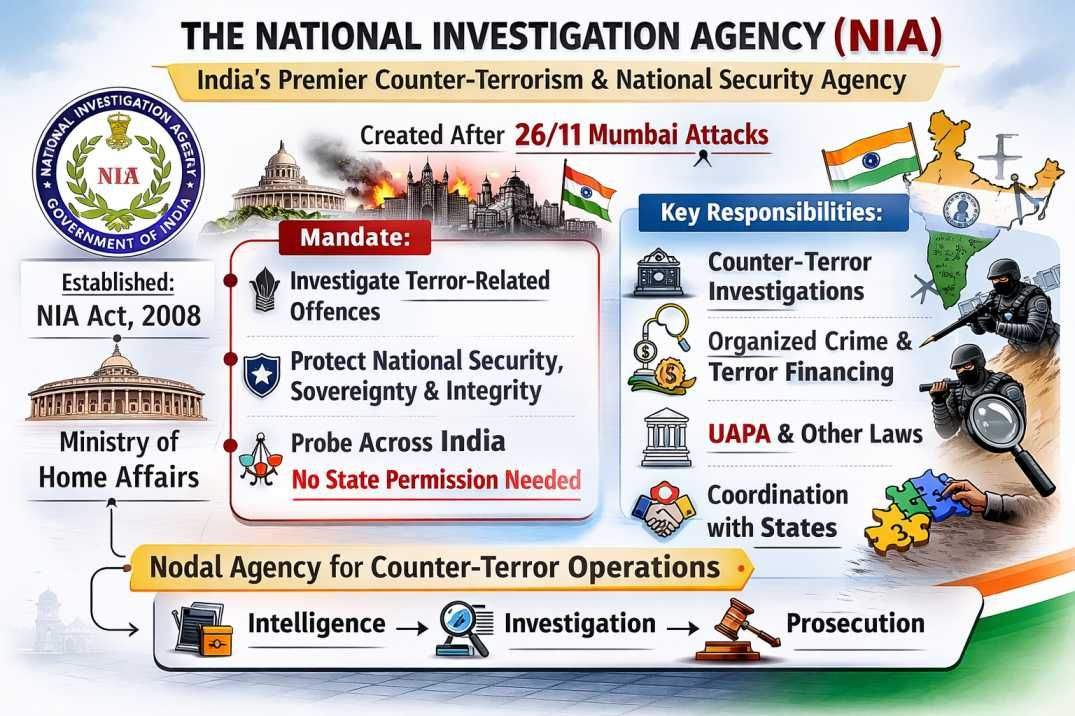
The National Investigation Agency (NIA) is India’s premier federal counter-terrorism law enforcement agency, responsible for investigating and prosecuting offences that affect national security, sovereignty, and integrity. The NIA was created in the aftermath of the 26/11 Mumbai terror attacks, which exposed serious gaps in India’s internal security and investigative framework.
- It is a statutory body established under the NIA Act, 2008 and functions under the Ministry of Home Affairs.
- NIA can investigate terror-related cases across India without prior permission from state governments.
- It deals with offences like terrorism, organised crime, terror financing, and offences under laws such as the UAPA.
- It acts as the nodal agency for coordinating counter-terror investigations across states.
Origin of the National Investigation Agency (NIA)
The establishment of the NIA is closely linked to India’s response to emerging terror threats.
In the aftermath of the 26/11 Mumbai terror attacks, which exposed critical gaps in intelligence coordination and investigation, the government felt the need for a centralised counter-terror agency.
In December 2008, then Union Home Minister P. Chidambaram introduced the National Investigation Agency Bill in Parliament. The agency was formally established on 31st December 2008 under the NIA Act, 2008 and became operational in 2009.
Since its inception, the NIA has evolved into a key institution in India’s internal security framework, handling hundreds of cases related to terrorism and national security.
Institutional Framework of the NIA
The institutional framework of the NIA is defined under the NIA Act, 2008, which lays down its structure, powers, and judicial mechanism for handling terror-related offences.
- The Act establishes the NIA as the central investigative agency to probe and prosecute offences listed in its Schedule (such as terrorism, terror financing, and certain organised crimes).
- NIA officers are vested with powers equivalent to those of regular police officers, including investigation, search, seizure, and arrest.
- The agency has pan-India jurisdiction and can take over cases from state police without requiring prior approval from state governments in matters of national security.
- It functions under the administrative control of the Ministry of Home Affairs, ensuring coordination at the national level.
- The Act empowers both the Central and State Governments to establish Special Courts for the speedy trial of offences investigated by the NIA.
Centre–State Coordination
While law and order is a State subject, the NIA framework enables the Centre to intervene in cases with national and cross-border implications. State governments are required to share information on scheduled offences, after which the Centre may direct the NIA to take over the investigation.
Special Courts under the NIA Act
To ensure speedy and focused trials of terrorism-related cases, the NIA Act, 2008, provides for the establishment of Special Courts.
Establishment and Composition
- The Central Government constitutes one or more Special Courts under Sections 11 and 22 of the Act for trying scheduled offences.
- Each Special Court is presided over by a judge appointed by the Central Government on the recommendation of the Chief Justice of the concerned High Court.
- If required, additional judges may also be appointed to handle the workload and ensure the timely disposal of cases.
Jurisdiction and Powers
- Special Courts exercise all powers of a Sessions Court under the Code of Criminal Procedure, 1973.
- They are empowered to conduct day-to-day trials to ensure faster justice in sensitive national security cases.
- In case of any jurisdiction dispute, the matter is referred to the Central Government, whose decision is final.
Transfer of Cases
The Supreme Court of India can transfer cases between Special Courts across states in exceptional situations to ensure a fair, impartial, and secure trial. The concerned High Court also has the power to transfer cases within the state between Special Courts.
Jurisdiction of NIA
The jurisdiction of the NIA is broad and extra-territorial, enabling it to effectively tackle modern security challenges. The NIA Act extends to the entire territory of India, allowing the agency to investigate offences anywhere in the country. Extra-territorial reach applies to:
- Indian citizens residing outside India
- Persons in government service, regardless of their place of posting
- Individuals on ships and aircraft registered in India, wherever they are located
The NIA can investigate cases where a scheduled offence is committed outside India, but:
- Targets Indian citizens, or
- Affects the sovereignty, security, or interests of India
This wide jurisdiction ensures that the NIA can address cross-border terrorism and global security threats in a comprehensive and coordinated manner.
What are Scheduled Offences?Scheduled offences are the specific categories of crimes listed in the NIA Act, 2008 that the NIA is empowered to investigate and prosecute. These mainly include serious offences related to terrorism, national security, and organized crime, such as those under:
Additionally, relevant provisions of the IPC, Arms Act, and Information Technology Act may also be invoked in such cases. |
UPSC Prelims Practice MCQ on NIA
QUESTION 1
With reference to the National Investigation Agency, consider the following statements:
- The NIA can investigate offences outside India subject to international agreements.
- The NIA requires prior approval from state governments before taking up any case.
- The NIA Act allows investigation of offences related to cyber-terrorism and human trafficking.
Which of the statements given above is/are correct?
Recent Amendments in the NIA Act
The NIA (Amendment) Act, 2019 significantly strengthened the mandate of the NIA to address evolving security threats and ensure faster investigation and prosecution.
1. Expanded Jurisdiction Beyond India
Earlier, the NIA primarily dealt with offences within India. The amendment empowered the agency to investigate and prosecute offences committed outside India, subject to international treaties and the domestic laws of the concerned country.
This enhanced India’s ability to tackle cross-border terrorism and transnational crimes.
2. Widened Scope of Scheduled Offences
The amendment expanded the range of offences under NIA’s jurisdiction. It now includes:
- Human trafficking
- Counterfeit currency and banknotes
- Manufacture or sale of prohibited arms
- Cyber-terrorism
- Offences under the Explosive Substances Act, 1908
3. Strengthening National Security Framework
By broadening both jurisdiction and subject-matter coverage, the amendment enables the NIA to respond more effectively to emerging and technology-driven threats. It also ensures faster and more coordinated investigations in complex cases with national and international linkages.
UPSC Mains Practice Question (GS Paper III – Internal Security)
The National Investigation Agency (NIA) has significantly strengthened India’s counter-terrorism framework, but concerns regarding federalism and capacity remain. Critically examine. (150 words, 10 marks)
Evaluate Your Answer in 60 SecondsChallenges Faced by the National Investigation Agency (NIA)
Despite its critical role in internal security, the NIA faces several structural and operational challenges:
- Centre–State Friction: Law and order is a State subject, leading to occasional resistance from states when the NIA takes over cases. Concerns over federalism and misuse of central power can affect smooth cooperation.
- Overlapping Jurisdiction: Multiple agencies like the state police, the Intelligence Bureau, and others may handle similar cases, leading to coordination issues and duplication of efforts.
- Expanding Mandate vs Capacity: With the expansion under the NIA (Amendment) Act, 2019, the agency’s workload has increased significantly. However, manpower, infrastructure, and technical capacity may not always keep pace.
- Delays in Investigation and Trial: Despite Special Courts, complex terror cases often involve multiple jurisdictions and evidentiary challenges, causing delays.
- International Cooperation Constraints: Investigating cases abroad depends on mutual legal assistance treaties (MLATs) and cooperation of foreign governments, which can be slow and uncertain.
- Political and Legal Scrutiny: The NIA sometimes faces allegations of political bias or selective investigation, which can affect its credibility. Ensuring transparency and accountability remains a key challenge.
- Evolving Nature of Threats: The rise of cyber-terrorism, lone-wolf attacks, and encrypted communications makes investigation more complex and technology-intensive.
Overall, addressing these challenges is essential to strengthening the NIA’s effectiveness as India’s premier counter-terror agency.
Way Forward
To enhance the effectiveness of the NIA, a focused and balanced approach is essential:
- Strengthen Centre–State coordination through institutional mechanisms and trust-building to ensure smoother investigations.
- Augment manpower and technical capacity in cyber forensics, data analysis, and financial intelligence.
- Improve international cooperation by streamlining extradition processes and strengthening legal frameworks for cross-border cases.
- Ensure transparency and accountability to maintain public trust and avoid allegations of misuse.
- Fast-track trials by strengthening Special Courts and reducing procedural delays.
Overall, with continuous reforms and capacity building under the NIA Act, 2008, the NIA can play a more decisive role in safeguarding India’s internal security in an evolving threat landscape.
Start your UPSC Preparation 2026/2027 with SuperKalam
SuperKalam is your personal mentor for UPSC preparation, guiding you at every step of the exam journey. Practice, revise, and evaluate– all in one place.
Download the SuperKalam App Now