GS 3: EconomyGS 2: International RelationsPrelims
July opens the biggest chapter in India-U.K. trade ties, Pg6
Landmark India-U.K. FTA, effective July 15, projects £25.5 billion annual trade surge, slashing tariffs and boosting GDP for both nations.
Practice MCQs
789 Students attempted
Key Highlights:
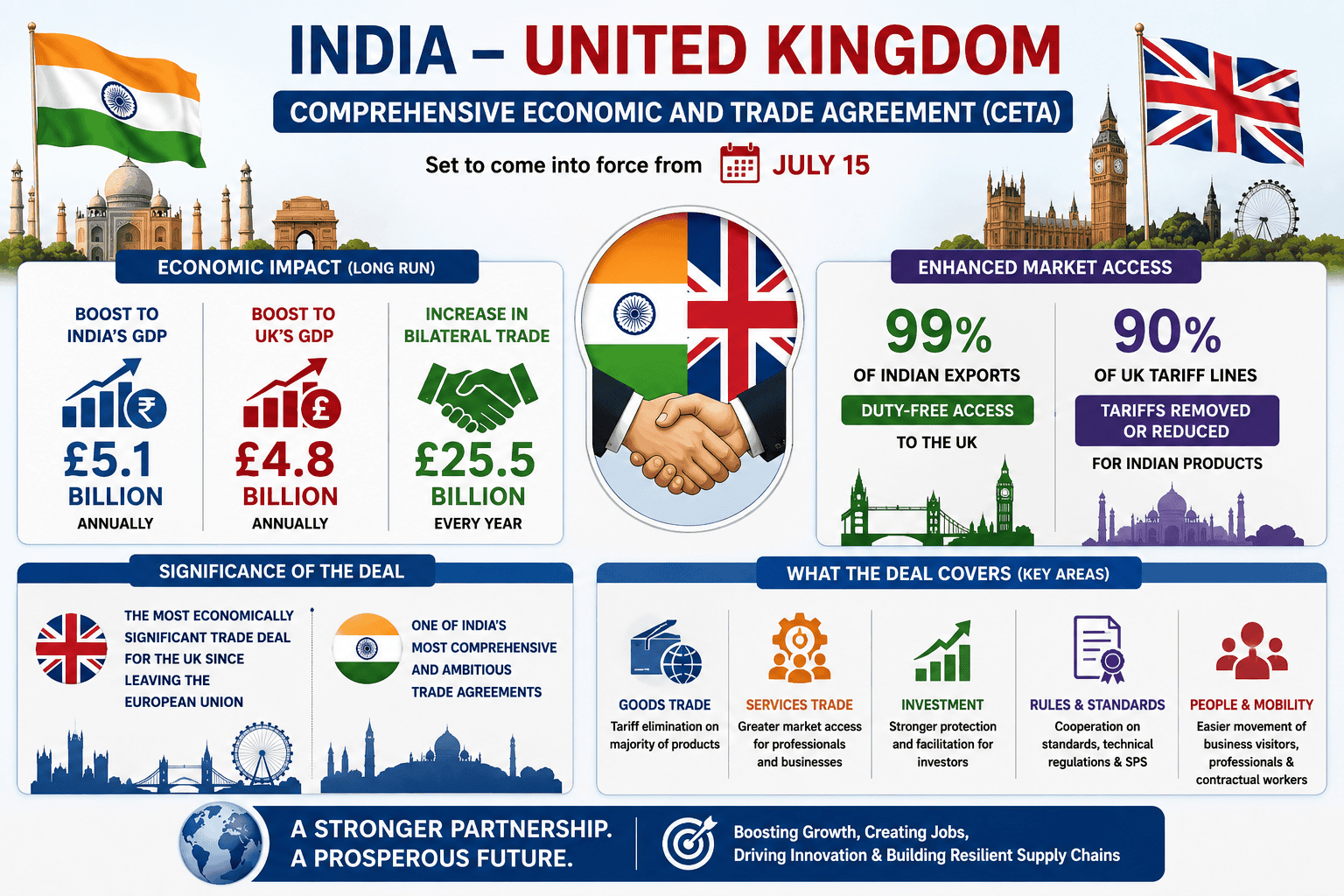
- The India-United Kingdom Free Trade Agreement (FTA), formally known as Comprehensive Economic and Trade Agreement (CETA), is set to come into force from July 15.
- The agreement is projected to boost India's GDP by £5.1 billion and the UK's GDP by £4.8 billion annually in the long run.
- Bilateral trade between the two nations is expected to increase by £25.5 billion every year in the long run.
- The deal grants duty-free access for 99% of Indian exports to the UK and removes or reduces tariffs on 90% of UK tariff lines for Indian products.
- It is considered the most economically significant trade deal for the UK since leaving the European Union and one of India's most comprehensive trade agreements.
India-UK.png
Detailed Insights:
- The CETA aims to drive shared growth across key sectors and unlock opportunities for businesses of all sizes in both countries.
- India is the fastest-growing economy in the G-20 and is projected to become the world’s third-largest economy within five years.
- The UK was the third fastest-growing economy in the G-7 in 2025 and remains a top global investment destination.
- For India, the deal supports jobs in labour-intensive sectors like textiles, leather, and jewellery, and boosts services exports in IT and finance.
- UK exports to India are estimated to see tariff duty reductions of around £400 million initially, potentially rising to £900 million after ten years.
- Critical UK industries such as aerospace, automotives, medical devices, and whiskies are expected to benefit significantly.
- The agreement includes provisions on customs, digital trade, and services, which are crucial for modern trade beyond just tariffs.
- It features India’s first-ever standalone chapters on anti-corruption, gender, and development, alongside comprehensive labour and environmental commitments.
- Specific protections are maintained for domestic producers, such as dairy and edible oils for India, while the UK shields sugar, milled rice, pork, chicken, and eggs.
- The deal is designed to benefit local economies beyond major cities, enabling manufacturers and service exporters in diverse regions to compete more effectively.
Key Concepts Involved:
- Free Trade Agreement (FTA): A pact between two or more countries to reduce barriers to imports and exports among them.
- Comprehensive Economic and Trade Agreement (CETA): A broad trade agreement covering goods, services, investment, and other economic cooperation areas.
- Tariff lines: Specific categories of goods listed in a country's tariff schedule, each with an assigned duty rate.
- Rules of origin: Criteria used to determine the national source of a product, crucial for applying preferential tariffs under trade agreements.

SuperKalam is your personal mentor for UPSC preparation, guiding you at every step of the exam journey.
Download the App


STUDY RESOURCES
CONTACT US
ⓒ Snapstack Technologies Private Limited