GS 2: GovernanceGS 3: Disaster ManagementGS 1: Indian SocietyPrelims
Viksit and Surakshit, Pg8
Lucknow fire tragedy exposes India's regulatory failures, unplanned urban growth, and inadequate fire safety, questioning the 'Viksit Bharat' vision amidst rising aspirations.
Practice MCQs
760 Students attempted
Key Highlights:
- A fire in Lucknow resulted in 15 deaths, primarily students, and 5 injuries.
- The incident occurred in a three-storey building reportedly not authorized for commercial use.
- The building lacked adequate fire safety provisions and had escaped demolition despite repeated notices.
- The tragedy highlights issues of unplanned urban growth and regulatory failures in India.
Fire Safety.png
Detailed Insights:
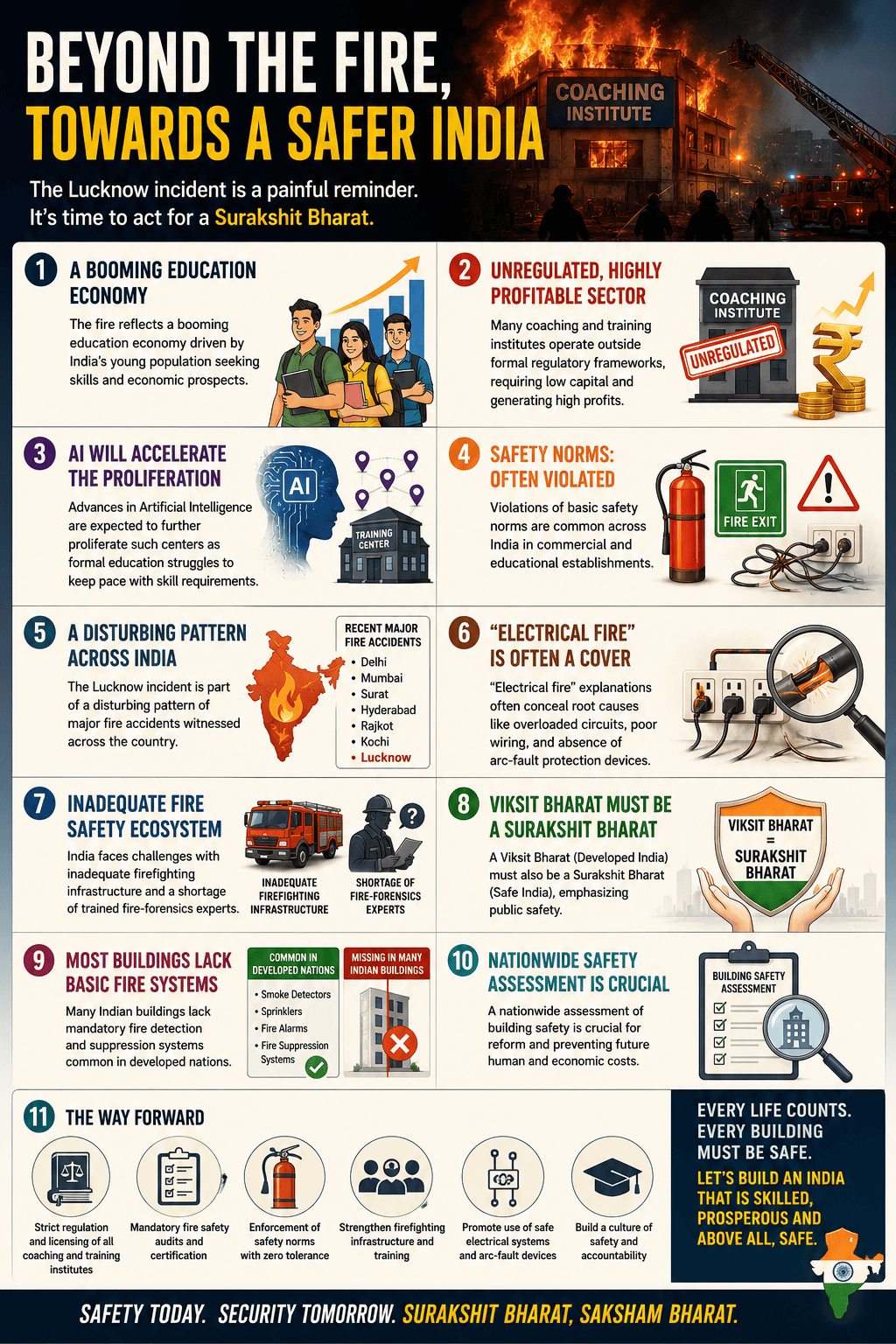
- The fire reflects a booming education economy driven by India's young population seeking skills and economic prospects.
- Many coaching and training institutes operate outside formal regulatory frameworks, requiring low capital and generating high profits.
- Advances in Artificial Intelligence are expected to further proliferate such centers as formal education struggles to keep pace with skill requirements.
- Violations of basic safety norms are common across India in commercial and educational establishments.
- The Lucknow incident is part of a disturbing pattern of major fire accidents witnessed across the country.
- "Electrical fire" explanations often conceal root causes like overloaded circuits, poor wiring, and absence of arc-fault protection devices.
- India faces challenges with inadequate firefighting infrastructure and a shortage of trained fire-forensics experts.
- A Viksit Bharat (Developed India) must also be a Surakshit Bharat (Safe India), emphasizing public safety.
- Many Indian buildings lack mandatory fire detection and suppression systems common in developed nations.
- A nationwide assessment of building safety is crucial for reform and preventing future human and economic costs.
Key Concepts Involved:
- Viksit Bharat: A vision for India to become a developed nation by 2047, encompassing economic growth and societal progress.
- Surakshit Bharat: A concept emphasizing the imperative of ensuring public safety and security across all sectors in India.
- Regulatory failures: The inability of government bodies to effectively implement, monitor, and enforce laws and standards.

SuperKalam is your personal mentor for UPSC preparation, guiding you at every step of the exam journey.
Download the App


STUDY RESOURCES
CONTACT US
ⓒ Snapstack Technologies Private Limited