GS 2: PolityGS 2: GovernanceGS 2: Social JusticePrelims
Clearing the road to timely trauma care in India, Pg8
Supreme Court mandates trauma care as Article 21 right, issues binding directions for integrated emergency response system across states.
Practice MCQs
760 Students attempted
Key Highlights:
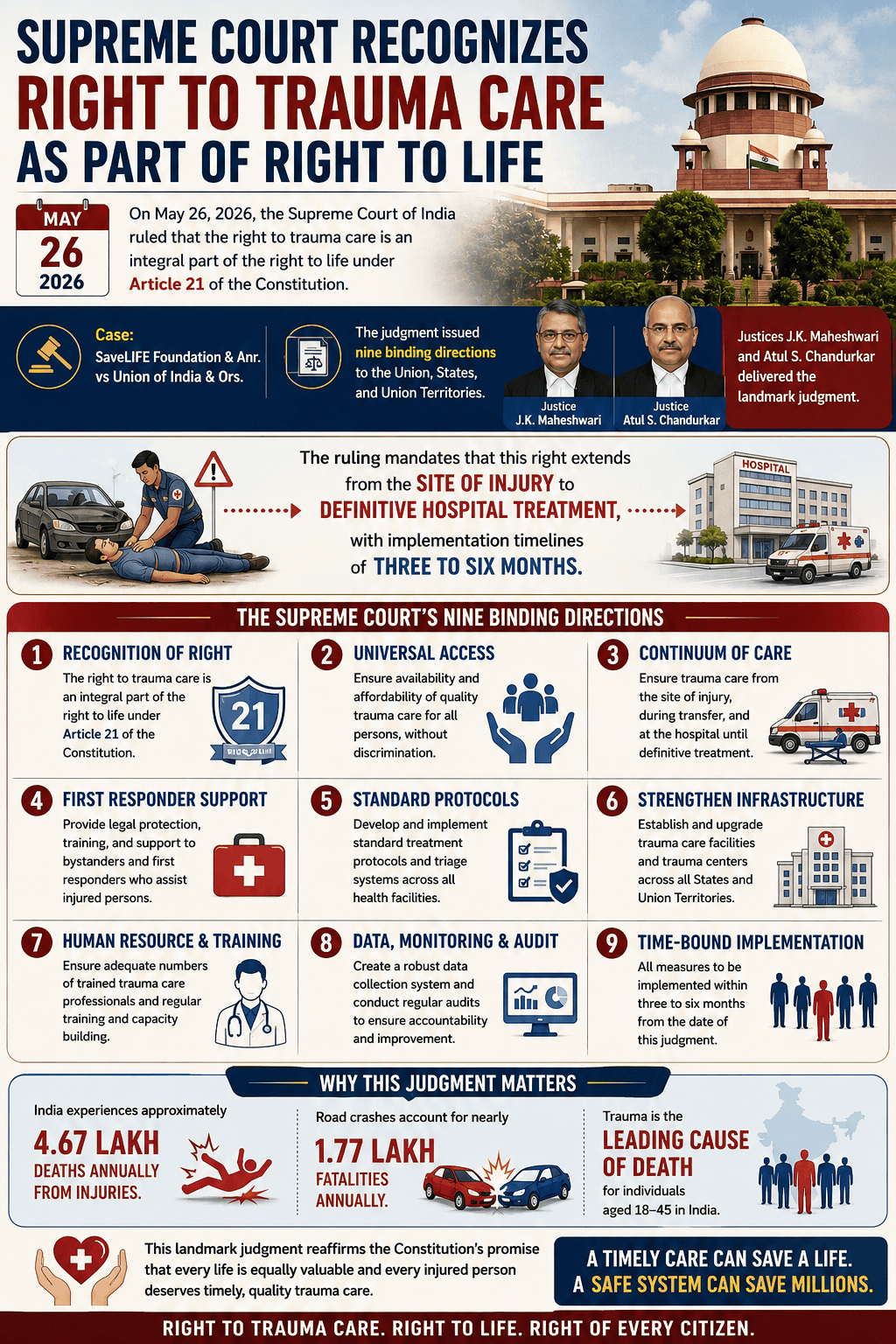
- On May 26, 2026, the Supreme Court of India ruled that the right to trauma care is an integral part of the right to life under Article 21 of the Constitution.
- The judgment, in the case of SaveLIFE Foundation & Anr. vs Union of India & Ors., issued nine binding directions to the Union, States, and Union Territories.
- The ruling mandates that this right extends from the site of injury to definitive hospital treatment, with implementation timelines of three to six months.
- Justices J.K. Maheshwari and Atul S. Chandurkar delivered the landmark judgment.
Trauma.png
Detailed Insights:
- India experiences approximately 4.67 lakh deaths annually from injuries, with road crashes accounting for nearly 1.77 lakh fatalities.
- Trauma is the leading cause of death for individuals aged 18-45 in India.
- The Law Commission (201st Report) estimated that timely care could prevent half of road-crash fatalities.
- The Court built on previous judgments like Parmanand Katara vs Union of India (1989) and Paschim Banga Khet Mazdoor Samiti vs State of West Bengal (1996).
- The ruling imposes a positive obligation on the state to build and sustain an integrated trauma response system.
- Public health, hospitals, and ambulance services fall under the State List, necessitating cooperative federalism for a uniform framework.
- The directions support existing frameworks such as PM RAHAT, National Ambulance Code AIS-125, ERSS-112, and the Good Samaritan Rules.
- Key directives include integrating all emergency numbers into helpline 112 and establishing grievance redressal for Good Samaritans.
- All registered ambulances must comply with the National Ambulance Code, have real-time GPS, and undergo audits.
- States must adopt the National Commission for Allied and Healthcare Professions (NCAHP)-notified EMT curriculum.
- Trauma facilities are to be graded and designated for transparency, and PM RAHAT must be operationalized within eight weeks.
- The Ministry of Health and Family Welfare is directed to notify a national medical rescue protocol and a Trauma Registry data format.
- The Attorney General of India will monitor implementation, with follow-up hearings scheduled.
Key Concepts Involved:
- Article 21: Guarantees the right to life and personal liberty, interpreted to include the right to health and emergency medical care.
- Cooperative Federalism: A system where central and state governments collaborate on policy implementation, especially in shared jurisdiction areas like public health.
- Good Samaritan Rules: Legal provisions protecting individuals who voluntarily assist others in distress from civil or criminal liability.
- PM RAHAT: A central government scheme for cashless treatment of road accident victims.
- National Ambulance Code AIS-125: Standards and specifications for ambulance design, equipment, and operation in India.
- Emergency Response Support System (ERSS)-112: India's single emergency helpline number for all types of emergencies.
- National Commission for Allied and Healthcare Professions (NCAHP): A statutory body regulating and standardizing education and services of allied and healthcare professionals.
- Motor Vehicles Act: Legislation governing motor vehicles in India, including provisions related to road safety and accident victim care.

SuperKalam is your personal mentor for UPSC preparation, guiding you at every step of the exam journey.
Download the App


STUDY RESOURCES
CONTACT US
ⓒ Snapstack Technologies Private Limited