GS 2: International RelationsGS 3: EconomyPrelims
PACOM, the deeper meaning behind a dropped prefix, Pg8
U.S. drops 'Indo' from PACOM, signaling major foreign policy shifts impacting Quad, West Asia, and South Asia, urging India to revise strategy.
Practice MCQs
760 Students attempted
Key Highlights:
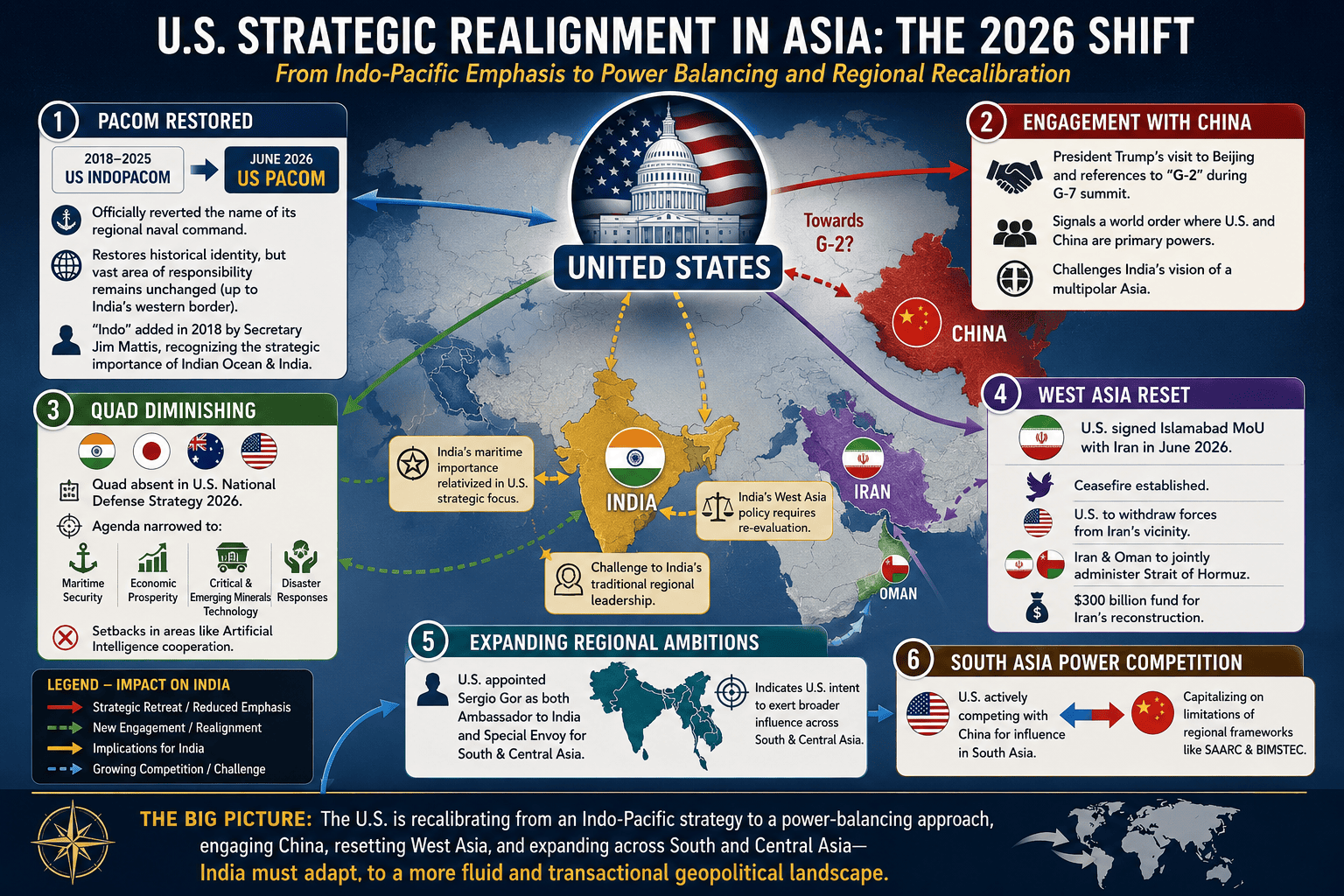
- The United States military officially reverted the name of its regional naval command from US INDOPACOM to US PACOM in June 2026, reversing a 2018 decision.
- U.S. Secretary of War Pete Hegseth's speech at the Shangri-La Dialogue in May 2026 notably omitted any references to the "Indo-Pacific" strategy, signaling a shift in U.S. policy.
- U.S. President Donald Trump's recent engagement with China, including a visit to Beijing and references to a "G-2," indicates a potential move towards defining global spheres of influence.
- The Quad (India, Japan, Australia, U.S.) appears to be diminishing in strategic importance, as evidenced by its absence from the U.S. National Defense Strategy 2026.
- The U.S. signed the Islamabad MoU with Iran in June 2026, establishing a ceasefire and reshaping power dynamics in West Asia.
- The U.S. appointed Sergio Gor as both Ambassador to India and Special Envoy for South and Central Asia, indicating Washington's expanding regional ambitions.
US Relaignment.png
Detailed Insights:
- The name change to US PACOM restores the command's historical identity, though its vast area of responsibility, extending to India's western border, remains unchanged.
- The original inclusion of "Indo" in 2018 by then-Defense Secretary Jim Mattis was a recognition of the growing strategic importance of the Indian Ocean and India.
- President Trump's "G-2" concept, mentioned during the G-7 summit, suggests a world order where the U.S. and China are the primary powers, potentially challenging India's vision of a multipolar Asia.
- The Quad's current agenda is narrowed to maritime security, economic prosperity, critical and emerging minerals technology, and disaster responses, with setbacks in areas like Artificial Intelligence cooperation.
- The Islamabad MoU includes provisions for the U.S. to withdraw forces from Iran's vicinity, for Iran and Oman to jointly administer the Strait of Hormuz, and a $300 billion fund for Iran's reconstruction.
- This U.S.-Iran agreement necessitates a re-evaluation of India's West Asia policy, which has historically maintained a delicate balance but now appears to lean towards Israel and the UAE.
- The dual appointment of Sergio Gor signifies a U.S. attempt to exert broader influence across South and Central Asia, potentially challenging India's traditional regional leadership.
- The U.S. is actively competing with China for influence in South Asia, capitalizing on the limitations of existing regional frameworks like SAARC and BIMSTEC.
Key Concepts Involved:
- US PACOM: The United States Pacific Command, a unified combatant command responsible for U.S. military operations across the Pacific Ocean and parts of the Indian Ocean.
- Quad: The Quadrilateral Security Dialogue, an informal strategic forum between Australia, India, Japan, and the United States.
- Shangri-La Dialogue: An annual inter-governmental security summit held in Singapore, bringing together defense officials from the Asia-Pacific region.
- Islamabad MoU: A memorandum of understanding signed between the United States and Iran in June 2026, outlining terms for a ceasefire and future engagement.
- G-2: A hypothetical informal grouping of the United States and China, suggesting a shared responsibility or dominance in global affairs.

SuperKalam is your personal mentor for UPSC preparation, guiding you at every step of the exam journey.
Download the App


STUDY RESOURCES
CONTACT US
ⓒ Snapstack Technologies Private Limited