GS 3: Environment & EcologyGS 2: GovernancePrelims
Govt prepares to notify Western Ghats eco sensitive areas in at least three states, Pg1
Centre prepares to notify Western Ghats Ecologically Sensitive Areas in three states, resolving 12-year deadlock over Kasturirangan committee recommendations.
Practice MCQs
739 Students attempted
Key Highlights:
- The Centre is preparing to finalize and notify Ecologically Sensitive Areas (ESA) in the Western Ghats region for at least three states.
- This decision comes 12 years after the first draft notification and after five revisions since the original 2014 draft.
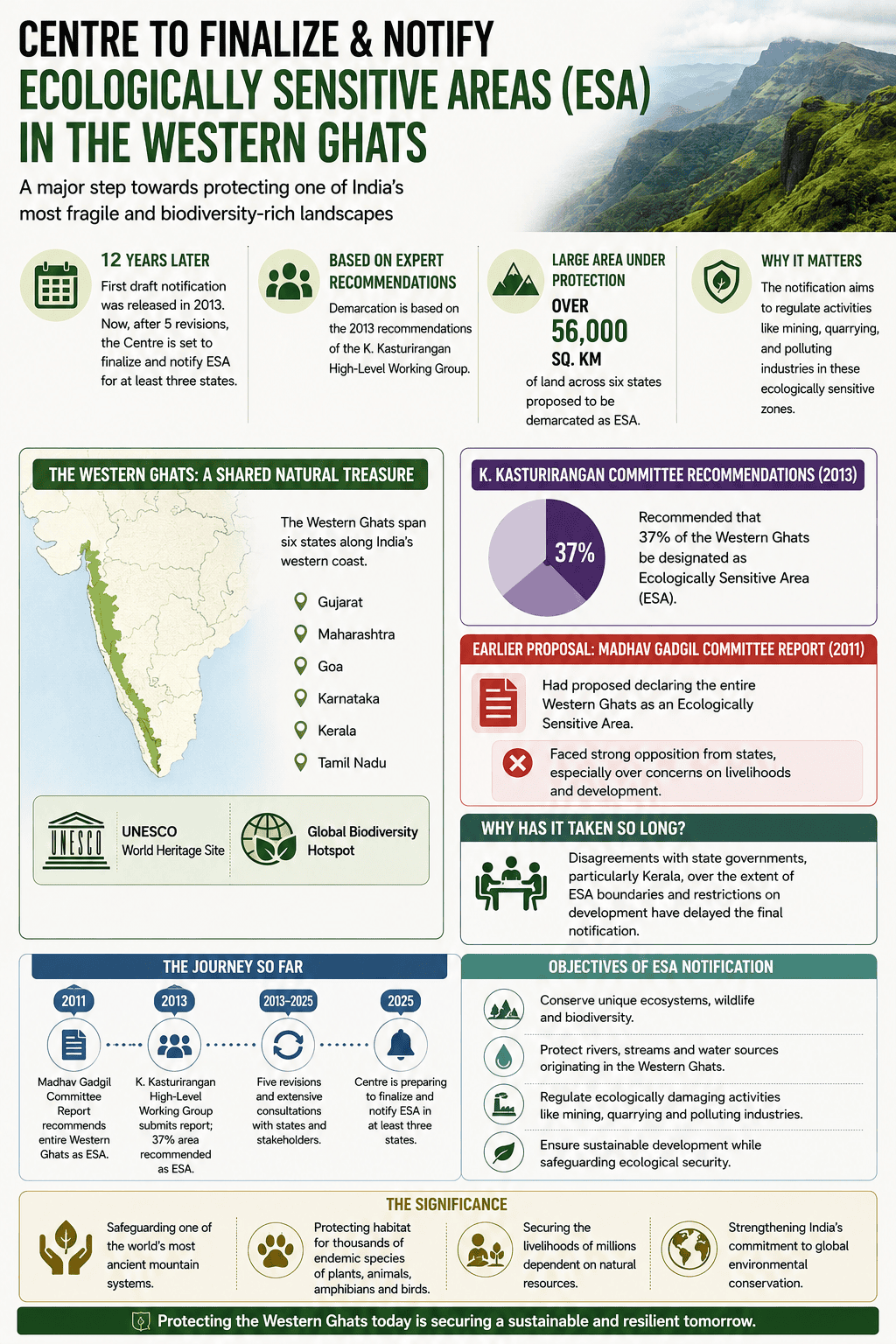
- The demarcation is based on the 2013 recommendations of the K. Kasturirangan High-Level Working Group.
- Over 56,000 square kilometers of land across six states are proposed to be demarcated as ESA.
Western Ghats.png
Detailed Insights:
- The Western Ghats span six states: Gujarat, Maharashtra, Goa, Karnataka, Kerala, and Tamil Nadu.
- Disagreements with state governments, particularly Kerala, have delayed the final notification of ESA boundaries.
- The Kasturirangan Committee Report recommended that 37% of the Western Ghats be designated as ESA.
- The notification aims to regulate activities like mining, quarrying, and polluting industries in these sensitive zones.
- The Western Ghats are recognized as a UNESCO World Heritage Site and a global biodiversity hotspot.
- The earlier Madhav Gadgil Committee Report (2011) had proposed declaring the entire Western Ghats as an Ecologically Sensitive Area, which faced strong opposition.
Key Concepts Involved:
- Ecologically Sensitive Areas (ESA): Regions notified under the Environment (Protection) Act, 1986, to regulate activities near protected areas and minimize adverse impacts.
- Western Ghats: A mountain range along India's western coast, renowned for its high biodiversity and endemic species.
- K. Kasturirangan High-Level Working Group: A committee that recommended 37% of the Western Ghats be declared as Ecologically Sensitive Area.
- Environment (Protection) Act, 1986: A central legislation providing for the protection and improvement of the environment in India.

SuperKalam is your personal mentor for UPSC preparation, guiding you at every step of the exam journey.
Download the App


STUDY RESOURCES
CONTACT US
ⓒ Snapstack Technologies Private Limited