GS 1: Physical GeographyGS 3: Science & TechnologyPrelims
New seismic hazard spotted in Japan’s 2011 quake, Pg12
Scientists identify new seismic hazard from Japan's 2011 quake, revealing ScS waves caused 6mm ground shift by bouncing off Earth's core.
Practice MCQs
731 Students attempted
Key Highlights:
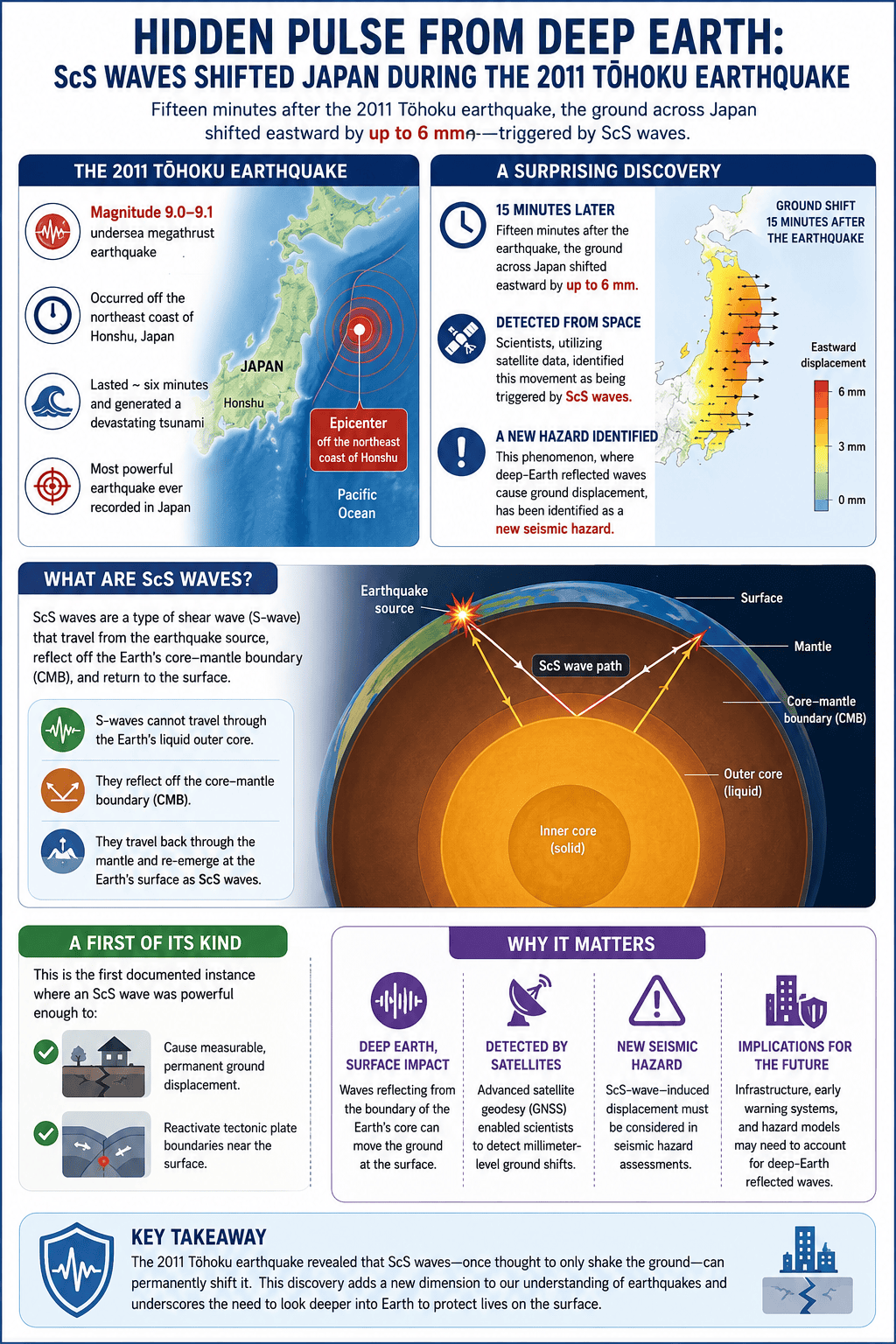
- Fifteen minutes after the 2011 Tōhoku earthquake, the ground across Japan shifted eastward by up to 6 mm.
- Scientists, utilizing satellite data, identified this movement as being triggered by ScS waves.
- ScS waves are seismic waves that travel from the earthquake source, reflect off the Earth's core-mantle boundary, and return to the surface.
- This phenomenon, where deep-Earth reflected waves cause ground displacement, has been identified as a new seismic hazard.
Earthquake.png
Detailed Insights:
- The 2011 Tōhoku earthquake, also known as the Great East Japan Earthquake, was a magnitude 9.0-9.1 undersea megathrust earthquake, the most powerful ever recorded in Japan.
- The earthquake occurred off the northeast coast of Honshu, Japan, lasting approximately six minutes and generating a devastating tsunami.
- ScS waves are a type of shear wave (S-wave) that cannot propagate through the Earth's liquid outer core, causing them to reflect off the core-mantle boundary (CMB).
- This is the first documented instance where an ScS wave was powerful enough to cause measurable, permanent ground displacement and reactivate tectonic plate boundaries near the surface.
- The strong main shock of the Tōhoku earthquake destabilized the tectonic plate boundaries, making them susceptible to the additional stimulus from the returning ScS waves.
- Japan is situated at the complex junction of four major tectonic plates: the Pacific, Philippine Sea, North American (or Okhotsk), and Eurasian (or Amurian) plates, contributing to its high seismic activity.
Scientific/Technical Concepts Involved:
- ScS waves: Shear waves that travel through the Earth's mantle, reflect off the core-mantle boundary, and return to the surface.
- Seismic Hazard: The probability of an earthquake occurring in a specific area within a given timeframe, with ground motion exceeding a certain intensity.
- Tectonic Plates: Large, rigid segments of Earth's lithosphere that move and interact, causing earthquakes, volcanic activity, and mountain formation.
- Core-Mantle Boundary (CMB): The interface between Earth's liquid outer core and its solid mantle, located at approximately 2,890 kilometers depth.

SuperKalam is your personal mentor for UPSC preparation, guiding you at every step of the exam journey.
Download the App


STUDY RESOURCES
CONTACT US
ⓒ Snapstack Technologies Private Limited