GS 3: Environment & EcologyGS 3: Disaster ManagementPrelims
IIT-Delhi study finds human activity drives India’s ‘wild’ weather, Pg12
IIT-Delhi study reveals human activity, not natural variation, drives India's extreme rainfall and floods, warning of future surge as air pollution drops.
Practice MCQs
731 Students attempted
Key Highlights:
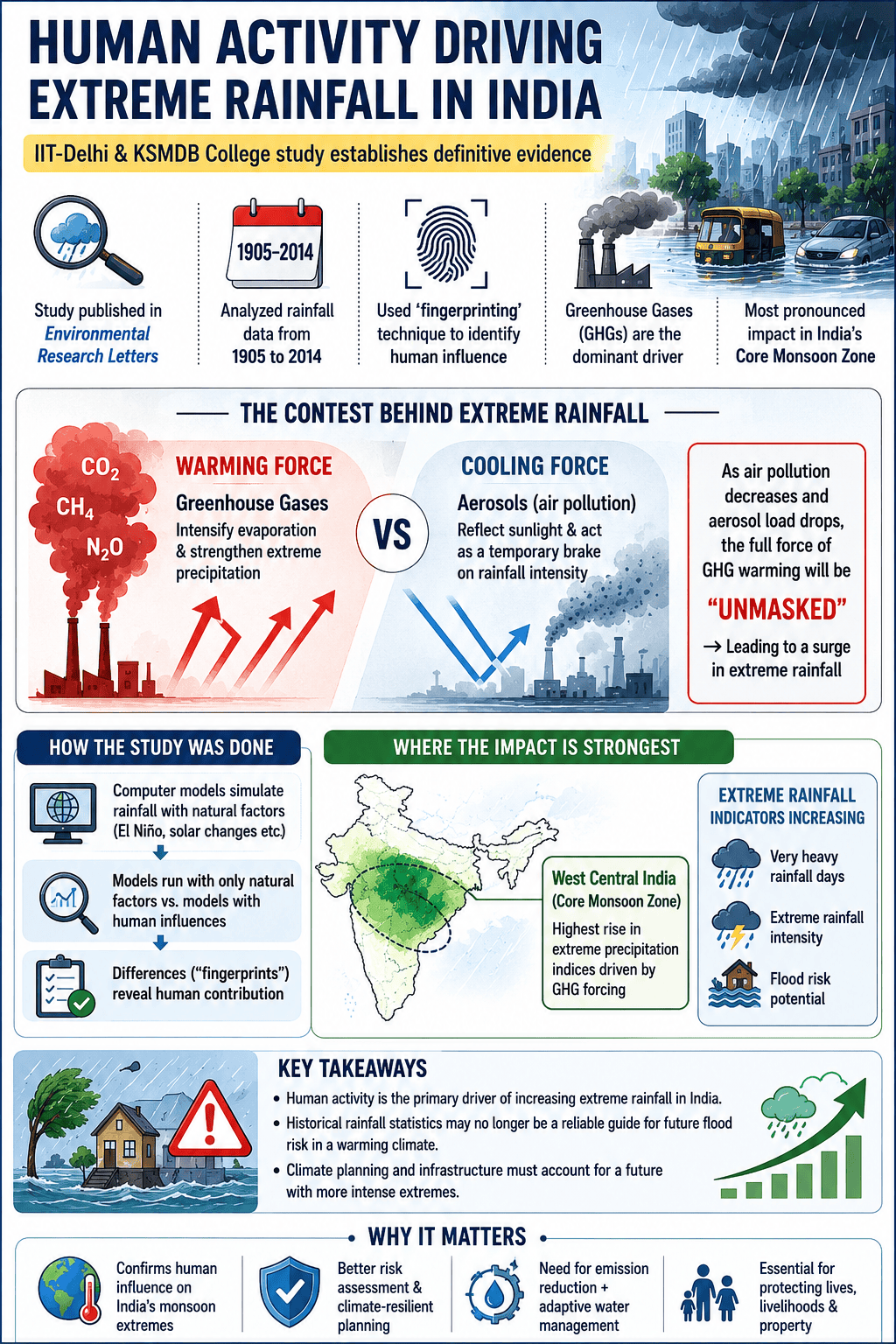
- A study by IIT-Delhi and KSMDB College found definitive evidence that human activity is the primary driver of increasing extreme rainfall events in India.
- Published in Environmental Research Letters, the research analyzed rainfall data from 1905 to 2014 using a "fingerprinting" technique.
- The study identified Greenhouse Gases as the dominant factor intensifying extreme precipitation, particularly in India's Core Monsoon Zone.
- It highlighted a "contest" between warming Greenhouse Gases and cooling Aerosols, with the latter temporarily suppressing the full impact of warming.
- Researchers warn that as air pollution decreases and the aerosol load drops, the full force of Greenhouse Gas warming will be "unmasked," potentially leading to a surge in extreme rainfall.
Human activity.png
Detailed Insights:
- The research utilized computer models to differentiate natural weather cycles, such as El Niño, from changes specifically caused by human activities.
- The Core Monsoon Zone in West Central India showed the most visible impact of increased extreme precipitation indices driven by Greenhouse Gas forcing.
- The findings suggest that historical rainfall statistics alone may no longer be a reliable guide for assessing future flood risks in a warming climate.
- Policymakers are urged to consider these findings for long-term planning, including investments in climate-resilient infrastructure and sustainable development practices.
- Previous studies have also indicated that Aerosols have historically influenced South Asian monsoon precipitation, sometimes even more strongly than Greenhouse Gases.
Key Concepts Involved:
- Greenhouse Gases: Atmospheric gases that trap heat, contributing to global warming and climate change.
- Aerosols: Tiny solid or liquid particles suspended in the atmosphere, which can scatter sunlight and influence cloud formation and precipitation.
- Fingerprinting: A scientific technique used in climate change attribution to identify the unique "signature" of human influence on climate patterns.
- El Niño: A natural climate pattern characterized by the warming of ocean surface temperatures in the central and eastern tropical Pacific Ocean, often impacting global weather.
- Core Monsoon Zone: A geographical region in central India crucial for the Indian monsoon, where rainfall variations significantly influence the country's overall monsoon performance and agriculture.

SuperKalam is your personal mentor for UPSC preparation, guiding you at every step of the exam journey.
Download the App


STUDY RESOURCES
CONTACT US
ⓒ Snapstack Technologies Private Limited