GS 1: Physical GeographyGS 1: Indian GeographyGS 3: Environment & EcologyGS 3: Disaster ManagementPrelims
What a ‘super’ El Niño might mean for India’s monsoon, Pg12
NOAA confirms 'super' El Niño likely, threatening India's monsoon amidst 35% June rainfall deficit, raising drought concerns for food and fiscal planning.
Practice MCQs
731 Students attempted
Key Highlights:
- The U.S. National Oceanic and Atmospheric Administration (NOAA) confirmed the formation of El Niño in the equatorial Pacific Ocean.
- There is a 63% probability that this El Niño will strengthen into a "very strong" or "super" event by the northern winter.
- India's June rainfall, as of the 16th, was approximately 35% below normal.
- Historically, "super" El Niño events have been rare, with only a handful crossing the 2°C sea-surface temperature threshold.
el nino.png
Detailed Insights:
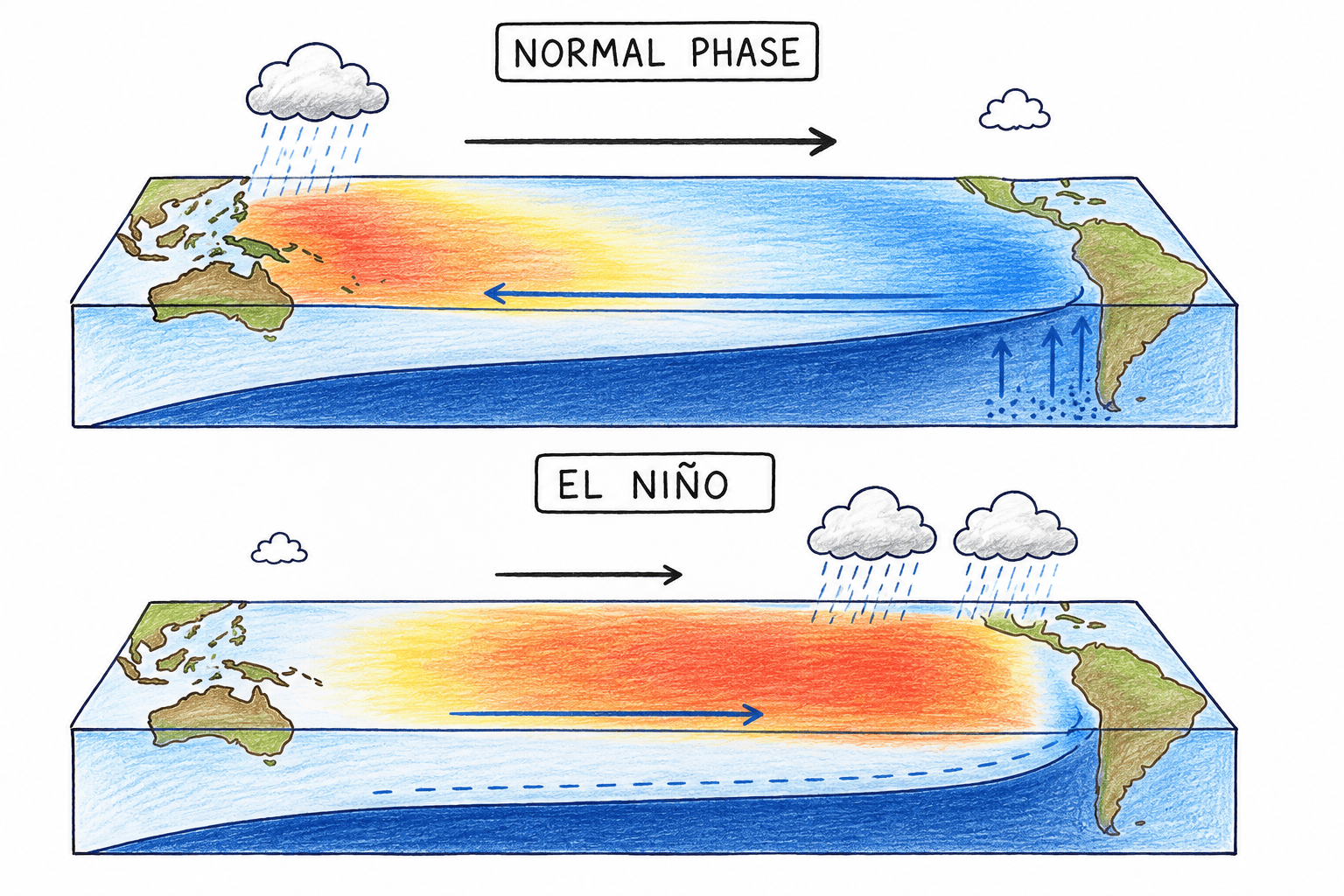
- El Niño is characterized by the periodic warming of the central and eastern equatorial Pacific Ocean, which typically weakens the South Asian monsoon.
- The strength of an El Niño is categorized by the departure of sea-surface temperatures from their long-term average: 0.5-1°C (weak), 1-1.5°C (moderate), 1.5-2°C (strong), and above 2°C (very strong).
- The warming is caused by the weakening of trade winds, creating a feedback loop that amplifies the anomaly.
- Climate change, leading to a warmer baseline ocean, is noted to intensify recent El Niño events.
- El Niño typically starts in spring, peaks in winter, and weakens by the next spring, affecting the middle and later parts of the June-September monsoon season.
- Past "super" El Niño events, such as 1982-83, 1997-98, and 2015-16, caused severe droughts, coral bleaching, and record global temperatures.
- The 1997-98 El Niño paradoxically brought above-normal rains to India due to a strong positive Indian Ocean Dipole (IOD).
- The India Meteorological Department (IMD) indicates that the Indian Ocean Dipole may not be strong enough this year to counteract the El Niño's drying effect.
- Approximately 15 out of two dozen El Niño years since 1950 have resulted in below-normal monsoons for India, with about 10 leading to outright deficiency (below 90% of the Long-Period Average).
- El Niño also redistributes tropical cyclones, generally suppressing Atlantic hurricane activity while making conditions more favorable for hurricanes in the central and eastern Pacific.
Key Concepts Involved:
- El Niño: A climate pattern describing the unusual warming of surface waters in the eastern equatorial Pacific Ocean.
- Indian Ocean Dipole (IOD): An irregular oscillation of sea surface temperatures in the Indian Ocean, influencing regional climate.
- Monsoon: A seasonal prevailing wind in the region of South and Southeast Asia, blowing from the southwest in summer and from the northeast in winter.
- Trade Winds: Prevailing easterly winds that blow in the Earth's equatorial region, crucial for ocean currents and weather patterns.

SuperKalam is your personal mentor for UPSC preparation, guiding you at every step of the exam journey.
Download the App


STUDY RESOURCES
CONTACT US
ⓒ Snapstack Technologies Private Limited