GS 3: EconomyGS 2: GovernanceGS 2: International RelationsPrelims
Indian industry is at a crossroads. It needs to look at longer horizons, Pg11
Indian industry's chronic R&D underinvestment, driven by volatility and family business dynamics, threatens future global competitiveness and strategic influence.
Practice MCQs
855 Students attempted
Key Highlights:
- Indian industry faces chronic underinvestment in Research and Development (R&D), crucial for its global competitiveness.
- The last 15 years of global volatility, including the 2008 financial crisis and Russia-Ukraine war, have deterred long-term R&D commitments.
- Family-owned businesses in India often prioritize wealth preservation over risky, capital-intensive R&D, especially in later generations.
- The allure of high returns from financial markets has diverted entrepreneurial energy away from manufacturing and R&D.
- India's ambition for global influence in a multipolar world depends on its private sector's technological and productive capabilities.
- The article emphasizes that strategic survival for Indian industry now hinges on shifting from short-term to long-term thinking.
R&D.png
Detailed Insights:
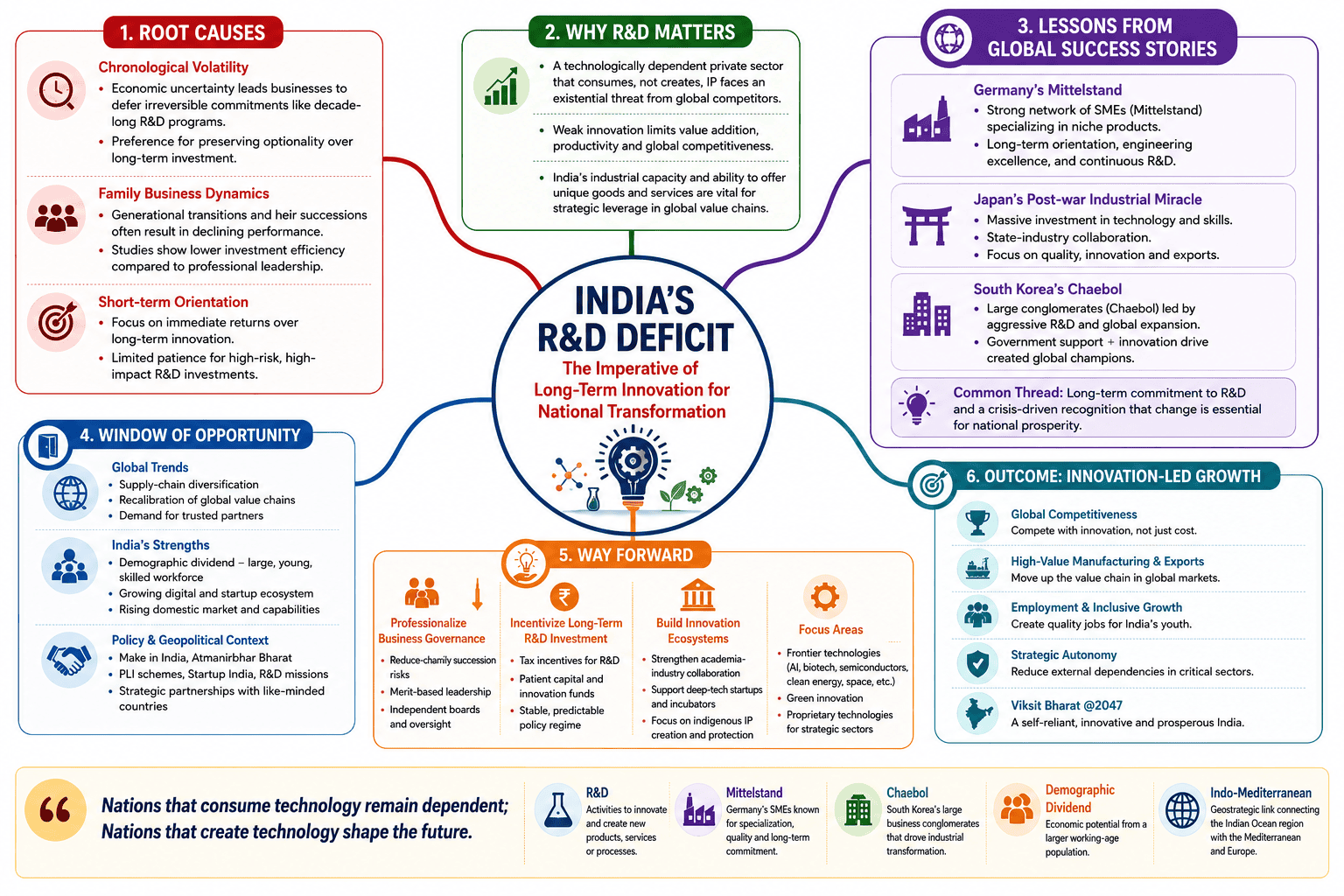
- The article identifies chronological volatility and the generational dynamics of family businesses as key reasons for India's R&D deficit.
- Economic uncertainty makes businesses defer irreversible commitments like decade-long R&D programs, preferring to preserve optionality.
- Studies indicate that family heir successions often lead to declining performance and investment efficiency compared to professional leadership.
- A technologically dependent private sector that consumes rather than generates intellectual property faces an existential threat from global competitors.
- India's industrial capacity and ability to offer unique goods and services are vital for its strategic leverage in global value chains.
- Historical examples like Germany's Mittelstand, Japan's post-war industrial miracle, and South Korea's Chaebol demonstrate successful long-term R&D investment.
- These transformations were often driven by a recognition, frequently born of crisis, that existing trajectories were insufficient for national prosperity.
- The current global landscape, including supply-chain diversification and India's demographic dividend, presents a unique window for transformation.
Key Concepts Involved:
- Research and Development (R&D): Activities undertaken by companies to innovate and introduce new products, services, or processes.
- Mittelstand: A term for small and medium-sized enterprises in Germany, often family-owned, known for specialized products and engineering.
- Chaebol: Large, family-controlled business conglomerates in South Korea, instrumental in the nation's economic development.
- Demographic Dividend: The economic growth potential that can result from shifts in a population's age structure, mainly when the share of the working-age population is larger than the non-working-age share.

SuperKalam is your personal mentor for UPSC preparation, guiding you at every step of the exam journey.
Download the App


STUDY RESOURCES
CONTACT US
ⓒ Snapstack Technologies Private Limited