GS 2: International RelationsGS 3: Science & TechnologyPrelims
How trust underpins India's ties with France, Pg12
PM Modi's 7th France visit solidifies 'Special Global Strategic Partnership,' boosting tech, defence, and nuclear ties, while addressing global challenges at G7 summit.
Practice MCQs
855 Students attempted
Key Highlights:
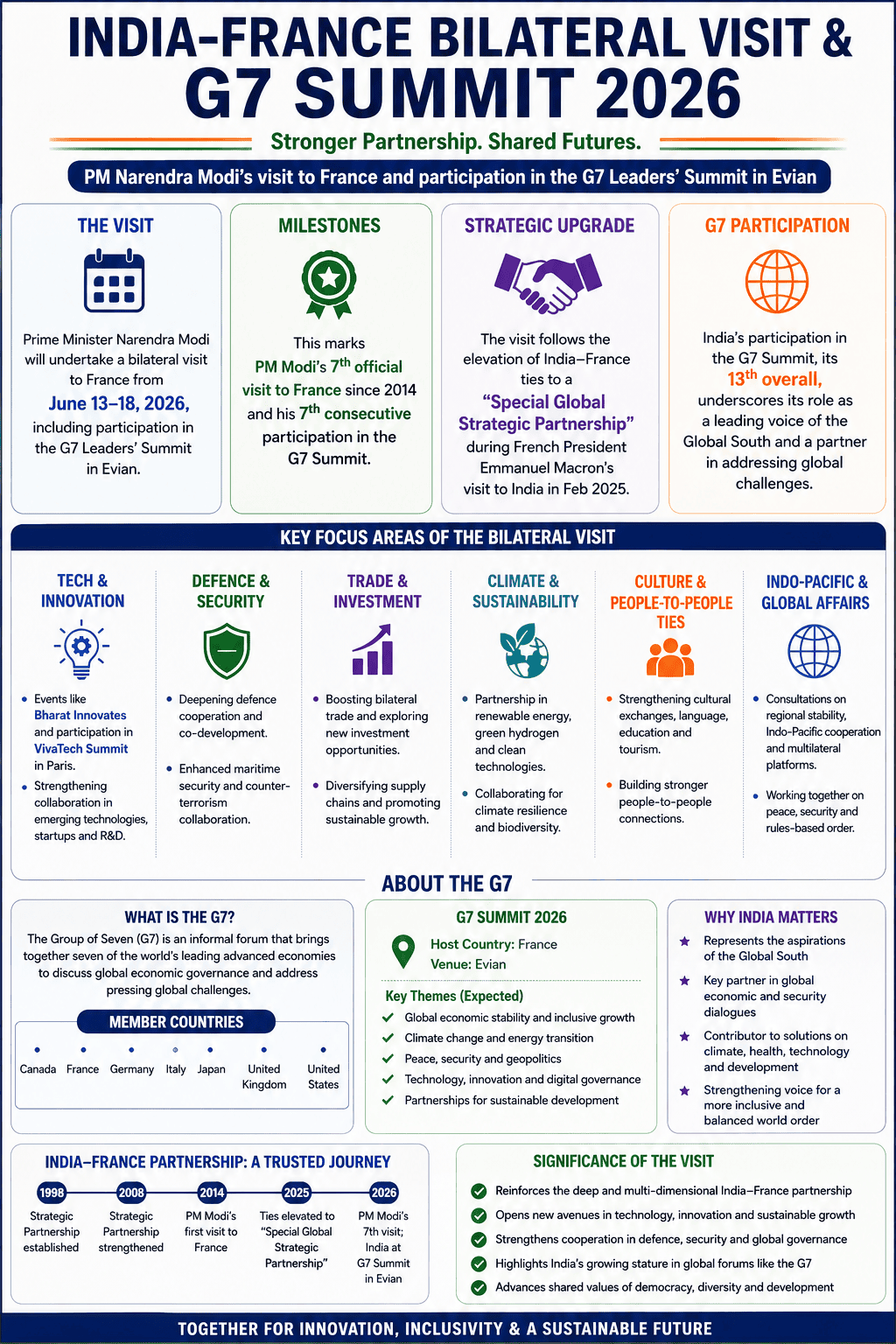
- Prime Minister Narendra Modi is undertaking a bilateral visit to France from June 13-18, 2026, including participation in the G7 Leaders’ Summit in Evian.
- This marks PM Modi's seventh official visit to France since 2014 and his seventh consecutive participation in the G7 Summit.
- The visit follows the elevation of India-France ties to a "Special Global Strategic Partnership" during French President Emmanuel Macron's visit to India in February 2025.
- Key focus areas of the bilateral visit include tech and innovation, with events like Bharat Innovates and the VivaTech Summit in Paris.
- India's participation in the G7 Summit, its 13th overall, underscores its role as a leading voice of the Global South and a partner in addressing global challenges.
India-France.png
Detailed Insights:
- India and France share a long-standing relationship built on strategic autonomy and mutual respect, making France a preferred European partner.
- The "strategic trust" between the two nations has been a cornerstone, exemplified by France's support during India's Pokhran-II nuclear tests in May 1998.
- Historical instances, such as former French President Jacques Chirac's visits for Republic Day in 1976 and 1998, highlight the enduring diplomatic ties.
- The partnership spans critical sectors including defence (Rafale, Scorpene, Shakti engines), space (ISRO-CNES collaboration, Gaganyaan), and nuclear energy (SHANTI Act, SMRs/AMRs).
- The upcoming visit aims to deepen cooperation in high-level technology and innovation, reflecting a shared confidence between the governments and leaders.
- India's consistent invitation to the G7 Summit, first in 2003 under PM Atal Bihari Vajpayee, demonstrates France's recognition of India's global standing.
- The visit also provides an opportunity for India to convey concerns regarding the West Asia conflict's impact on its security and economic interests.
Key Concepts Involved:
- Strategic Autonomy: A nation's ability to make independent foreign policy and security decisions without external influence.
- Special Global Strategic Partnership: An elevated level of bilateral relations signifying deep cooperation across various strategic domains.
- Global South: A term referring to countries in Asia, Africa, and Latin America, often characterized by developing economies.
- Small Modular Reactors (SMRs): Advanced nuclear reactors that are smaller, simpler, and potentially more flexible than traditional large-scale reactors.

SuperKalam is your personal mentor for UPSC preparation, guiding you at every step of the exam journey.
Download the App


STUDY RESOURCES
CONTACT US
ⓒ Snapstack Technologies Private Limited