GS 2: International RelationsGS 3: EconomyPrelims
India at G7: From guest to strategic partner, Pg11
India elevates G7 engagement, transforming from guest to strategic partner, championing the Indo-Mediterranean vision and Global South leadership.
Practice MCQs
855 Students attempted
Key Highlights:
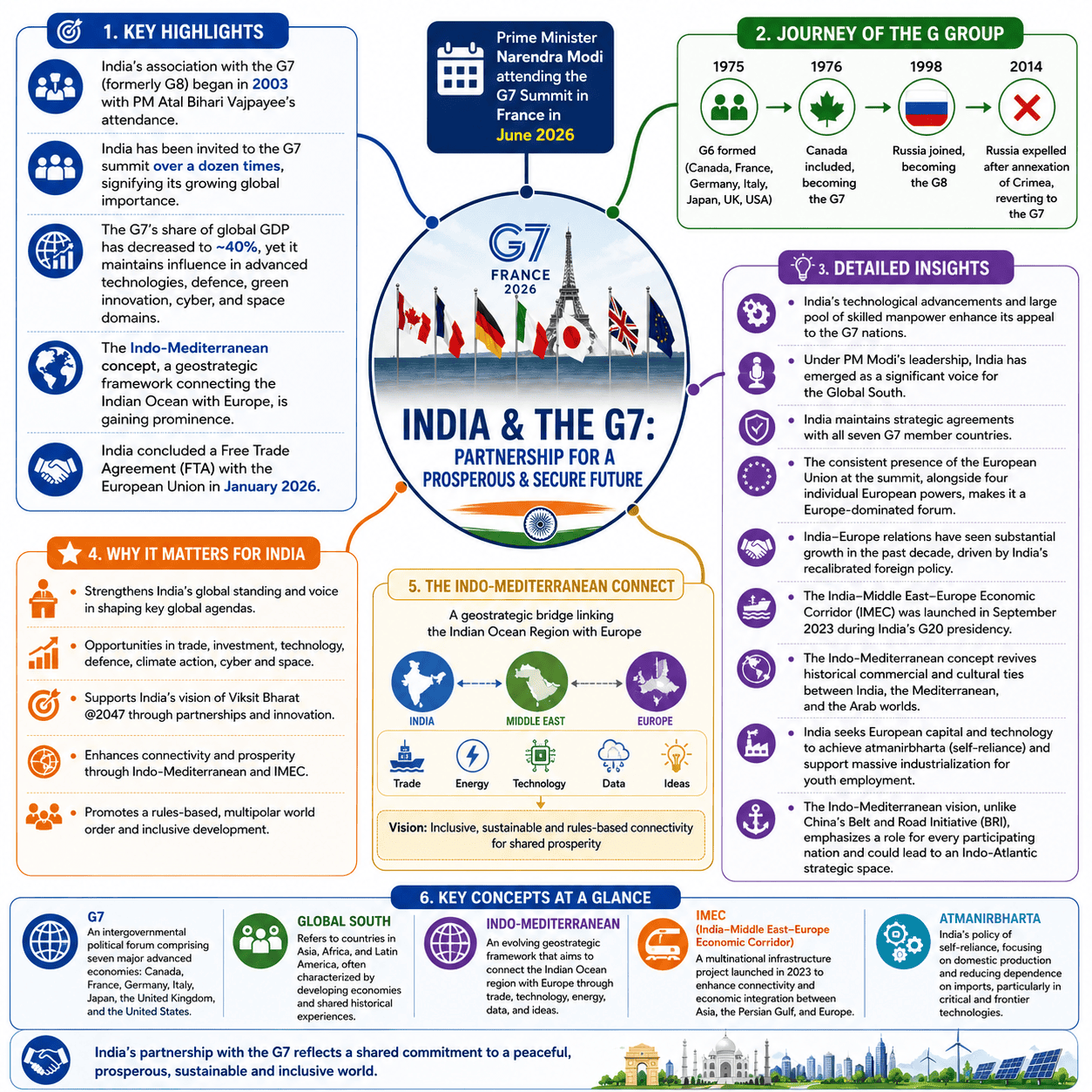
- Prime Minister Narendra Modi is attending the G7 summit in France in June 2026.
- India's association with the G7 (formerly G8) began in 2003 with PM Atal Bihari Vajpayee's attendance.
- India has been invited to the G7 summit over a dozen times, signifying its growing global importance.
- The G7's share of global GDP has decreased to approximately 40%, yet it maintains influence in advanced technologies, defence, green innovation, cyber, and space domains.
- The Indo-Mediterranean concept, a geostrategic framework connecting the Indian Ocean with Europe, is gaining prominence.
- India concluded a Free Trade Agreement (FTA) with the European Union in January 2026.
G7.png
Detailed Insights:
- The G6 was formed in 1975, becoming the G7 in 1976 with Canada's inclusion, and the G8 in 1998 when Russia joined.
- Russia was expelled in 2014 following the annexation of Crimea, reverting the group to the G7.
- India's technological advancements and large pool of skilled manpower enhance its appeal to the G7 nations.
- Under PM Modi's leadership, India has emerged as a significant voice for the Global South.
- India maintains strategic agreements with all seven G7 member countries.
- The consistent presence of the European Union at the summit, alongside four individual European powers, makes it a Europe-dominated forum.
- India-Europe relations have seen substantial growth in the past decade, driven by India's recalibrated foreign policy.
- The India-Middle East-Europe Economic Corridor (IMEC) was launched in September 2023 during India's G20 presidency.
- The Indo-Mediterranean concept revives historical commercial and cultural ties between India, the Mediterranean, and the Arab worlds.
- India seeks European capital and technology to achieve atmanirbharta (self-reliance) and support massive industrialization for youth employment.
- The Indo-Mediterranean vision, unlike China's Belt and Road Initiative (BRI), emphasizes a role for every participating nation and could lead to an Indo-Atlantic strategic space.
Key Concepts Involved:
- G7: An intergovernmental political forum comprising seven major advanced economies: Canada, France, Germany, Italy, Japan, the United Kingdom, and the United States.
- Global South: A term referring to countries in Asia, Africa, and Latin America, often characterized by developing economies and shared historical experiences.
- Indo-Mediterranean: An evolving geostrategic framework that aims to connect the Indian Ocean region with Europe through trade, technology, energy, data, and ideas.
- IMEC (India-Middle East-Europe Economic Corridor): A multinational infrastructure project launched in 2023 to enhance connectivity and economic integration between Asia, the Persian Gulf, and Europe.
- Atmanirbharta: India's policy of self-reliance, focusing on domestic production and reducing dependence on imports, particularly in critical and frontier technologies.

SuperKalam is your personal mentor for UPSC preparation, guiding you at every step of the exam journey.
Download the App


STUDY RESOURCES
CONTACT US
ⓒ Snapstack Technologies Private Limited