GS 3: EconomyGS 2: International RelationsPrelims
The Oman CEPA, a new gateway for India’s exports, Pg8
India-Oman CEPA, effective June 1, 2026, grants 99.38% duty-free access for Indian exports, boosting trade and strategic ties.
Practice MCQs
826 Students attempted
Key Highlights:
- India and Oman signed a Comprehensive Economic Partnership Agreement (CEPA), which officially came into force on June 1, 2026.
- Oman has granted duty-free access on 98.08% of its tariff lines, covering 99.38% of India’s exports by value.
- Bilateral trade between the two nations grew from $8.94 billion in FY2023-24 to $11.18 billion in FY2025-26.
- The agreement aims to significantly deepen trade, investment, and economic cooperation, building on their historic relationship.
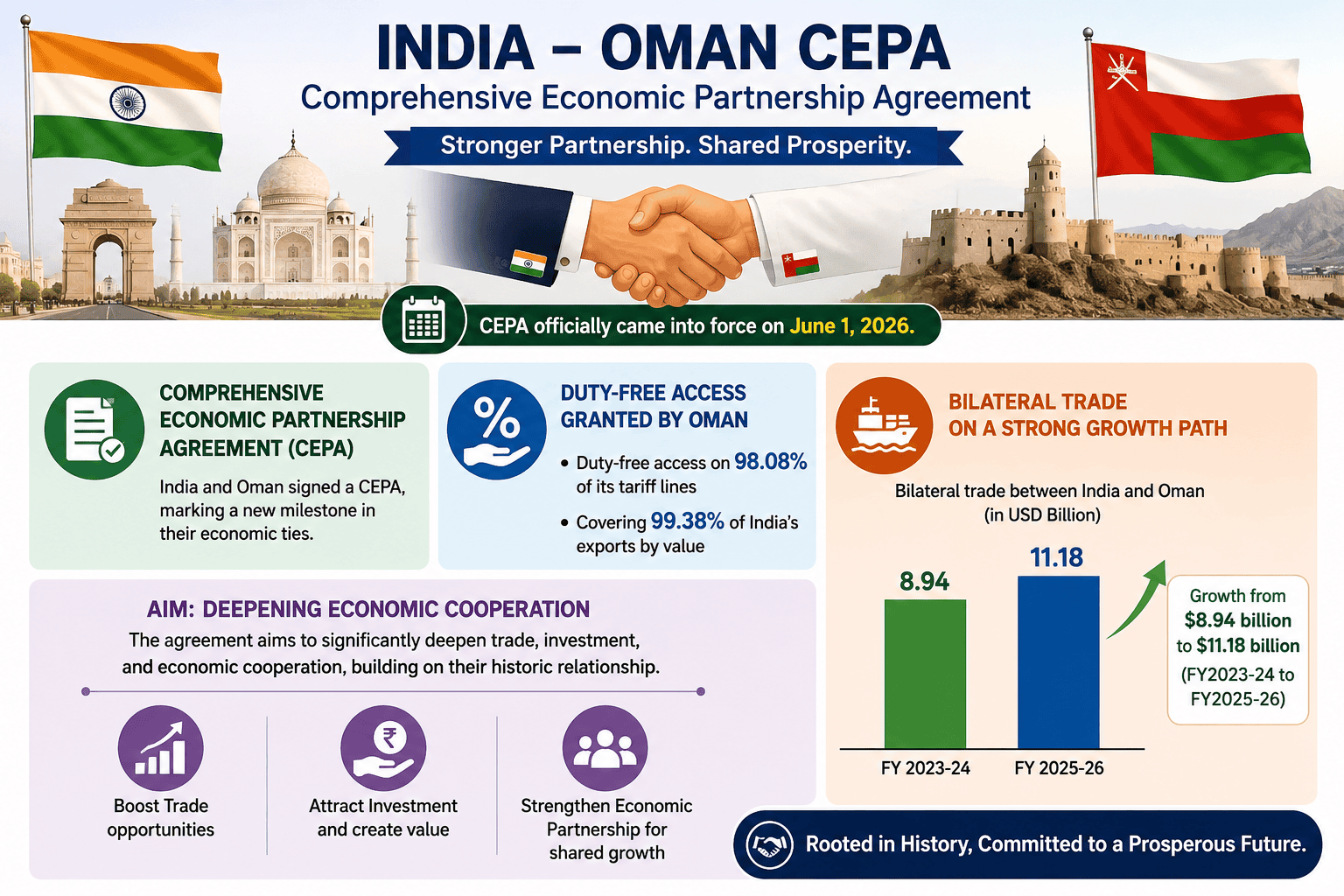
India-Oman CEPA.png
Detailed Insights:
- The CEPA provides a substantial boost to India's export competitiveness, as only 15.33% of India's exports previously entered Oman at zero duty under the Most Favoured Nation (MFN) regime.
- Key Indian sectors such as textiles and apparel, chemicals, engineering goods, pharmaceuticals, and processed foods are expected to benefit from enhanced market access and regulatory facilitation.
- The agreement includes significant trade facilitation measures, such as Oman accepting certificates from India’s Export Inspection Council (EIC) and recognizing India’s National Programme for Organic Production (NPOP) and halal certification systems.
- It incorporates dedicated provisions for Sanitary and Phytosanitary (SPS) measures and Technical Barriers to Trade (TBT), enhancing regulatory transparency and cooperation.
- The CEPA also focuses on services trade and professional mobility, with Oman undertaking commitments in sectors like accounting, engineering, IT, healthcare, education, and consulting, and increasing quotas for intra-corporate transferees.
- Strategically, Oman's key ports at Sohar, Duqm, and Salalah are positioned to serve as a gateway for Indian businesses to the wider Gulf Cooperation Council (GCC) region and East African economies.
- This agreement reflects India's evolving trade policy, moving towards comprehensive economic partnerships that encompass goods, services, investment, and regulatory cooperation.
Key Concepts Involved:
- Comprehensive Economic Partnership Agreement (CEPA): A broad free trade agreement covering trade in goods, services, investment, and other areas of economic cooperation.
- Most Favoured Nation (MFN): A principle under WTO where a country treats all its trading partners equally, offering the same low tariffs to all.
- Sanitary and Phytosanitary (SPS) Measures: Regulations to protect human, animal, or plant life or health from risks arising from food additives, contaminants, toxins, or disease-carrying organisms.
- Technical Barriers to Trade (TBT): Non-tariff barriers to trade that include technical regulations, standards, and conformity assessment procedures.

SuperKalam is your personal mentor for UPSC preparation, guiding you at every step of the exam journey.
Download the App


STUDY RESOURCES
CONTACT US
ⓒ Snapstack Technologies Private Limited