GS 3: EconomyGS 3: Environment & EcologyGS 2: GovernancePrelims
The boost Centre's solar power schemes need, Pg14
India's Rs 95,000 crore solar schemes, PM Suryaghar and PM-KUSUM, face adoption hurdles from state power subsidies, jeopardizing clean energy transition targets.
Practice MCQs
826 Students attempted
Key Highlights:
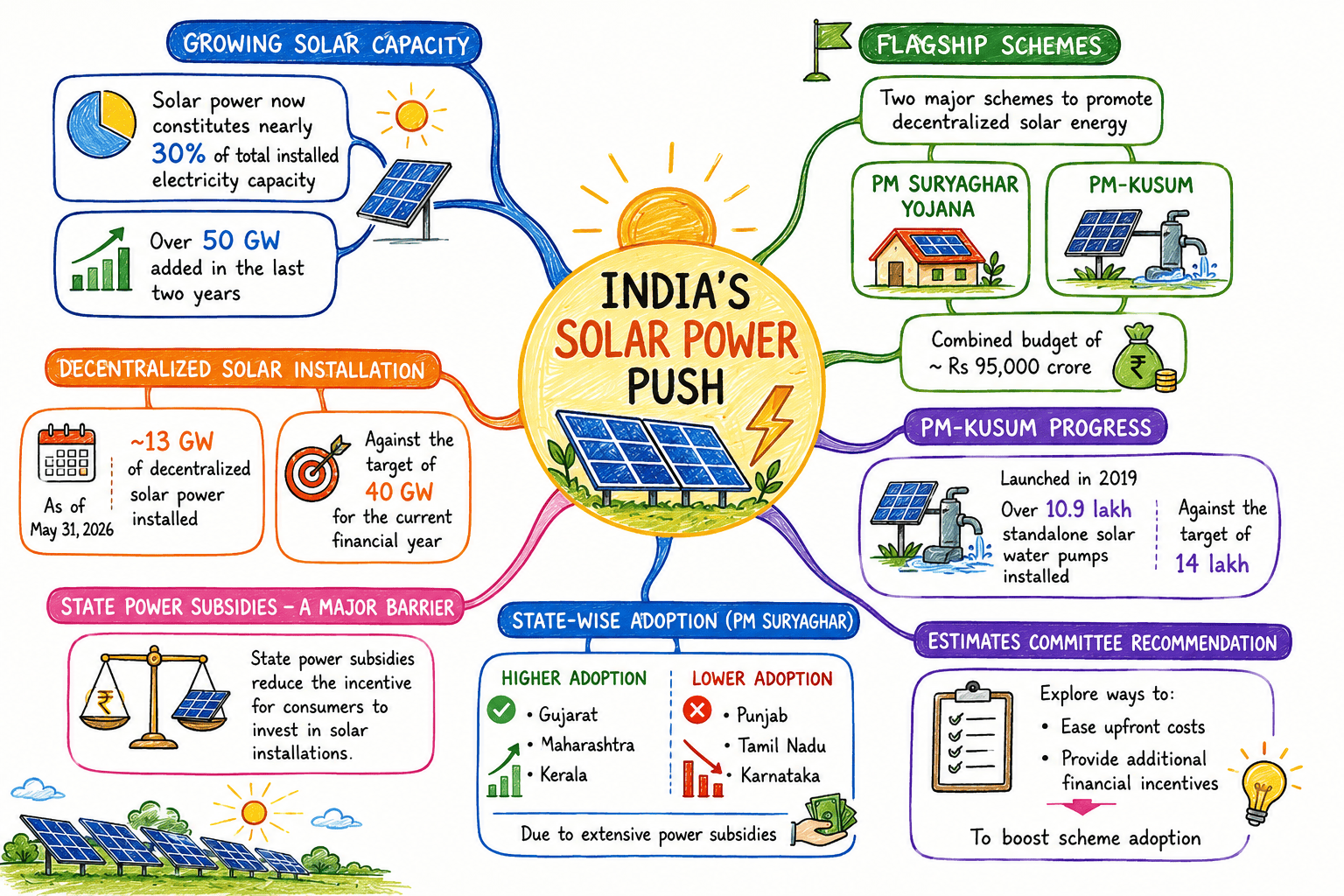
- India's solar power now constitutes nearly 30% of its total installed electricity capacity, with over 50 gigawatts (GW) added in the last two years.
- The government is implementing two flagship schemes, PM Suryaghar Yojana and PM-KUSUM, with a combined budget of approximately Rs 95,000 crore, to promote decentralized solar energy.
- As of May 31, 2026, about 13 GW of decentralized solar power has been installed, falling short of the 40 GW target for the current financial year.
- PM-KUSUM, launched in 2019, has seen over 10.9 lakh standalone solar water pumps installed against a target of 14 lakh.
- State power subsidies are a significant barrier to adoption, as they reduce the incentive for consumers to invest in solar installations.
- States like Gujarat, Maharashtra, and Kerala show higher adoption rates for PM Suryaghar, while Punjab, Tamil Nadu, and Karnataka lag due to extensive power subsidies.
- The Estimates Committee of Parliament has recommended exploring ways to ease upfront costs and provide additional financial incentives to boost scheme adoption.
PMKUSUM.png
Detailed Insights:
- India has rapidly expanded its renewable energy capacity, becoming the second-largest adder of solar power globally in 2025, only behind China.
- The PM Suryaghar Yojana aims to install rooftop solar units on one crore households, offering free electricity up to 300 units monthly and a cash subsidy for equipment.
- PM-KUSUM supports farmers in setting up small solar plants on unused land or installing grid-connected/standalone solar water pumps, enabling additional income and reduced energy bills.
- Despite substantial budgetary allocation, both schemes have performed below their full potential, with PM-KUSUM targets extended due to the pandemic.
- The uneven progress across states highlights that Gujarat, Maharashtra, Uttar Pradesh, Kerala, and Rajasthan collectively account for nearly 70% of the 33 lakh rooftop installations.
- States offering free or highly subsidized electricity to domestic and agricultural consumers, such as Punjab (spending over Rs 20,000 crore on subsidies last year), face low solar adoption.
- The upfront cost of solar equipment, which can be several lakh rupees, is a deterrent, as recovery through free electricity and excess power sales is a long-term prospect.
- Ironically, some states like Uttar Pradesh and Rajasthan have successfully boosted adoption by offering additional one-time financial incentives, proving more sustainable than recurring power subsidies.
- Decentralized solar power is critical for India's clean energy transition, addressing rising power demand, land constraints for large solar parks, and reducing transmission losses.
- Full implementation of PM Suryaghar is estimated to save the government approximately Rs 75,000 crore annually in electricity costs.
- Solar power is poised to become India's second-largest source of electricity generation, surpassing hydropower, which has seen stagnated capacity.
- Decentralized solar is increasingly vital for meeting peak demands during extreme weather conditions, such as heatwaves and low rainfall, which are becoming more frequent.
Key Concepts Involved:
- Decentralized Solar Power: Electricity generation at or near the point of consumption, reducing transmission losses and enhancing energy access.
- Power Subsidies: Financial assistance provided by the government to consumers to lower electricity costs, often impacting the economic viability of alternative energy investments.
- Renewable Energy: Energy derived from natural sources that replenish faster than they are consumed, such as solar, wind, and hydro.
- Grid-connected Solar: Solar power systems that are linked to the main electricity grid, allowing excess generated power to be fed back into the grid.

SuperKalam is your personal mentor for UPSC preparation, guiding you at every step of the exam journey.
Download the App


STUDY RESOURCES
CONTACT US
ⓒ Snapstack Technologies Private Limited