GS 3: EconomyGS 2: GovernancePrelims
Fifteen FTAs, 27 countries, four challenges, Pg12
India's 15 FTAs with 27 nations raise alarm over soaring trade deficits, inverted duties, and manufacturing relocation, jeopardizing domestic industry and 'Make in India' goals.
Practice MCQs
826 Students attempted
Key Highlights:
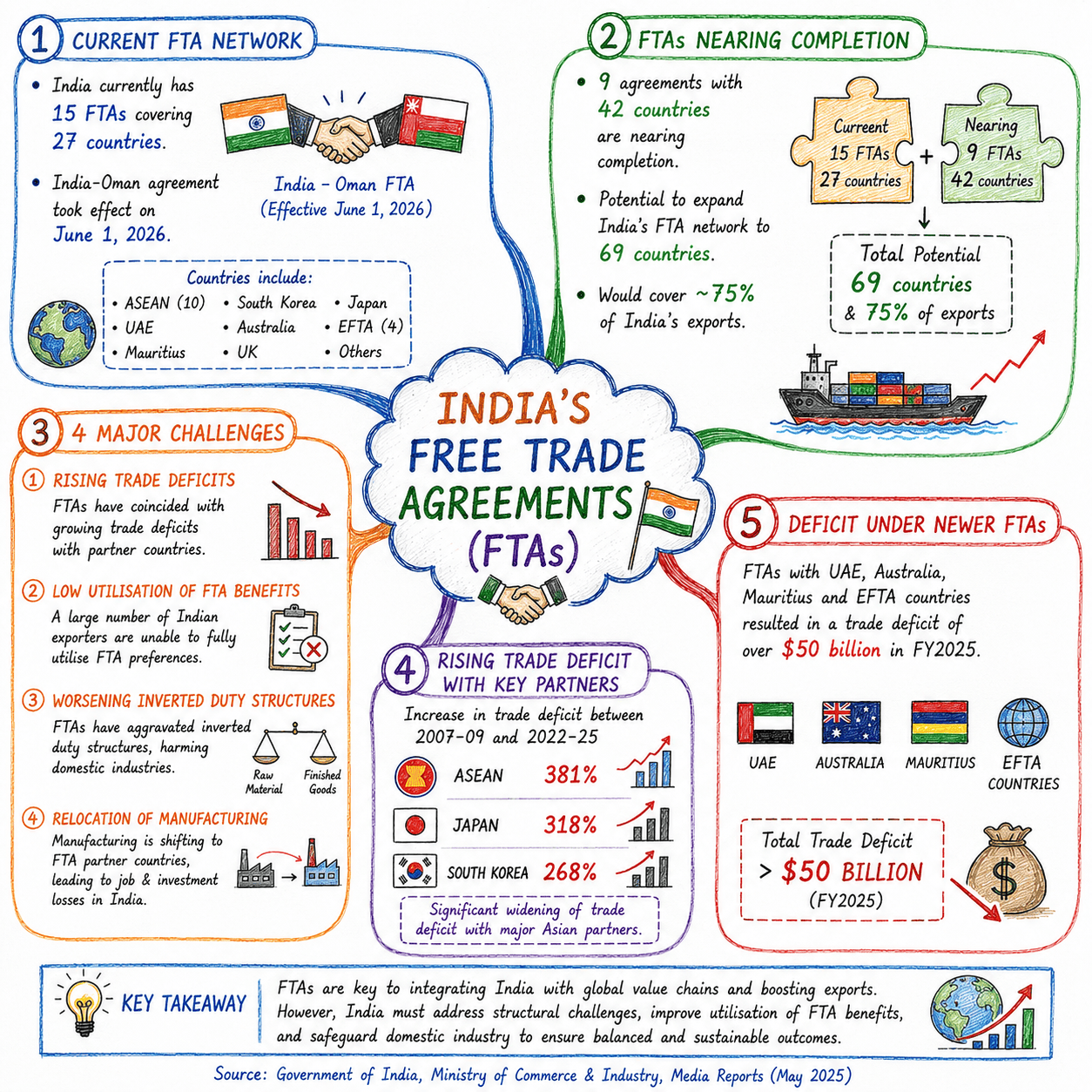
- India currently has 15 Free Trade Agreements (FTAs) covering 27 countries, with the India-Oman agreement taking effect on June 1.
- An additional 9 agreements with 42 countries are nearing completion, potentially expanding India's FTA network to 69 countries and 75% of exports.
- Four major challenges associated with India's FTAs include rising trade deficits, low utilization of FTA benefits by Indian exporters, worsening inverted duty structures, and the relocation of manufacturing.
- India's trade deficit with ASEAN grew by 381%, with Japan by 318%, and with South Korea by 268% between 2007-09 and 2022-25.
- Newer FTAs with the UAE, Australia, Mauritius, and EFTA countries resulted in a trade deficit of over $50 billion in FY2025.
FTA.png
Detailed Insights:
- The significant trade deficit is largely due to India's higher Most Favoured Nation (MFN) tariffs (average 12.6%) compared to its FTA partners, who often have near-zero or very low tariffs.
- This tariff asymmetry grants foreign exporters a substantial price advantage in the Indian market when tariffs are cut under FTAs.
- Indian exporters face limited benefits from FTAs as partner countries already have low or zero MFN tariffs, making the cost of complying with Rules of Origin often outweigh small tariff savings.
- Consequently, only an estimated 20-30% of India's eligible exports utilize FTA preferences, while import-side utilization rates are much higher at 60-70%.
- An inverted duty structure arises when duties on raw materials are higher than on finished products, a problem exacerbated by FTAs allowing finished goods to enter India at low or zero duty.
- This disadvantages Indian manufacturers who pay higher duties on imported inputs while competing with duty-free finished products, hindering "Make in India" initiatives.
- The incentive for firms to manufacture outside India, particularly in ASEAN countries, and export duty-free to the Indian market is growing, leading to potential job and investment relocation.
- Addressing these challenges requires aligning India's tariffs on industrial inputs with its FTA commitments to strengthen the domestic manufacturing base.
Key Concepts Involved:
- Free Trade Agreement (FTA): A pact between two or more countries to reduce or eliminate barriers to trade, such as tariffs and quotas.
- Trade Deficit: An economic measure where a country's imports of goods and services exceed its exports.
- Most Favoured Nation (MFN) Tariff: A non-discriminatory tariff rate that a country applies to imports from all its trading partners, unless a specific preferential agreement exists.
- Inverted Duty Structure: A tariff regime where the import duty on finished goods is lower than the import duty on the raw materials or intermediate goods used to produce them.

SuperKalam is your personal mentor for UPSC preparation, guiding you at every step of the exam journey.
Download the App


STUDY RESOURCES
CONTACT US
ⓒ Snapstack Technologies Private Limited