GS 3: EconomyGS 2: Social JusticeGS 1: Indian SocietyGS 2: GovernancePrelims
Linking women’s incomes and healthcare, Pg9
New research reveals women's increased income drives proactive health investments, reducing reactive healthcare spending and linking economic empowerment to public health outcomes.
Practice MCQs
826 Students attempted
Key Highlights:
- India is undergoing dual transformations: a rise in female labour force participation and an epidemiological shift towards chronic diseases.
- New research suggests a strong connection between increased women's income and improved public health outcomes.
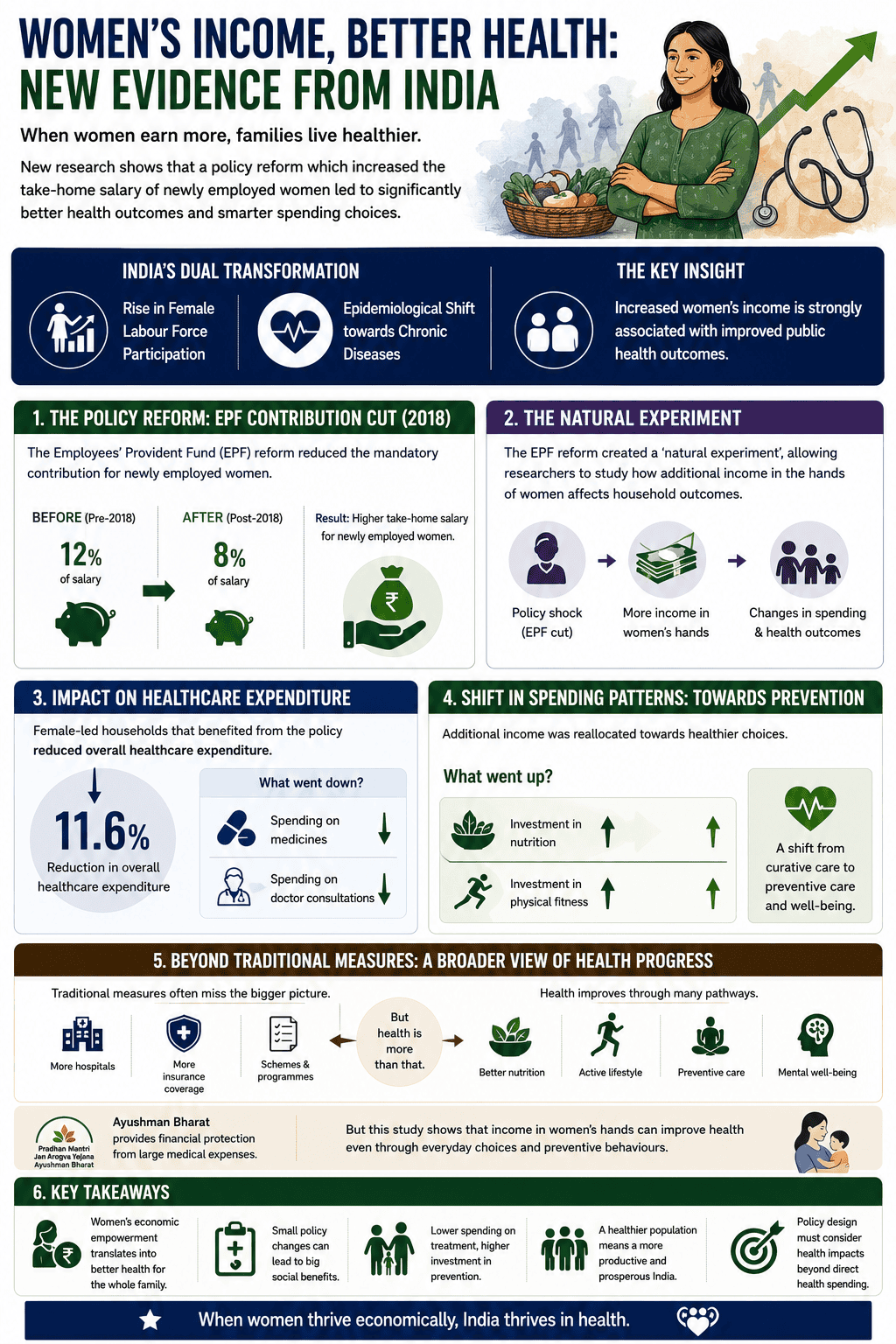
- A 2018 reform of the Employees’ Provident Fund reduced mandatory contributions for newly employed women from 12% to 8%.
- This reform led to an unexpected increase in take-home salary for these women.
- Female-led households benefiting from this policy reduced overall healthcare expenditure by approximately 11.6%.
- This reduction was accompanied by decreased spending on medicines and doctor consultations, while investment in nutrition and physical fitness increased.
Women Income and Health.png
Detailed Insights:
- Traditional measures of healthcare progress, such as hospital numbers or insurance coverage, often overlook broader health determinants.
- Schemes like Ayushman Bharat provide financial protection, but health can also improve through preventive measures and lifestyle changes.
- The Employees’ Provident Fund reform created a natural experiment to observe how women allocate additional income.
- The reform specifically applied to newly employed women in the formal sector for their initial three years of employment.
- The findings indicate that women use additional income to prioritize preventive health, reorganizing household spending.
- This aligns with economic research showing that income directed to women often leads to greater investments in education, nutrition, and child well-being.
- Women's economic empowerment can reduce future reliance on healthcare services and alleviate pressure on India's already strained healthcare system.
- The study suggests that policies enhancing women's economic agency can effectively function as health policies, contributing to India's demographic dividend.
Key Concepts Involved:
- Female Labour Force Participation (FLFP): The proportion of working-age women who are employed or actively seeking employment.
- Epidemiological Transition: A shift in a population's disease patterns from infectious diseases to chronic, non-communicable diseases.
- Out-of-pocket expenditure (OOPE): Direct payments made by individuals for healthcare services at the point of receiving care.
- Demographic Dividend: The economic growth potential that can result from shifts in a population’s age structure.

SuperKalam is your personal mentor for UPSC preparation, guiding you at every step of the exam journey.
Download the App


STUDY RESOURCES
CONTACT US
ⓒ Snapstack Technologies Private Limited