GS 3: EconomyGS 2: International RelationsGS 3: Environment & EcologyPrelims
India’s economic prospects after the West Asian crisis, Pg8
India's 2026-27 GDP growth projected at 6.6%, navigating West Asia truce, El Niño, and 90% crude import dependence.
Practice MCQs
826 Students attempted
Key Highlights:
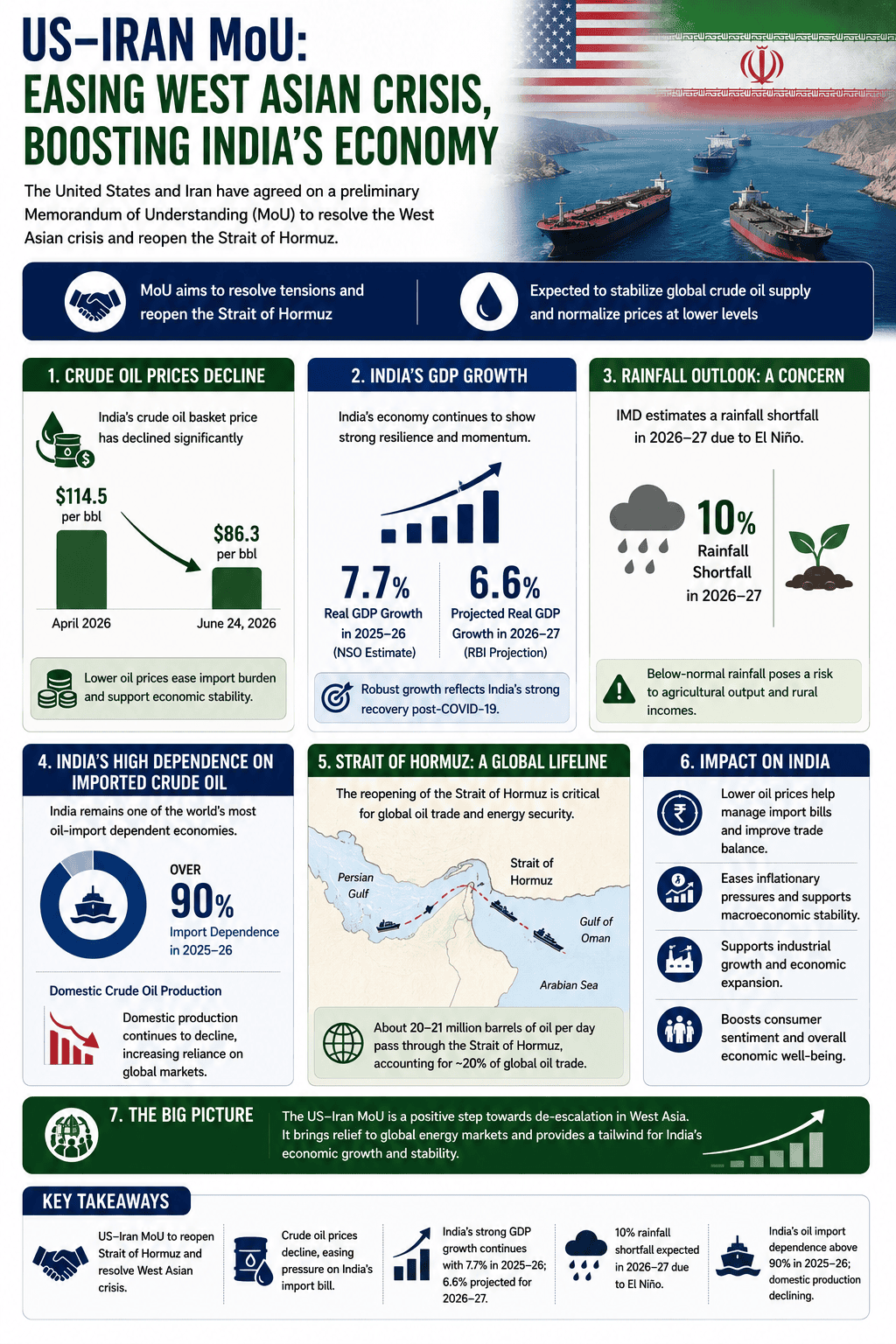
- The United States and Iran agreed to a preliminary Memorandum of Understanding (MoU) to resolve the West Asian crisis and reopen the Strait of Hormuz.
- This agreement is expected to stabilize global crude oil supply and normalize prices at lower levels.
- India's crude oil basket price significantly declined from $114.5 per bbl in April 2026 to $86.3 per bbl by June 24, 2026.
- India's real GDP growth was 7.7% in 2025-26, with the Reserve Bank of India (RBI) projecting 6.6% for 2026-27.
- The India Meteorological Department estimated a 10% rainfall shortfall for 2026-27 due to El Niño, posing a risk to agricultural output.
- India's dependence on imported crude oil increased to over 90% in 2025-26, while domestic production has declined.
Indian Economy resilience.png
Detailed Insights:
- The reopening of the Strait of Hormuz is critical for global oil trade, ensuring smoother supply chains.
- The decline in crude oil prices is beneficial for India, a major oil importer, helping to manage import bills.
- The National Statistical Office confirmed India's robust economic recovery post-COVID-19 with strong GDP growth in 2025-26.
- El Niño conditions combined with potential fertilizer shortages threaten both kharif and rabi crop yields in 2026-27.
- Higher nominal GDP growth is anticipated for 2026-27, driven by a projected increase in the Implicit Price Deflator (IPD).
- A substantial dividend of ₹2.69 lakh crore from the RBI will significantly support the government's fiscal position.
- India's fiscal deficit for 2026-27 is expected to remain close to the budgeted 4.3% of GDP.
- Domestic crude oil production has fallen to 26 million metric tons (MMT) in 2025-26 from a peak of 35.9 MMT in 2011-12.
- India's impressive crude oil refining capacity helps save costs by importing crude oil rather than refined products.
- Recommendations include building strategic reserves of fertilizers and other critical commodities, including crude oil.
- Diversifying crude import sources and reducing reliance on the Strait of Hormuz are crucial for energy security.
- The current account deficit is projected to be lower at 1.5% of GDP for 2026-27, assuming continued peace in West Asia.
Key Concepts Involved:
- Strait of Hormuz: A vital chokepoint for global oil shipments, connecting the Persian Gulf to the Gulf of Oman.
- El Niño: A climate pattern characterized by the warming of surface waters in the eastern tropical Pacific Ocean, impacting global weather.
- Fiscal Deficit: The difference between the government's total expenditure and its total non-borrowed receipts.
- Current Account Deficit (CAD): Occurs when a country's total imports of goods, services, and transfers exceed its total exports.

SuperKalam is your personal mentor for UPSC preparation, guiding you at every step of the exam journey.
Download the App


STUDY RESOURCES
CONTACT US
ⓒ Snapstack Technologies Private Limited