GS 3: Environment & EcologyGS 3: EconomyGS 2: GovernanceGS 1: Indian GeographyPrelims
The real crisis in India’s fisheries, Pg8
India's marine fisheries face severe inshore ecosystem degradation and unsustainable mechanised trawling, contradicting government's optimistic sustainability claims.
Practice MCQs
811 Students attempted
Key Highlights:
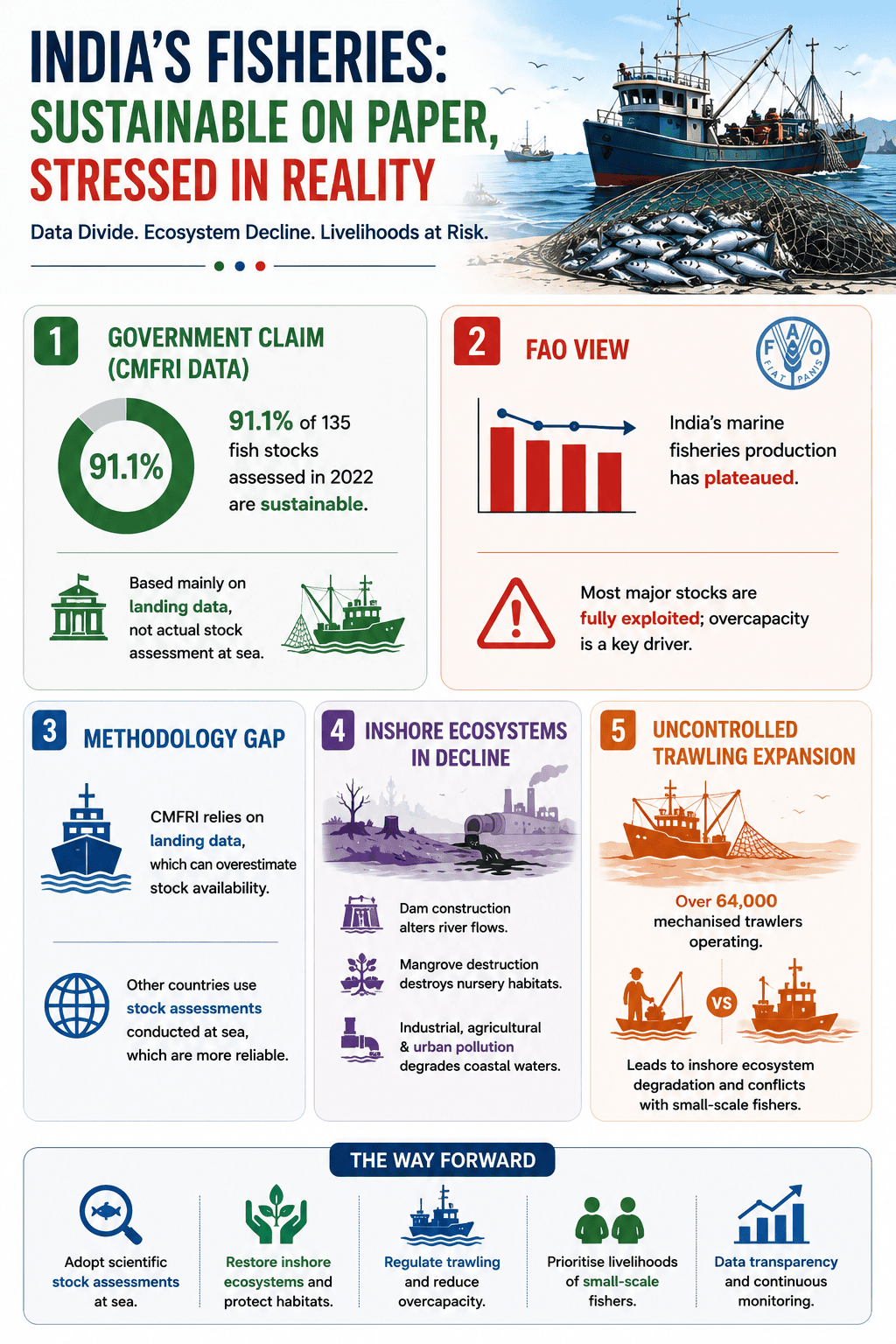
- The Indian government, citing Central Marine Fisheries Research Institute (CMFRI) data, claims 91.1% of 135 fish stocks evaluated in 2022 are sustainable.
- The Food and Agriculture Organization (FAO), however, suggests India's marine fisheries production has plateaued due to fully exploited stocks and overcapacity.
- CMFRI primarily relies on landing data for sustainability assessments, unlike other nations that use more reliable stock assessments at sea.
- There is a significant decline and destruction of inshore benthic environments, impacting traditional fishing grounds.
- The uncontrolled expansion of mechanised trawling, with over 64,000 vessels, is a major contributor to inshore ecosystem degradation and conflicts with small-scale fishers.
Fisheries.png
Detailed Insights:
- The government's optimistic assessment contrasts sharply with the FAO's view that most major stocks are fully exploited.
- CMFRI's methodology, based on landing data, is questioned for its accuracy in determining actual fish stock availability.
- The decline of inshore ecosystems is attributed to factors like dam construction, mangrove destruction, and industrial, agricultural, and urban pollution.
- India's narrow continental shelf, particularly outside Gujarat and Maharashtra, makes inshore waters crucial for commercially valuable species.
- Mechanised trawling, introduced around 1960, has expanded significantly with few restrictions on new entries or vessel upgrades.
- The continuous ploughing of the seabed by trawlers leads to a decline in marine life and imperils the livelihoods of small-scale fishers.
- Regulations like the 5 NM prohibition for mechanised boats are ineffective due to insufficient coastal state patrolling and lack of fisher involvement in management.
- The government's push for deep-sea fishing is viewed cautiously by FAO, which estimates only marginal potential increases from such resources.
- Current fisheries policy is criticised for imposing extra costs on fishers for distant water travel while neglecting proper management of productive inshore waters.
- The political influence of mechanised boat fishers often hinders effective management, as seen in the Palk Bay conflict with Sri Lankan fishers.
Key Concepts Involved:
- Central Marine Fisheries Research Institute (CMFRI): A leading Indian institution responsible for marine fisheries research and assessment.
- Food and Agriculture Organization (FAO): A specialized agency of the United Nations that leads international efforts to defeat hunger.
- Exclusive Economic Zone (EEZ): A sea zone over which a state has special rights regarding the exploration and use of marine resources, extending up to 200 nautical miles from the coast.
- Territorial Seas: A belt of coastal waters extending up to 12 nautical miles from the baseline of a coastal state, over which the state has full sovereignty.

SuperKalam is your personal mentor for UPSC preparation, guiding you at every step of the exam journey.
Download the App


STUDY RESOURCES
CONTACT US
ⓒ Snapstack Technologies Private Limited