GS 2: GovernanceGS 3: EconomyGS 2: Social JusticePrelims
Shah to launch several projects as Cooperation Ministry completes 5 years, Pg10
Amit Shah launches major projects, including 'White Revolution 2.0' and banking reforms, marking five years of Cooperation Ministry's push for cooperative sector growth.
Practice MCQs
811 Students attempted
Key Highlights:
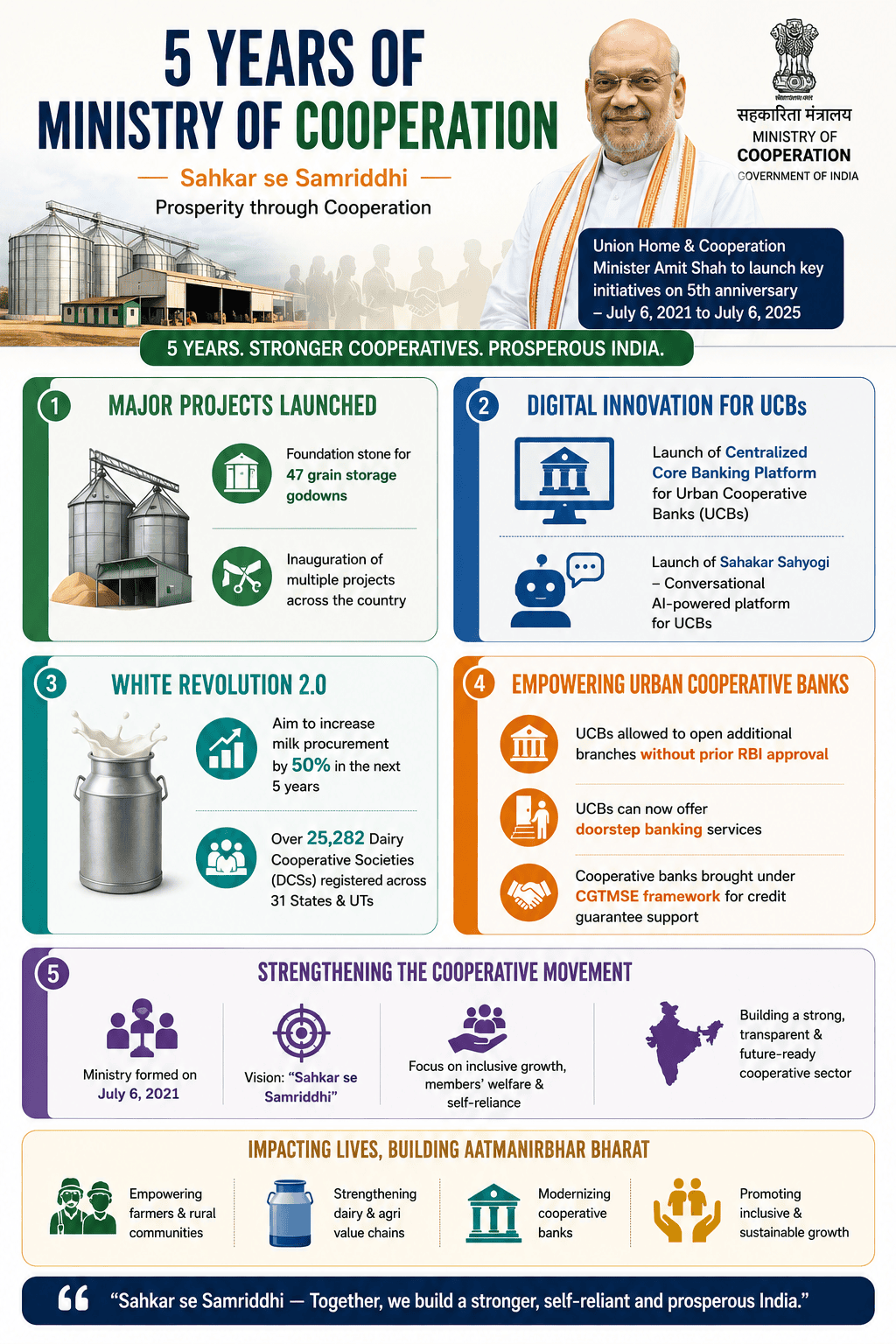
- Union Home and Cooperation Minister Amit Shah will launch several projects on Monday, marking the completion of five years since the formation of the Ministry of Cooperation.
- Key initiatives include the foundation stone for 47 grain storage godowns and the inauguration of other major projects.
- A centralized core banking platform and Sahakar Sahyogi, a conversational AI-powered platform, will be launched for Urban Cooperative Banks (UCBs).
- The Ministry aims to increase milk procurement by 50% over the next five years under White Revolution 2.0.
- Over 25,282 Dairy Cooperative Societies (DCSs) have been registered across 31 States and Union Territories as part of this initiative.
- UCBs have been granted permission to open additional branches without prior Reserve Bank of India (RBI) approval and offer doorstep banking services.
- Cooperative banks have also been brought under the Credit Guarantee Fund Trust for Micro and Small Enterprises (CGTMSE) framework.
Ministry of Cooperation.png
Detailed Insights:
- The Ministry of Cooperation was established on July 6, 2021, with the vision of "Sahkar se Samriddhi" (Prosperity through Cooperation), aiming to strengthen the cooperative movement.
- The Ministry emphasizes cooperation with States as a crucial pillar for implementing its initiatives.
- White Revolution 2.0 is designed to expand cooperative coverage, generate employment, and empower women in the dairy sector, building on the success of the original Operation Flood.
- New multi-State cooperatives for dairy inputs and manure management have been registered to promote sustainability in the dairy sector.
- The Sardar Patel Cooperative Dairy Federation Limited (SPCDF) was created to integrate over 20 lakh dairy farmers into an organized cooperative structure.
- Reforms for UCBs also include enabling them to provide higher-value housing loans, expanding their financial services.
- The inclusion of cooperative banks under CGTMSE facilitates collateral-free credit guarantees for loans extended to Micro and Small Enterprises.
- Primary Agricultural Credit Societies (PACS) are being strengthened by transforming them into multi-purpose rural institutions, enhancing their role in grassroots financial inclusion.
- The transformation of 50,000 PACS into e-PACS is a significant step towards digitizing these grassroots cooperative bodies.
Key Concepts Involved:
- Ministry of Cooperation: A Union Ministry formed in 2021 to provide a dedicated administrative, legal, and policy framework for strengthening India's cooperative movement.
- White Revolution 2.0: A renewed initiative by the Ministry of Cooperation to boost milk procurement and empower women through the expansion of dairy cooperatives.
- Urban Cooperative Banks (UCBs): Member-owned financial institutions operating in urban and semi-urban areas, providing banking services to their members.
- Primary Agricultural Credit Societies (PACS): Village-level cooperative credit societies that serve as the grassroots arm of the short-term cooperative credit structure, providing financial services to farmers.
- Credit Guarantee Fund Trust for Micro and Small Enterprises (CGTMSE): A scheme providing credit guarantees to financial institutions for collateral-free loans extended to Micro and Small Enterprises.
- Sahakar Sahyogi: A conversational AI-powered platform launched to enhance digital services for Urban Cooperative Banks.

SuperKalam is your personal mentor for UPSC preparation, guiding you at every step of the exam journey.
Download the App


STUDY RESOURCES
CONTACT US
ⓒ Snapstack Technologies Private Limited