GS 3: Environment & EcologyGS 2: GovernanceGS 2: PolityPrelims
India needs a second home for Asiatic lions, Pg7
Gujarat's resistance stalls Supreme Court-mandated Asiatic lion translocation to Kuno National Park, leaving the species vulnerable to extinction from a single habitat.
Practice MCQs
811 Students attempted
Key Highlights:
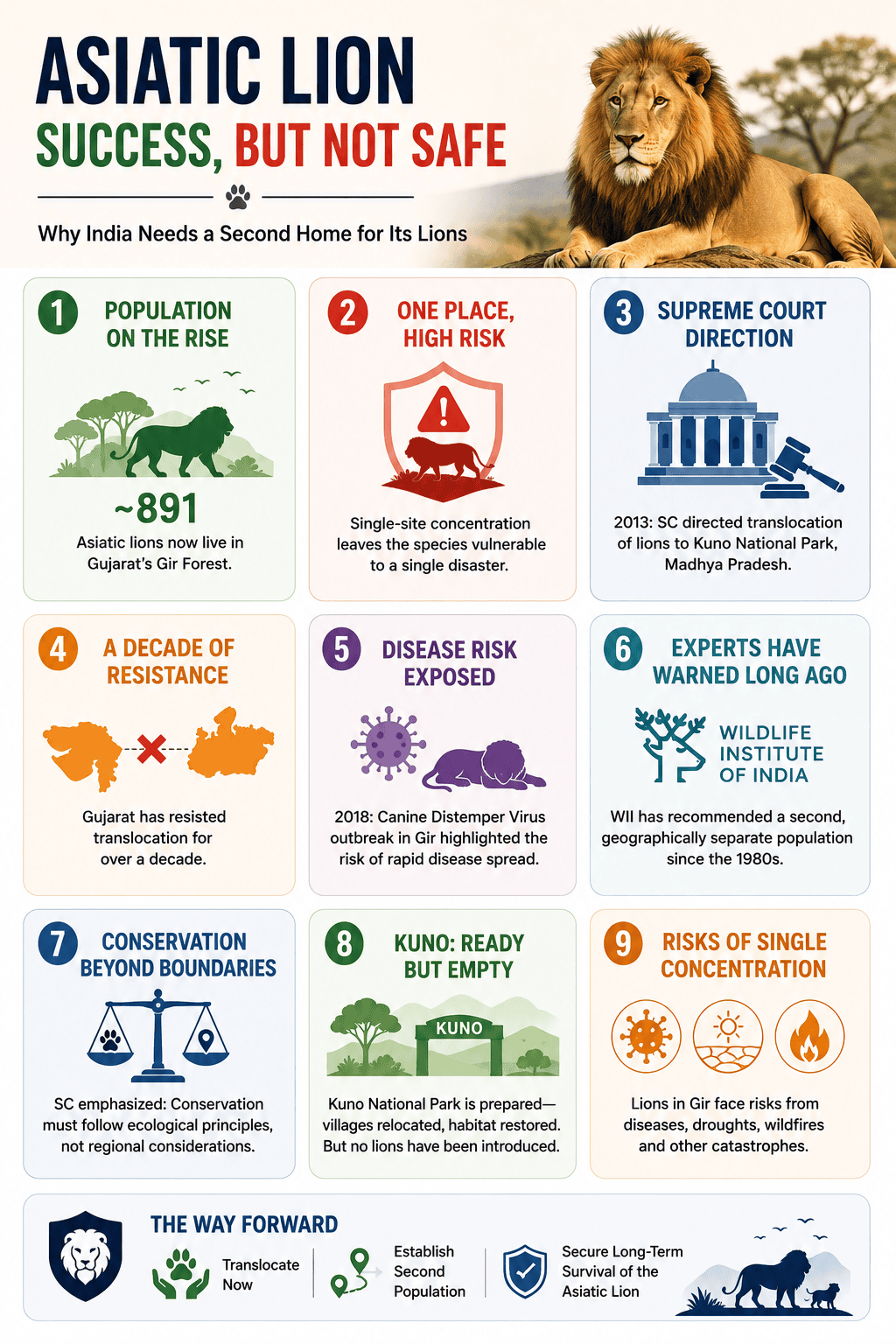
- India's Asiatic lion population has grown to approximately 891, primarily concentrated in Gujarat's Gir Forest.
- Despite this success, the entire species remains vulnerable to extinction from a single catastrophic event due to its single-site concentration.
- The Supreme Court in 2013 directed the translocation of lions to Kuno National Park in Madhya Pradesh to establish a second population.
- Gujarat has resisted this translocation for over a decade, creating a policy impasse.
- The 2018 Canine Distemper Virus outbreak in Gir highlighted the risks of disease spread in a concentrated population.
Asiatic lion.png
Detailed Insights:
- The Wildlife Institute of India has consistently recommended a second, geographically separate population for Asiatic lions since the 1980s.
- The Supreme Court emphasized that conservation must be guided by ecological principles, not regional considerations, for the species' long-term survival.
- Kuno National Park was specifically prepared for lion translocation, including village relocation and habitat restoration, but no lions have been introduced.
- The concentration of lions in Gir makes them susceptible to rapid disease spread and impacts from environmental factors like droughts or wildfires.
- Conservation science advocates for a metapopulation approach to distribute species across multiple habitats and reduce overall risk.
- Project Lion (2020) aims to revive discussions on expanding lion habitats, though proposals like Barda Wildlife Sanctuary within Gujarat may not offer sufficient risk diversification.
- The delay reflects a tension between national conservation priorities, where Asiatic lions are a national heritage, and State-level political interests.
Key Concepts Involved:
- Metapopulation Approach: A conservation strategy involving a group of spatially separated populations of the same species which interact at some level.
- Conservation Security: Ensuring the long-term survival and resilience of a species against various threats, beyond just increasing numbers.
- National Heritage: A concept recognizing certain species or sites as having significant cultural, historical, or ecological value for the entire nation.

SuperKalam is your personal mentor for UPSC preparation, guiding you at every step of the exam journey.
Download the App


STUDY RESOURCES
CONTACT US
ⓒ Snapstack Technologies Private Limited