GS 3: EconomyGS 1: Physical GeographyGS 3: Environment & EcologyGS 2: GovernancePrelims
El Niño, Iran sharpen food prices challenge, Pg12
Intensifying El Niño and monsoon deficit threaten India's food prices, risking protracted inflation and impacting kharif-rabi crops, demanding proactive government action.
Practice MCQs
811 Students attempted
Key Highlights:
- India's southwest monsoon recorded a 39.8% deficit in June, marking it the fifth lowest rainfall for the month.
- The India Meteorological Department forecasts "below normal" rainfall for July, exacerbating concerns.
- The El Niño phenomenon is currently in a moderate phase and is predicted to intensify to "strong" during the latter half of the monsoon season, potentially becoming "very strong" from October to January.
- This climatic event is expected to negatively impact both kharif and rabi crops, including wheat, mustard, chana, masoor, and potato.
- The previous "strong" El Niño event in 2023-24 led to an average retail food inflation exceeding 8.5% between July 2023 and December 2024.
- The government's Pradhan Mantri Fasal Bima Yojana and the newly enacted Viksit Bharat-Guarantee for Rozgar and Ajeevika Mission (Gramin) Act, 2025 (replacing MGNREGA) will be crucial in mitigating the impact.
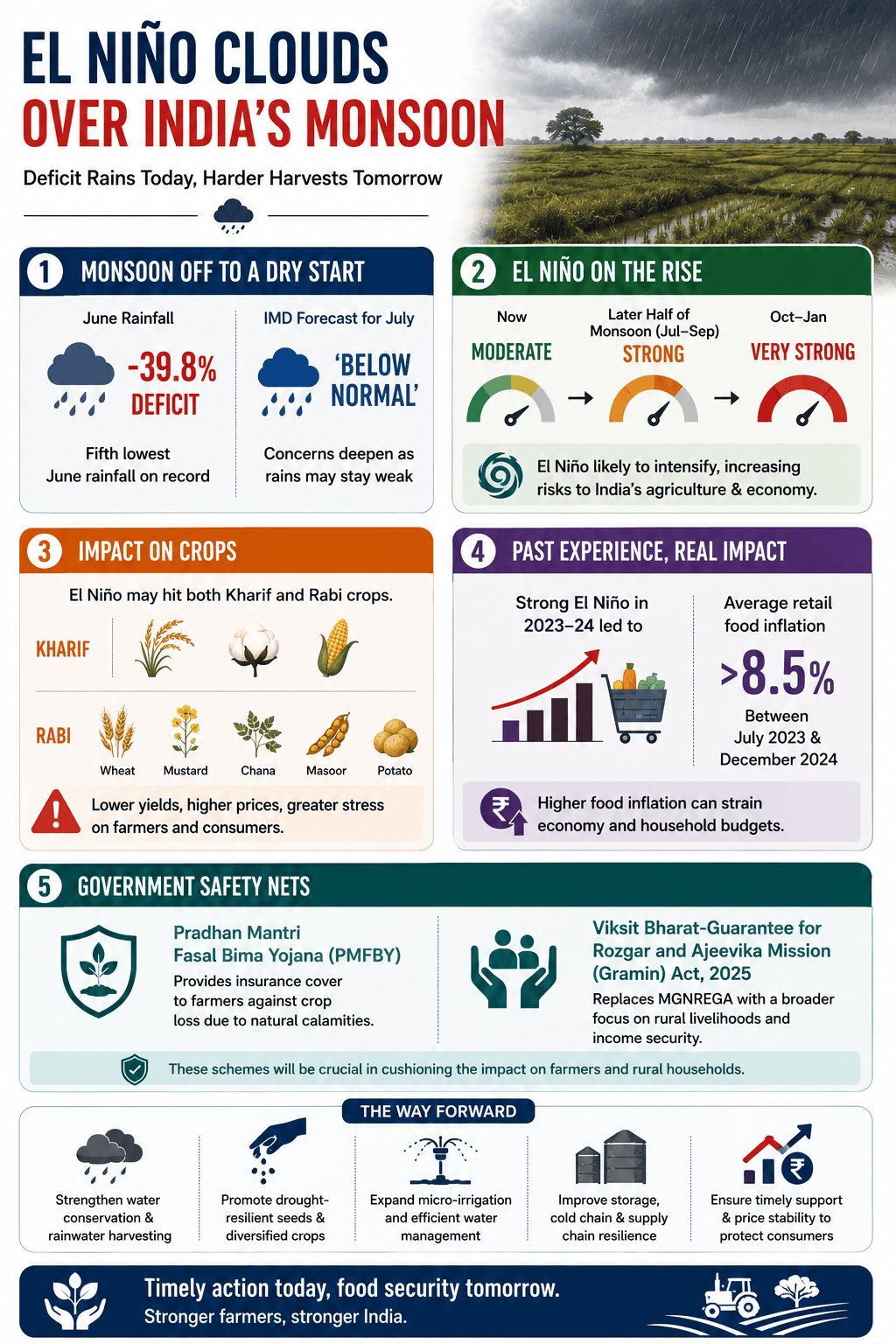
ElNino and Monsoon.png
Detailed Insights:
- The cumulative rainfall deficit for the season has narrowed to 24.1% as of July 5, with the monsoon covering approximately 95% of the country's area.
- Despite the recent revival, sowing acreages for kharif crops like oilseeds, pulses, and cotton were significantly lower compared to the previous year.
- An intensified El Niño could lead to a shorter and warmer winter, affecting rabi crop yields due to suppressed rainfall and higher temperatures.
- India's substantial imports of vegetable oils (16.9 million tonnes in 2025-26) and pulses (7.3 million tonnes in 2024-25) highlight the country's vulnerability to domestic production shortfalls.
- Proactive supply-side management, including keeping import windows open, is essential to prevent a repeat of protracted food price inflation.
- Ensuring Minimum Support Prices for pulses, oilseeds, millets, and cotton through difference payments can incentivize farmers to cultivate these less water-intensive crops.
- Effective implementation of crop insurance and rural employment schemes is vital for stabilizing farmer incomes and controlling food inflation.
Key Concepts Involved:
- El Niño: A climate pattern characterized by the unusual warming of surface waters in the eastern tropical Pacific Ocean, impacting global weather patterns and often leading to droughts in India.
- Kharif Crops: Monsoon crops sown at the beginning of the southwest monsoon (June-July) and harvested in September-October, requiring warm, wet conditions and significant rainfall.
- Rabi Crops: Winter crops sown after the monsoon (October-December) and harvested in spring (March-April), requiring cooler temperatures and less water, often relying on irrigation.
- Minimum Support Price (MSP): A minimum price set by the government for certain crops to protect farmers from market price fluctuations and ensure a remunerative return.
- Pradhan Mantri Fasal Bima Yojana (PMFBY): A government-sponsored crop insurance scheme launched in 2016 to provide financial support to farmers against crop losses due to unforeseen events.
- Viksit Bharat-Guarantee for Rozgar and Ajeevika Mission (Gramin) Act, 2025: A new rural employment scheme that replaced the Mahatma Gandhi National Rural Employment Guarantee Act (MGNREGA), aiming to provide guaranteed wage employment.
- India Meteorological Department (IMD): The national meteorological service of India, responsible for weather forecasting, meteorological observations, and seismology under the Ministry of Earth Sciences.

SuperKalam is your personal mentor for UPSC preparation, guiding you at every step of the exam journey.
Download the App


STUDY RESOURCES
CONTACT US
ⓒ Snapstack Technologies Private Limited