GS 2: International RelationsGS 3: EconomyGS 3: Science & TechnologyPrelims
PM's Indonesia visit could lay foundations of nickel diplomacy, Pg13
PM Modi's Indonesia visit targets critical nickel access for India's clean energy transition, bolstering Indo-Pacific strategy and defense cooperation amidst China's regional assertiveness.
Practice MCQs
811 Students attempted
Key Highlights:
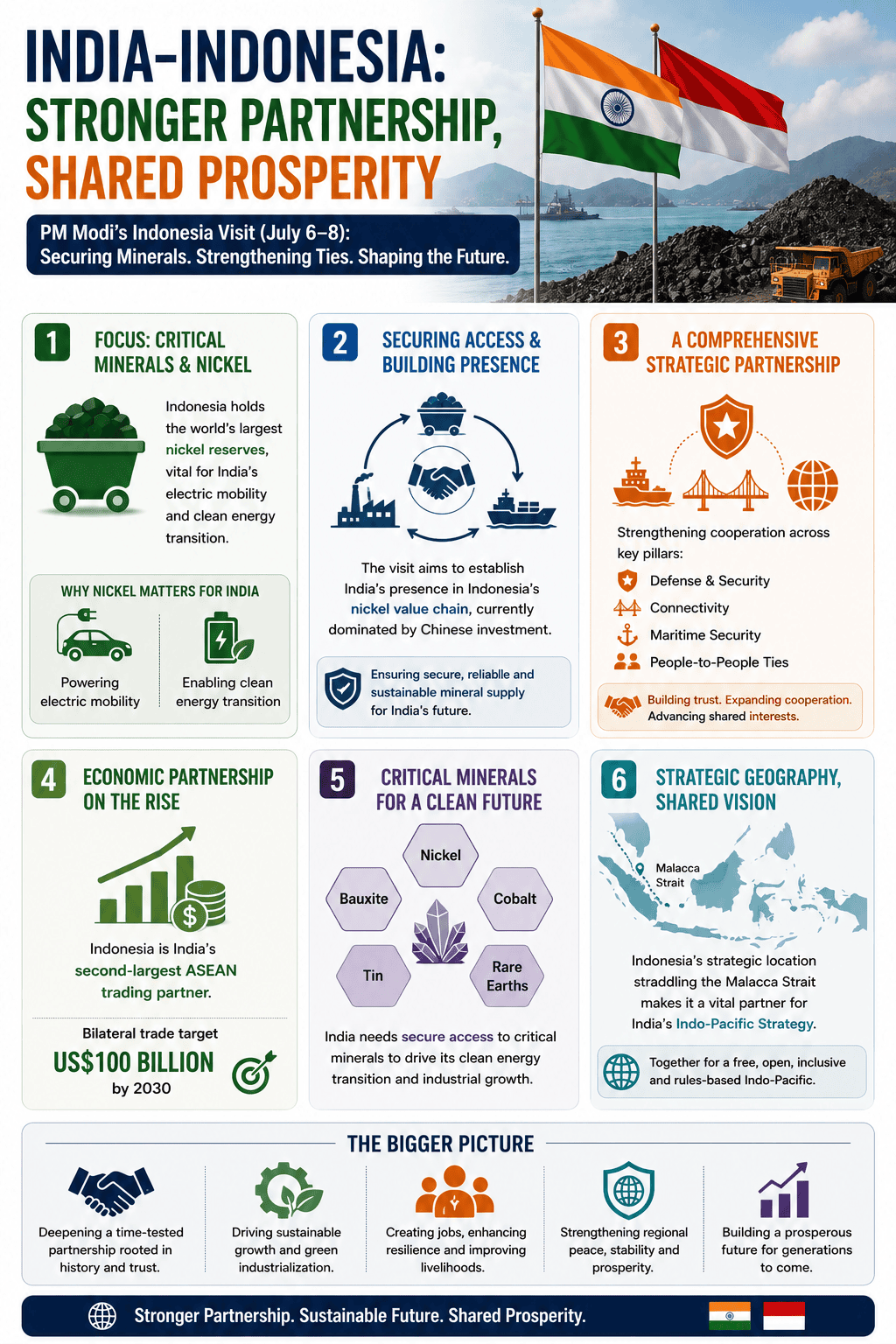
- Prime Minister Narendra Modi's visit to Indonesia from July 6-8 aims to secure India's access to critical minerals, particularly nickel.
- Indonesia holds the world's largest nickel reserves, essential for India's electric mobility and clean energy transition.
- The visit seeks to establish India's presence in Indonesia's nickel value chain, currently dominated by Chinese investment.
- The visit also strengthens the Comprehensive Strategic Partnership between India and Indonesia, focusing on defense, connectivity, and maritime security.
- Indonesia is India’s second-largest ASEAN trading partner, with a bilateral trade target of US$100 billion by 2030.
India-Indonesia.png
Detailed Insights:
- India requires secure access to critical minerals like nickel, cobalt, bauxite, tin, and rare earths for its clean energy transition.
- Indonesia's strategic location, straddling the Malacca Strait, makes it a vital partner for India's Indo-Pacific Strategy.
- The visit reciprocates President Prabowo Subianto’s 2025 visit to India and precedes his expected visit for the BRICS Summit in September.
- Historical ties, including the 1955 Bandung Conference and the Non-Aligned Movement, underpin the strong bilateral relationship.
- India's Act East Policy aligns with Indonesia's maritime ambitions, exemplified by the strategic potential of Sabang port in Aceh province.
- Defense cooperation, including potential acquisition of BrahMos supersonic cruise missiles by Indonesia, is a key immediate outcome.
- China's Nine-Dash Line overlaps Indonesia’s Exclusive Economic Zone around the Natuna Islands, creating a strategic backdrop for cooperation.
- Despite being India's second-largest ASEAN trading partner, bilateral trade (currently US$20 billion deficit for India) is below potential.
- Connectivity challenges, such as limited direct flights and shipping links, need to be addressed to deepen engagement.
Key Concepts Involved:
- Critical Minerals: Minerals essential for economic and national security, whose supply chains are vulnerable to disruption.
- Act East Policy: India's foreign policy initiative to strengthen economic and strategic relations with Southeast Asian and East Asian countries.
- Indo-Pacific Strategy: A geopolitical concept emphasizing a free, open, and inclusive region stretching from the Indian Ocean to the Pacific Ocean.
- ASEAN: The Association of Southeast Asian Nations, a regional intergovernmental organization promoting economic, political, and security cooperation.

SuperKalam is your personal mentor for UPSC preparation, guiding you at every step of the exam journey.
Download the App


STUDY RESOURCES
CONTACT US
ⓒ Snapstack Technologies Private Limited