GS 3: EconomyGS 3: Environment & EcologyGS 2: GovernancePrelims
Direct-seeded rice gains traction among farmers amid El Nino shadow on monsoon, Pg3
Direct-seeded rice gains traction amid El Nino, but India's rice policies, driven by MSP and subsidies, fuel environmental crisis and fiscal burden, demanding urgent reforms.
Practice MCQs
811 Students attempted
Key Highlights:
- Direct-seeded rice (DSR) is gaining traction among farmers as a water and labor-saving alternative to traditional methods.
- Traditional rice cultivation, involving puddling and transplantation, is highly water-intensive, requiring up to 30 irrigations per season.
- India became the world's largest rice producer (154 MMT in 2025-26) and exporter (24.5 MMT in 2025), dominating 40% of global trade.
- The Food Corporation of India (FCI) maintains rice stocks nearly five times the buffer norm, incurring significant carrying costs.
- Government policies like open-ended Minimum Support Price (MSP) procurement, free power, and highly subsidized urea contribute to overproduction and environmental concerns.
- The government's strategy to divert surplus rice for ethanol production has sparked a food-vs-fuel debate.
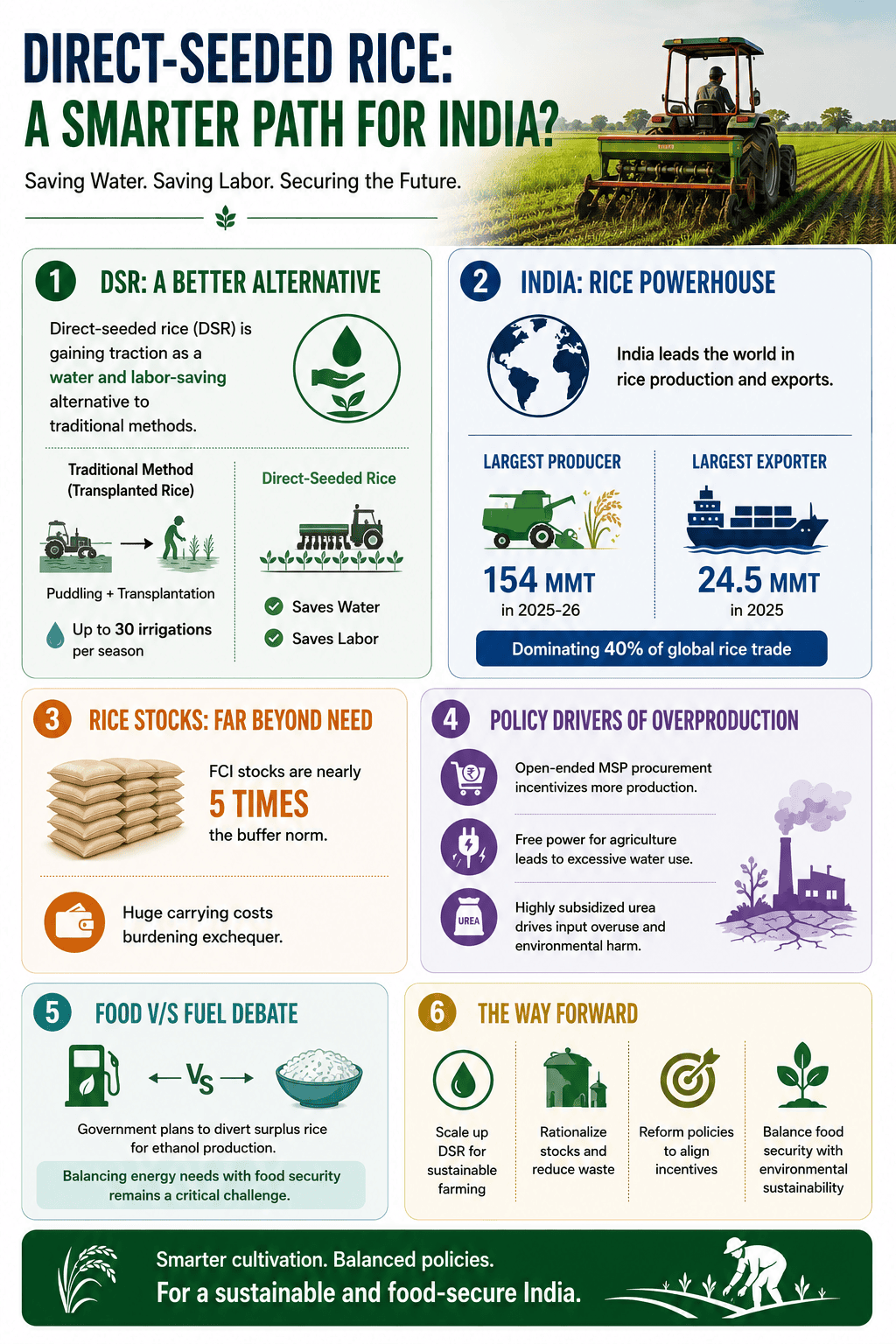
Direct seeding of rice.png
Detailed Insights:
- Traditional puddling and transplantation methods are highly water-intensive, consuming over 200,000 liters per acre per irrigation.
- India distributes free rice to approximately 800 million people under the National Food Security Act (NFSA).
- The Food Corporation of India (FCI) incurred a carrying cost of ₹10,712 crore in 2024-25 for its surplus rice stocks.
- FCI sells rice to ethanol plants at ₹23/kg, significantly below its economic cost of ₹44/kg, raising questions about subsidies.
- Open-ended Minimum Support Price (MSP) procurement, free power, and highly subsidized urea are key policy drivers of current rice production.
- States often offer bonuses or input subsidies, pushing paddy prices 20-40% above the central MSP.
- Free power in the rice belt encourages unsustainable groundwater extraction for flood irrigation.
- Frozen urea prices lead to its over-application, with only 35-40% of nitrogen absorbed by plants, causing environmental damage.
- Paddy cultivation is a significant source of methane emissions, a potent greenhouse gas 25 times more powerful than carbon dioxide.
- Suggested reforms include limiting MSP procurement to 40% of production and ending state-level bonuses.
- Promoting Direct-seeded rice (DSR) and shifting from fertilizer subsidies to direct income support for farmers are also proposed.
- Reforming the Public Distribution System (PDS) to target only the most vulnerable and decontrolling fertilizer prices are critical steps.
Key Concepts Involved:
- Direct-seeded rice (DSR): A method of rice cultivation where seeds are directly sown into the field, bypassing nursery raising and transplantation.
- Puddling: A traditional practice of flooding and tilling rice fields to create a soft, impermeable soil layer for transplanting seedlings.
- Minimum Support Price (MSP): A guaranteed price set by the government to purchase crops from farmers, ensuring a minimum income.
- National Food Security Act (NFSA): A law providing subsidized food grains to a significant portion of India's population.
- Food Corporation of India (FCI): The central agency responsible for procurement, storage, and distribution of food grains for the PDS and maintaining buffer stocks.

SuperKalam is your personal mentor for UPSC preparation, guiding you at every step of the exam journey.
Download the App


STUDY RESOURCES
CONTACT US
ⓒ Snapstack Technologies Private Limited