GS 3: EconomyGS 3: Environment & EcologyGS 2: International RelationsPrelims
Signs of resilience, but risks need monitoring, Pg12
Indian economy displays resilience amid global disruptions, yet faces critical monitoring for El Niño impact, rising household debt, and stagnant private investment.
Practice MCQs
782 Students attempted
Key Highlights:
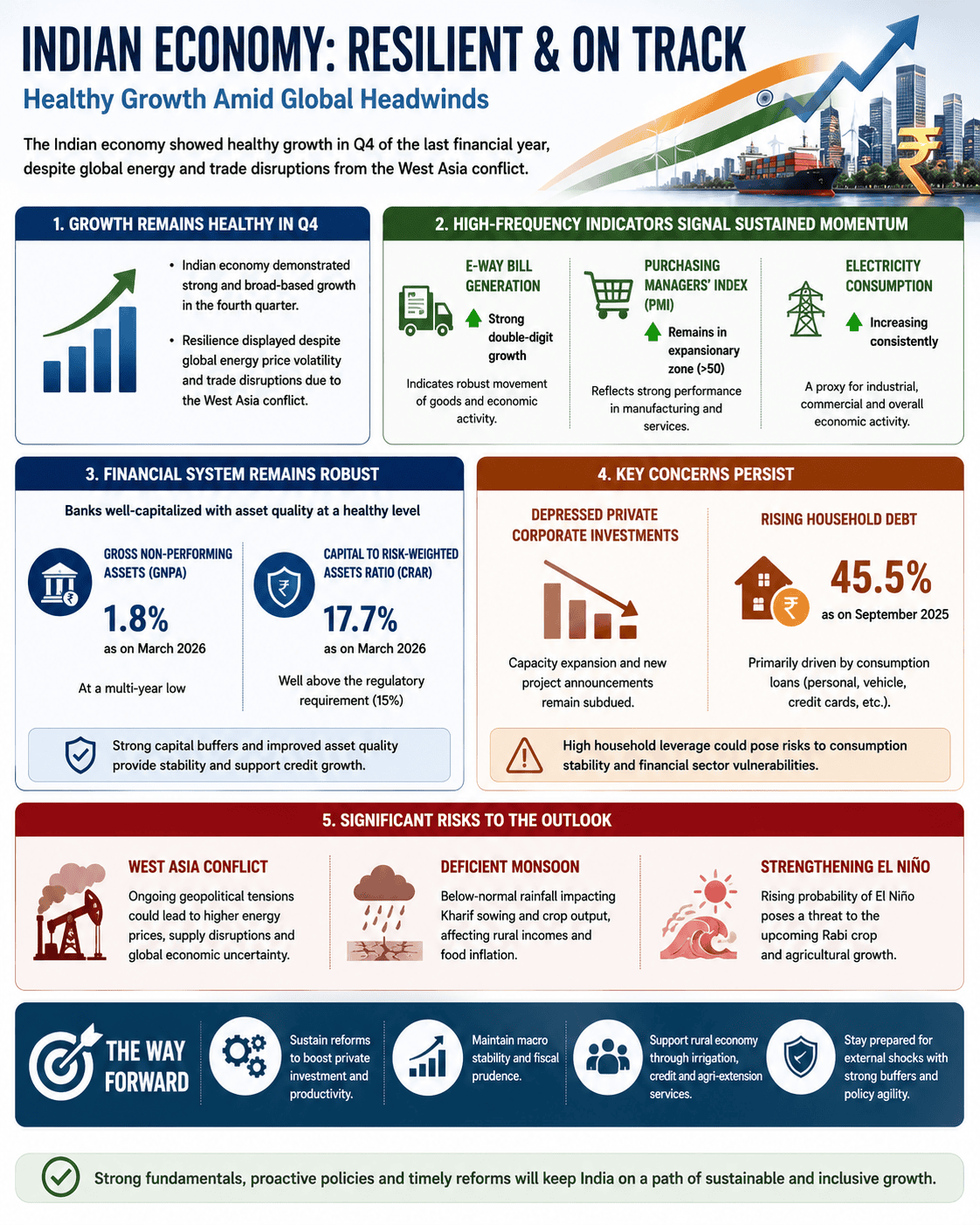
- The Indian economy demonstrated healthy growth in the fourth quarter of the last financial year, despite global energy and trade disruptions from the West Asia conflict.
- High-frequency indicators like e-way bill generation, Purchasing Managers' Index (PMI), and electricity consumption show sustained economic momentum.
- India's financial system remains robust, with banks reporting low Gross Non-Performing Assets (GNPA) at 1.8% in March 2026 and a comfortable Capital to Risk-Weighted Assets Ratio (CRAR) of 17.7%.
- Concerns persist regarding depressed private corporate investments and rising household debt, which reached 45.5% by September last year, primarily driven by consumption.
- Significant risks include the ongoing West Asia conflict, a deficient monsoon impacting Kharif sowing, and a strengthening El Niño threatening the upcoming Rabi crop.
Indian Economy.png
Detailed Insights:
- The finance ministry's latest monthly economic review highlighted the resilience, but also noted signs of moderation, such as the Index of Eight Core Industries growing by only 1.1% during April-May.
- Reserve Bank of India (RBI) Governor Sanjay Malhotra affirmed the macro-financial stability, attributing it to high growth, low inflation, and strong bank and corporate balance sheets.
- Stress tests conducted by the central bank indicate that Indian banks are well-equipped to manage adverse economic shocks.
- Despite the strong financial health of the corporate sector, marked by falling leverage and improved debt servicing, private investments have not picked up.
- The rise in household debt is a concern as a significant portion is for consumption rather than asset creation, potentially increasing financial vulnerability.
- Prolonged food inflation, averaging 8.5% between July 2023 and December 2024 during a previous El Niño year, underscores the potential impact of current climatic risks on inflation and demand.
Key Concepts Involved:
- El Niño: A climatic phenomenon characterized by the abnormal warming of surface waters in the eastern equatorial Pacific Ocean, often leading to altered global weather patterns, including droughts in India.
- Gross Non-Performing Assets (GNPA): The total value of loans in a bank's portfolio for which the principal or interest payment has remained overdue for more than 90 days.
- Purchasing Managers' Index (PMI): An economic indicator derived from monthly surveys of private sector companies, reflecting business activity and conditions in manufacturing and services sectors.
- Capital to Risk-Weighted Assets Ratio (CRAR): A measure of a bank's capital in relation to its risk-weighted assets, indicating its financial strength and ability to absorb potential losses.
- Kharif Crop: Monsoon crops sown at the beginning of the southwest monsoon (June-July) and harvested in September-October, such as rice, maize, and cotton.
- Rabi Crop: Winter crops sown after the monsoon (October-December) and harvested in spring (March-April), such as wheat, barley, and mustard.

SuperKalam is your personal mentor for UPSC preparation, guiding you at every step of the exam journey.
Download the App


STUDY RESOURCES
CONTACT US
ⓒ Snapstack Technologies Private Limited