GS 3: EconomyGS 2: GovernanceGS 3: Environment & EcologyPrelims
PPP 2.0 should focus on matching capital to risk, Pg12
Expert advocates 'PPP 2.0' with circular finance, matching capital to risk, to fund India's $20 trillion infrastructure and green transition by 2047.
Practice MCQs
782 Students attempted
Key Highlights:
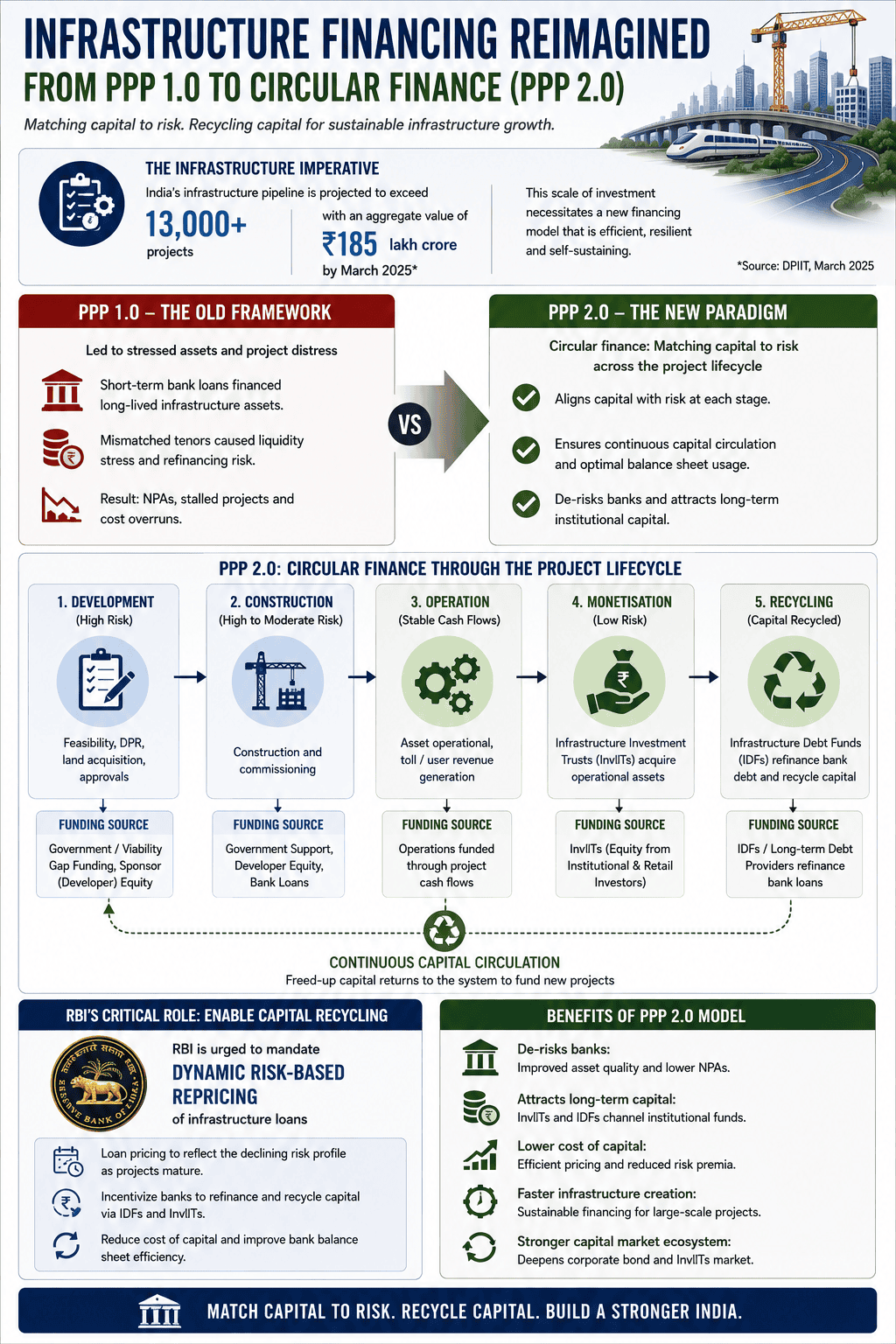
- India's infrastructure pipeline is projected to exceed 13,000 projects with an aggregate value of ₹185 lakh crore by March 2025, necessitating a new financing model.
- The previous Public-Private Partnership (PPP) framework, or PPP 1.0, led to stressed assets due to short-term bank loans financing long-lived infrastructure projects.
- A new model, termed PPP 2.0, proposes circular finance to match capital to risk across a project's lifecycle, ensuring continuous capital circulation.
- This approach involves government and developers funding initial high-risk phases, with Infrastructure Investment Trusts (InvITs) acquiring operational assets and Infrastructure Debt Funds (IDFs) refinancing bank debt.
- The Reserve Bank of India (RBI) is urged to mandate dynamic risk-based repricing of infrastructure loans to incentivize refinancing and capital recycling.
PPP 2.0.png
Detailed Insights:
- The initial PPP model in India, while transforming sectors like airports and highways, faced challenges due to financing long-duration assets (30-50 years) with short-term bank loans (7-10 years).
- This mismatch led to heavy debt-service burdens when revenues were uncertain, contributing to rising Non-Performing Assets (NPAs) in the banking sector, especially after the 2008 global financial crisis.
- India aims to become a developed economy by 2047 and achieve net-zero emissions by 2070, requiring investments potentially exceeding $20 trillion for the green transition alone.
- Circular finance suggests that public capital should fund high-risk stages like project preparation and construction, then be recycled once projects stabilize.
- Global institutional investors, including pension funds, insurance companies, and sovereign wealth funds, control over $110 trillion and seek stable, long-term, inflation-linked returns suitable for mature infrastructure assets.
- InvITs have emerged as credible vehicles for attracting such long-term capital by allowing investors to acquire stakes in revenue-generating infrastructure.
- The National Investment and Infrastructure Fund (NIIF) has demonstrated its ability to attract global institutional capital, serving as a platform for infrastructure investment.
- Reviving Infrastructure Debt Funds (IDFs) is crucial as they act as a bridge between operational infrastructure and long-term institutional investors, facilitating the refinancing of high-cost bank debt.
- The RBI's role in mandating dynamic risk-based repricing would prevent banks from retaining high-risk premia on de-risked projects, thereby encouraging capital recycling.
Key Concepts Involved:
- Public-Private Partnership (PPP): A long-term contract between a public sector entity and a private sector entity for providing a public asset or service.
- Non-Performing Assets (NPAs): Loans or advances where the principal or interest payment remains overdue for more than 90 days.
- Infrastructure Investment Trusts (InvITs): Investment vehicles that enable direct investment of money from individual and institutional investors in infrastructure projects, regulated by SEBI.
- National Investment and Infrastructure Fund (NIIF): India's first sovereign wealth fund, established in 2015, registered with SEBI as a Category II Alternative Investment Fund (AIF), focused on infrastructure financing.
- Infrastructure Debt Funds (IDFs): Specialized financial entities that mobilize long-term resources for financing infrastructure projects, regulated by either RBI (as NBFCs) or SEBI (as Mutual Funds).
- Circular Finance: A financing model where capital is continuously recycled from mature, de-risked projects into new ones, optimizing its use across the project lifecycle.

SuperKalam is your personal mentor for UPSC preparation, guiding you at every step of the exam journey.
Download the App


STUDY RESOURCES
CONTACT US
ⓒ Snapstack Technologies Private Limited