GS 3: EconomyGS 2: GovernanceGS 2: PolityPrelims
The fiscal tightrope for State govts., Pg10
Kerala and Tamil Nadu navigate fiscal tightrope, burdened by alarming debt, high revenue expenditure, and limited capital for crucial development projects.
Practice MCQs
775 Students attempted
Key Highlights:
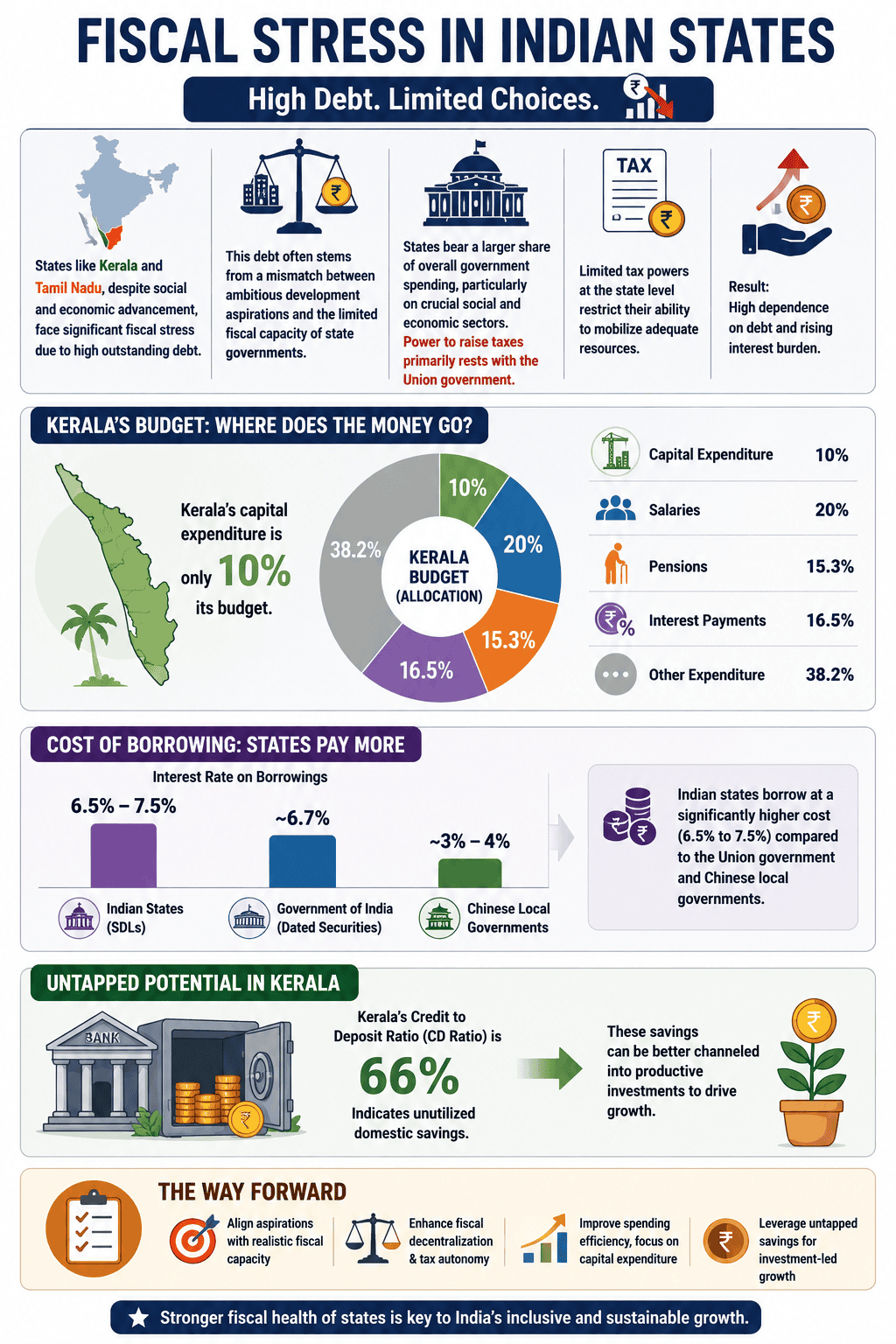
- Indian states like Kerala and Tamil Nadu, despite social and economic advancement, face significant fiscal stress due to high outstanding debt.
- This debt often stems from a mismatch between ambitious development aspirations and the limited fiscal capacity of state governments.
- States bear a larger share of overall government spending, particularly on crucial social and economic sectors, while the power to raise taxes primarily rests with the Union government.
- Kerala's capital expenditure is only 10% of its budget, with substantial portions allocated to salaries (20%), pensions (15.3%), and interest payments (16.5%).
- The cost of borrowing for Indian states through State Development Loans (SDLs) is significantly higher (6.5% to 7.5%) compared to the Union government and Chinese local governments.
- Kerala exhibits a low credit to deposit ratio of 66%, indicating unutilized domestic savings that could potentially be channeled into investments.
Fiscal Tightrope.png
Detailed Insights:
- State government debt accumulates over years due to persistent deficits, where expenditure exceeds tax and other receipts.
- Per capita social expenditure in Kerala and Tamil Nadu (30% and 20% higher, respectively) significantly surpasses the average for all Indian states (2020-23 data).
- States primarily fund expenditures through their own revenues, such as State Goods and Services Tax (SGST) and sales tax, supplemented by fiscal transfers, grants, and loans from the Union government.
- Kerala's share in the Union government's tax devolution (1.92%) is lower than its population share (2.6%) in 2023–24.
- The fiscal dilemma for states like Kerala involves balancing essential social sector spending with the urgent need for large-scale investments in infrastructure, higher education, and public transport.
- A low credit to deposit ratio suggests that banks are not lending out a large proportion of their deposits, indicating a potential for greater credit deployment to stimulate economic activity.
- In contrast, China's local governments heavily finance investments through borrowing, utilizing domestic savings via Local Government Bonds (LGBs), land sales, and Local Government Financing Vehicles (LGFVs).
- The high interest burden on state borrowings further exacerbates the debt situation, limiting funds available for developmental activities.
- Indian state and Union government bonds are largely purchased by domestic financial institutions, including commercial banks and insurance companies.
Key Concepts Involved:
- Fiscal Stress: A situation where government expenditure significantly exceeds revenue, leading to continuous borrowing and a large portion of revenue being used for debt repayment.
- State Development Loans (SDLs): Dated securities issued by state governments to meet their market borrowing requirements and fund their fiscal deficits.
- Fiscal Transfers: Mechanisms through which funds are transferred from the Union government to state governments, including tax devolution and grants-in-aid, to address vertical and horizontal fiscal imbalances.
- Credit to Deposit Ratio: A financial metric indicating the proportion of a bank's total deposits that has been extended as loans and advances.

SuperKalam is your personal mentor for UPSC preparation, guiding you at every step of the exam journey.
Download the App


STUDY RESOURCES
CONTACT US
ⓒ Snapstack Technologies Private Limited