Yashoda AI: Empowering Rural Women and Frontline Health Workers with AI Literacy
NCW's digital literacy drive equips rural health workers and grassroots leaders with AI skills, data privacy awareness, and cyber threat protection.
Aug, 2026
•7 min read
Overview
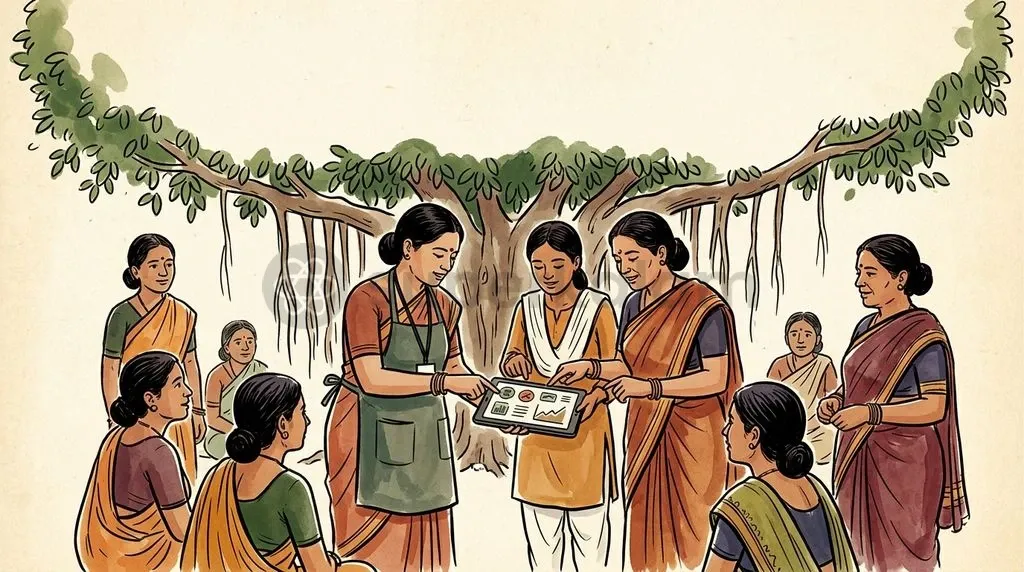
The Yashoda AI initiative is a specialised digital empowerment programme launched by the National Commission for Women. It equips rural women, local administrators, and frontline healthcare workers with artificial intelligence literacy and cybersecurity skills.
The platform addresses critical knowledge deficits across 13 Indian states by delivering vernacular, role-based training modules. These courses help Accredited Social Health Activists (ASHAs) and Auxiliary Nurse Midwives (ANMs) navigate public health digital workflows.
By embedding personal data governance under the Digital Personal Data Protection Act, 2023, the initiative protects grassroots functionaries from emerging threats like deepfakes and voice-cloning fraud. As of August 2026, the programme establishes an essential bridge connecting national emerging technology missions with grassroots maternal health and community administration.
Why is the Yashoda AI Initiative in the News?
The National Commission for Women expanded its flagship Yashoda AI initiative on 19 August 2026 at Lovely Professional University in Jalandhar, Punjab, to accelerate digital leadership among women. NCW Chairperson Vijaya Rahatkar inaugurated the expanded phase alongside the 'She Serves' initiative, which mentors and prepares young women for careers in defence and the armed forces.
Key institutional milestones behind this expansion include:
- Statutory establishment: The Commission operates as a statutory body under the National Commission for Women Act, 1990 (Act No. 20 of 1990).
- Phased geographic expansion: Initially rolled out in May 2025, the digital literacy drive has grown from a pilot into a multi-state training initiative spanning 29 cities.
What is the Yashoda AI Platform?
The Yashoda AI platform operates under the official tagline 'Your AI SAKHI for Shaping Horizons with Digital Awareness' to advance the vision of an AI-literate female workforce. Executed by the National Commission for Women in technical partnership with Future Shift Labs, the initiative translates advanced technological concepts into accessible grassroots tools.
The curriculum specifically serves rural and semi-urban demographics who frequently face exclusion from digital transformation pipelines. The target groups include:
- Frontline health personnel, including Accredited Social Health Activists (ASHAs) and Auxiliary Nurse Midwives (ANMs).
- Community leadership, including Self-Help Group (SHG) federations, Sarpanchs, and village Pradhans.
- Public safety officials, including local police personnel handling community disputes.
- Academic cohorts, including university students, campus ambassadors, and rural educators.
Discuss with Superkalam
Which statutory body launched the Yashoda AI initiative, and what is the official tagline of the platform?
Ask NowCore Objectives: What the Initiative Aims to Solve
The Yashoda AI initiative eliminates structural digital disparities, improves public health workflow efficiency, and shields women from artificial intelligence-driven cybercrimes. India's frontline healthcare architecture depends heavily on community health workers who often navigate complex digital reporting systems without formal technical instruction.
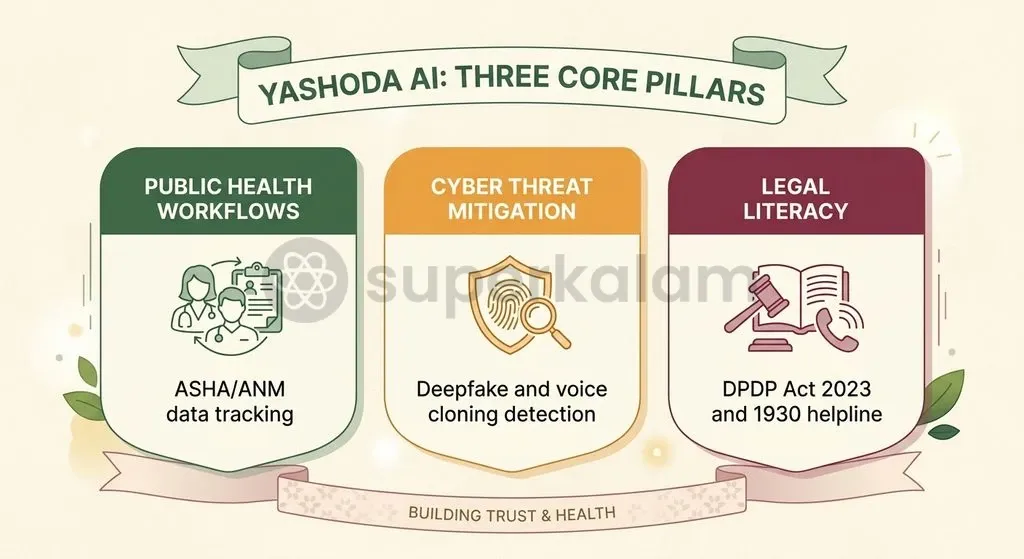
The curriculum focuses on three practical operational pillars:
- Public health digital workflows: Yashoda AI trains ASHA workers to utilise digital workflows, access maternal-child welfare databases, and resolve community-level communication bottlenecks.
- Cyber threat mitigation: Modules train participants to detect and counter malicious deepfakes, voice-cloning banking scams, and non-consensual image manipulation.
- Institutional reporting channels: Grassroots functionaries learn to access official grievance mechanisms, including the National Cyber Crime Reporting Portal (cybercrime.gov.in) and the 1930 national helpline.
Key Features and the Technology Behind Yashoda AI
The technology architecture of Yashoda AI combines role-specific modular learning paths with natural language processing tools to ensure barrier-free adoption. The curriculum developed by Future Shift Labs deploys specialised modules tailored to the operational duties of health workers, law enforcement officers, and educators. Frontline healthcare workers receive practical training in data entry, patient follow-up tracking, and public health database navigation.
Key technological design features include:
- Multilingual voice integration, incorporating national linguistic frameworks like Project Bhashini to deliver real-time translations across non-English regional dialects.
- Low-bandwidth accessibility, featuring offline-compatible toolkits and lightweight interfaces tailored for rural areas with weak mobile connectivity.
- Jargon-free interactive modules, using experiential case scenarios rather than abstract programming theory.
Discuss with Superkalam
How does integrating Project Bhashini into Yashoda AI help bridge the technological divide for non-English-speaking frontline workers?
Ask NowImplementation Model: From Pilot to Primary Health Centres
The National Commission for Women structured the rollout of Yashoda AI as a phased deployment scaling from localized pilot workshops to national institutional networks.
The initiative scales across three distinct operational tiers:
- Initial pilot phase: Commencing in May 2025, the pilot trained approximately 2,500 rural and semi-urban women across initial target districts.
- Multi-state expansion: By mid-2026, operations reached 13 states and 29 cities, successfully training over 5,500 women across diverse socio-economic backgrounds.
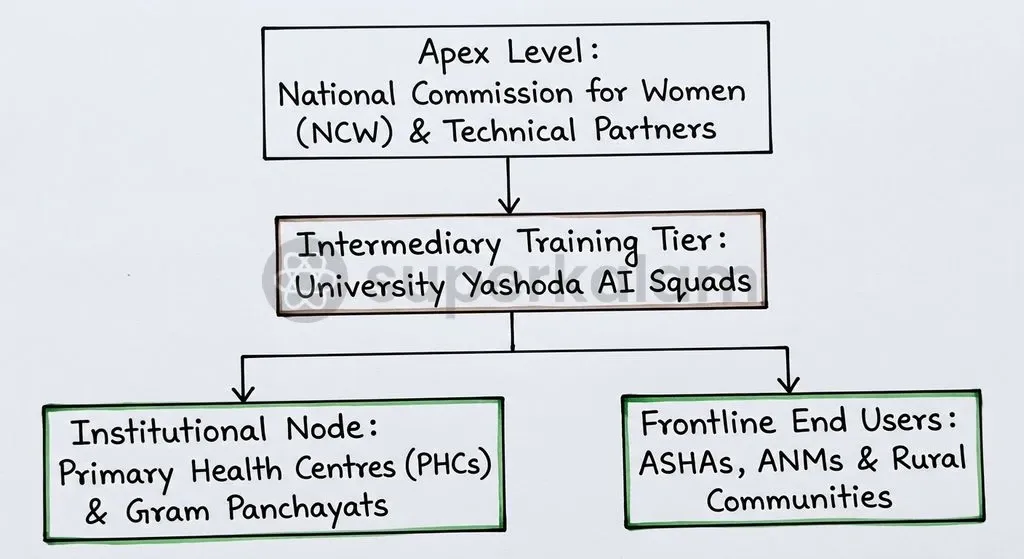
- Higher education outreach: Through the 'Yashoda AI Squad Program' in colleges and universities, student ambassadors receive specialized training in ethical AI principles and peer education. These cohorts run grassroots awareness camps that reinforce local health centres and administrative bodies.
How Yashoda AI Compares with Traditional Healthcare Monitoring
The Yashoda AI framework upgrades conventional, paper-heavy frontline administrative workflows into digitally verifiable, secure, and automated public health reporting mechanisms. Traditional community monitoring systems often suffer from duplicated records, delayed maternal health reporting, and vulnerability to digital fraud. Yashoda AI establishes a modern capability baseline for grassroots workers.
| Dimension | Traditional Frontline Monitoring | Yashoda AI-Enabled Workflow |
|---|---|---|
| Data Entry and Tracking | Manual paper registers and fragmented mobile forms | Automated digital workflows and structured database navigation |
| Language Accessibility | English or standardized state-language text interfaces | Multilingual voice support integrated with Project Bhashini |
| Cybersecurity Preparedness | Minimal awareness of phishing and financial scams | Active threat identification covering voice fraud and deepfakes |
| Legal and Privacy Compliance | Informal data collection without explicit privacy protocols | Statutory alignment under Digital Personal Data Protection Act, 2023 |
| Connectivity Dependency | Frequent disruption due to poor rural internet bandwidth | Offline-compatible toolkits optimized for low-bandwidth zones |
Discuss with Superkalam
If an ASHA worker suspects a voice-cloning scam attempting to access maternal health records, what institutional reporting steps taught in Yashoda AI should she take?
Ask NowChallenges: Digital Literacy, Data Privacy, and Infrastructure Deficits
Implementing Yashoda AI across rural districts reveals substantial operational hurdles surrounding hardware availability, baseline digital literacy, and personal data compliance.
Key operational challenges include:
- Hardware and connectivity deficits: While Yashoda AI provides offline-compatible resources, many frontline workers operate entry-level smartphones with limited processing capacity. Rural Primary Health Centres also face uneven digital infrastructure.
- Data privacy and compliance: The curriculum instructs trainees on statutory safeguards established by the Digital Personal Data Protection Act, 2023. Because maternal and child welfare records constitute sensitive personal data, frontline workers must balance rapid digital intake with strict patient consent norms.
Ethical and Governance Dimensions: Algorithmic Accountability in Public Health
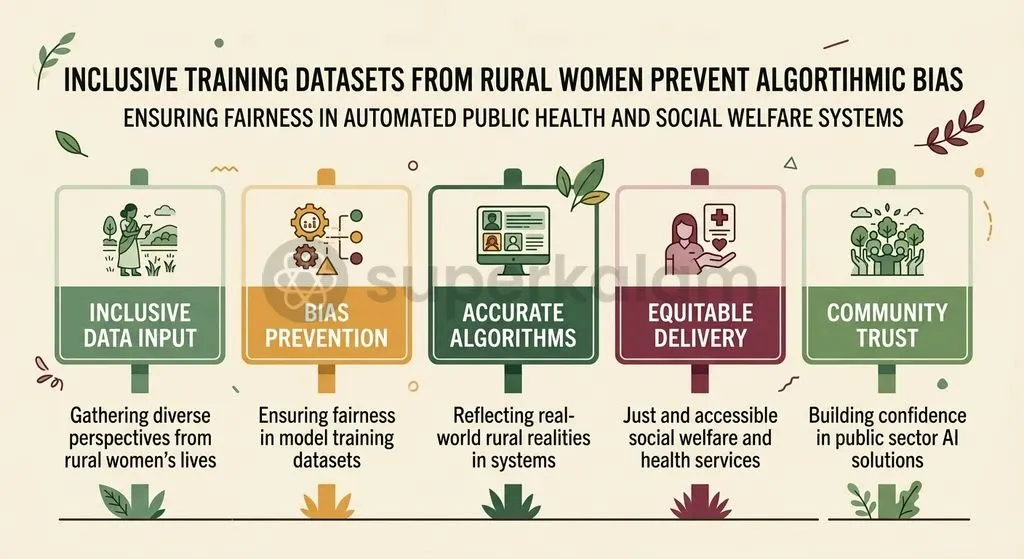
The Yashoda AI curriculum integrates algorithmic ethics to address dataset representation gaps and prevent gender bias in automated decision systems. Machine learning models frequently reflect the systemic biases present in their training datasets.
The programme tackles ethical governance across two dimensions:
- Mitigating dataset skew: Yashoda AI educates women on identifying demographic representation gaps that skew automated healthcare and social welfare tools. When public algorithms lack adequate rural female data points, diagnostic recommendations and welfare targeting risk significant systemic distortion.
- Grassroots oversight: Democratising technical comprehension empowers local Sarpanchs, SHG federations, and health workers to establish algorithmic accountability at community level. This ground-up oversight ensures public welfare technologies remain transparent, gender-inclusive, and socially equitable.
Way Forward: Integrating AI Sustainably into Frontline Healthcare
Sustainable expansion of the Yashoda AI initiative requires institutional convergence across central ministries, national digital health platforms, and enterprise technology ecosystems.
Key policy priorities include:
- Inter-ministerial synergy: The programme strategically supports the 'AI by HER: Global Impact Challenge', managed under the IndiaAI Mission by the Ministry of Electronics and Information Technology alongside NITI Aayog's Women Entrepreneurship Platform. Deepening this alignment links community-level digital training directly with national artificial intelligence innovation pipelines.
- National health integration: Policy reviews suggest formal integration of Yashoda AI modules into national capacity-building curricula under the National Health Mission and the Ayushman Bharat Digital Mission [LIKELY — not settled]. Institutionalising vernacular artificial intelligence literacy equips India's frontline health workforce to deliver faster, safer, and more inclusive maternal healthcare.
Discuss with Superkalam
Compare traditional paper-based healthcare monitoring with the Yashoda AI framework in terms of data accuracy, cybersecurity awareness, and privacy compliance.
Ask NowKey Takeaways
- Foundational Mandate: The National Commission for Women, a statutory body established under the National Commission for Women Act, 1990, launched Yashoda AI with Future Shift Labs in May 2025.
- Core Acronym and Vision: Operating as 'Your AI SAKHI for Shaping Horizons with Digital Awareness', the initiative advances the national goal of 'AI Literate Women for Developed India' (Viksit Bharat).
- Pan-India Reach: As of mid-2026, the programme has trained more than 5,500 women across 13 states and 29 cities, targeting ASHAs, ANMs, SHG leaders, police personnel, and students.
- Technological Inclusivity: The framework deploys offline-compatible modules and vernacular translation powered by Project Bhashini to overcome rural linguistic and connectivity barriers.
- Data Governance and Ethics: The curriculum instills compliance with the Digital Personal Data Protection Act, 2023, while training grassroots workers to counter deepfakes and algorithmic bias.
- Scaling Trajectory: Institutional proposals under review suggest integrating Yashoda AI modules into frontline worker training under the Ayushman Bharat Digital Mission and National Health Mission [LIKELY — not settled].
Mains Question
The integration of emerging technologies into frontline public health administration necessitates not only technical literacy but also robust data governance. In the context of the Yashoda AI initiative launched by the National Commission for Women, examine how vernacular AI training and statutory compliance under the Digital Personal Data Protection Act, 2023 empower grassroots health workers. (10 Marks)
Evaluate NowMains Question
'Algorithmic bias in automated decision systems often stems from demographic dataset skews, risking the exclusion of rural communities from public welfare.' In light of this, critically analyse the ethical and operational dimensions of deploying AI literacy programmes like Yashoda AI among rural women and community leadership. (15 Marks)
Evaluate NowPractice MCQs
QUESTION 1
Consider the following statements regarding the Yashoda AI initiative:
- It is a digital empowerment programme launched by the National Commission for Women in technical partnership with Future Shift Labs.
- The National Commission for Women is a statutory body established under the National Commission for Women Act, 1990.
- The initiative is exclusively restricted to training recruits for the Indian Armed Forces.
Which of the statements given above are correct?
QUESTION 2
Consider the following statements regarding the technological and pedagogical features of Yashoda AI:
- It incorporates Project Bhashini to deliver real-time translations across non-English regional dialects.
- It includes offline-compatible toolkits designed to function in low-bandwidth rural environments.
- It embeds compliance principles derived from the Digital Personal Data Protection Act, 2023.
Which of the statements given above is/are correct?
QUESTION 3
With reference to cyber threat mitigation under the Yashoda AI curriculum, consider the following statements:
- Frontline healthcare workers and rural women are trained to identify artificial intelligence-driven threats like malicious deepfakes and voice-cloning fraud.
- The curriculum educates trainees on accessing official reporting channels, including the 1930 national helpline and the National Cyber Crime Reporting Portal.
Which of the statements given above is/are correct?
QUESTION 4
In the context of recent initiatives launched by the National Commission for Women, what is the primary objective of the 'She Serves' initiative?
QUESTION 5
Consider the following statements regarding the ethical governance dimensions addressed in the Yashoda AI framework:
- The curriculum trains participants to identify demographic representation gaps that cause dataset skew in healthcare algorithms.
- It aims to empower community leadership, such as Sarpanchs and Self-Help Groups, to exercise ground-up algorithmic accountability.
Which of the statements given above is/are correct?