Wild Water Buffalo Translocation: Kanha's Species Recovery Blueprint
Reversing a century of local extinction, Kanha's experiment tests whether active habitat restoration can rescue Central India's fragile wild water buffalo herds.
Oct, 2026
•7 min read
Overview
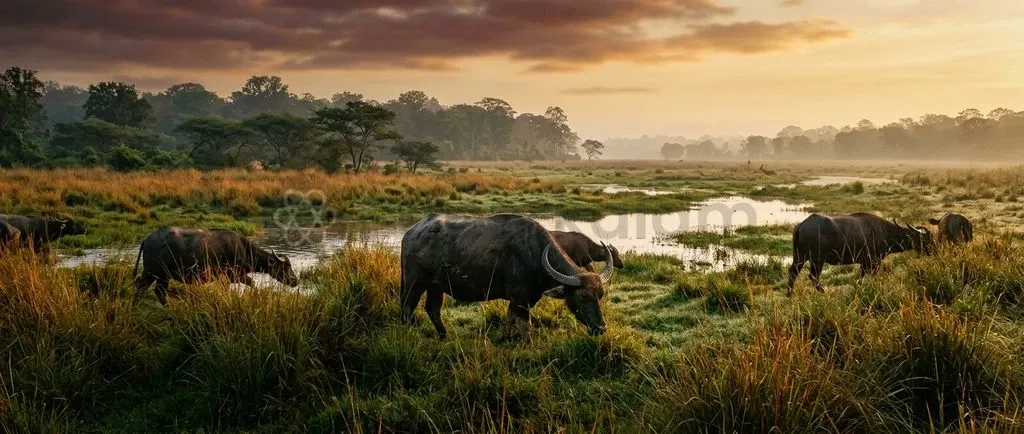
Reintroducing wild water buffaloes into Kanha Tiger Reserve creates an insurance population against regional extinction. Over a three-year programme, Madhya Pradesh aims to translocate 50 pure-strain individuals from Assam. This step rebuilds a viable breeding pool across restored central grasslands.
The project tackles severe inbreeding and hybridisation seen across isolated herds. Establishing this founder stock applies decades of grassland management to safeguard one of India's rarest bovids.
Why in the News?
On 11 October 2026, Madhya Pradesh released eight wild water buffaloes (Bubalus arnee) into a 17-hectare soft-release enclosure located in the Supkhar range of Kanha Tiger Reserve. This release marks the operational second phase of species restoration in a state where the animal suffered local extinction roughly a century ago.
As of October 2026, forest authorities are managing the newly introduced herd under intensive veterinary observation following its road transport across 2,200 kilometres from Assam's Kaziranga National Park. Statutory approval for this inter-state scientific movement derives directly from Section 12 of the Wildlife (Protection) Act, 1972.
Why the Kanha Experiment Matters for Central India's Wild Water Buffalo
The Kanha experiment protects Bubalus arnee from disappearing across Central India's fragmented sal forests. Wild water buffaloes are classified as Endangered on the IUCN Red List and receive Schedule I statutory protection.
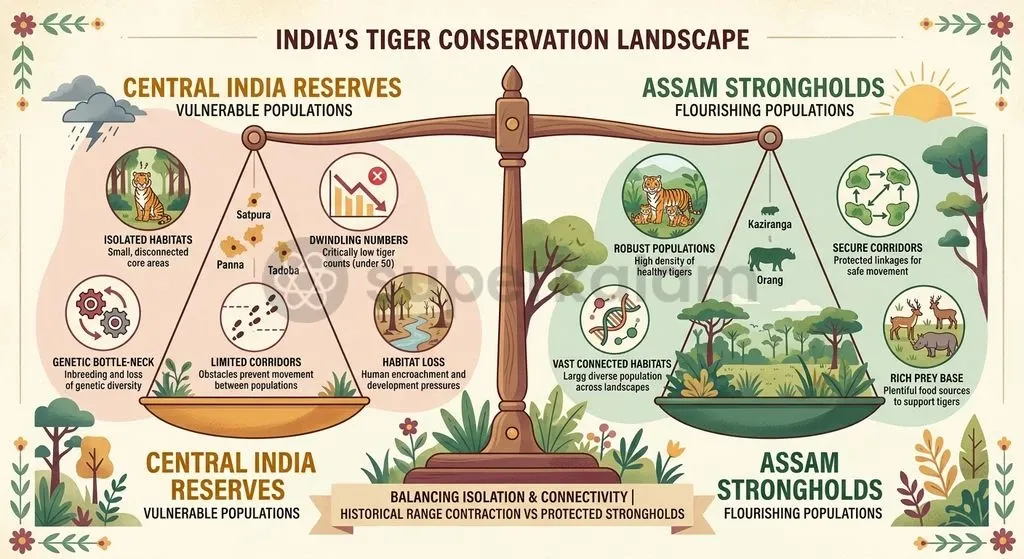
Historical trophy hunting, agricultural clearance, and livestock diseases wiped out wild herds from Madhya Pradesh approximately 100 years ago. The remaining Central Indian population collapsed to fewer than 50 individuals, confined to two isolated tracts:
- Indravati Tiger Reserve: Hosts scattered family groups along the Maharashtra-Chhattisgarh border.
- Udanti-Sitanadi Tiger Reserve: Retains an isolated micro-population prone to demographic collapse.
Without a predator-sheltered reserve, random disease outbreaks could wipe out Central India's free-ranging buffaloes. Translocating 50 founder buffaloes over three years supplies the demographic mass needed to seed self-sustaining herds while reviving historic grazing dynamics.
Discuss with Superkalam
Which statutory section of the Wildlife (Protection) Act, 1972 empowers state authorities to permit the inter-state capture and translocation of Schedule I species for scientific management?
Ask NowThe Crisis That Forced the Move: How Udanti-Sitanadi's Population Collapsed
Udanti-Sitanadi Tiger Reserve in Chhattisgarh suffered an acute ecological bottleneck. By the late 2000s, the reserve's wild herd dwindled down to a critically skewed sex ratio comprising only one pure wild female, an iconic matriarch named 'Asha', alongside a dwindling cluster of adult males.
Captive enclosure management preserved Asha's breeding output. She delivered six male calves and a single surviving female offspring named 'Khushi'. Asha died of natural causes in February 2020 at 17 years of age, terminating the landscape's primary maternal reproductive lineage. In 2014, scientists at ICAR-National Dairy Research Institute (NDRI) in Karnal produced a clone named 'Deepasha' using the hand-guided cloning technique to rescue this genetic line.
To counter demographic collapse, the Chhattisgarh Forest Department translocated six wild water buffaloes from Manas National Park to an in-situ Conservation Breeding Centre in Barnawapara Wildlife Sanctuary between 2020 and 2023. Complementary in-situ breeding strategies have been reported by the state forest department to prepare further releases in Udanti-Sitanadi, Pamed, and Indravati reserves. The crisis confirmed that isolated pockets cannot survive without regular genetic infusions.
| Dimension | Wild Water Buffalo (Bubalus arnee) | Domestic Water Buffalo (Bubalus bubalis) |
|---|---|---|
| IUCN Status & Legal Shield | Endangered (Schedule I) under Wildlife (Protection) Act, 1972 | Not listed; managed as domestic livestock |
| Horn Morphology & Build | Massive, wide-spreading backward crescent horns; robust, barrel-chested musculature | Variable, coiled, downward-directed or compact horns; slighter build |
| Primary Habitat Anchor | Alluvial grasslands, riparian marshes, and terai swamps | Fallow pasture, agricultural villages, and rural human settlements |
| Conservation Vulnerability | Severe threat from genetic swamping through domestic introgression | Expansive, unthreatened global population exceeding tens of millions |
Discuss with Superkalam
How does genetic swamping differ from normal hybridization, and why does it represent a critical threat to the survival of Bubalus arnee?
Ask NowWhy Kanha Was Chosen: Grassland Management and Lessons from the Barasingha
Kanha Tiger Reserve earned selection through its proven record in grassland restoration and ungulate recovery. Kanha's wildlife managers rescued the endemic Hardground Barasingha (Rucervus duvaucelii branderi) from fewer than 66 animals in 1970 to an expansive population exceeding 800 wild individuals.
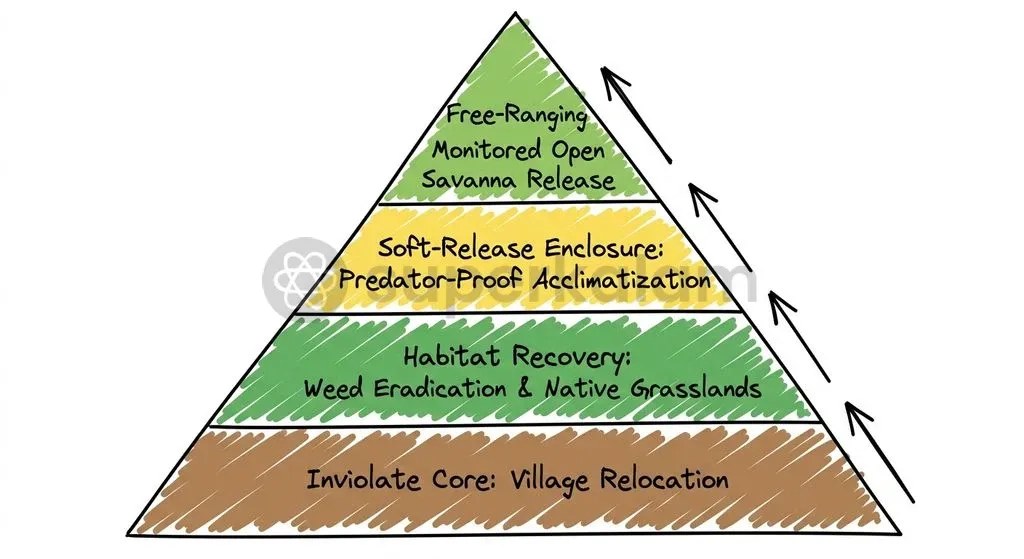
This recovery rested on three practical management pillars:
- Habitat Reclamation: Relocating forest villages and systematically clearing unpalatable invasive weeds.
- Predator Protection: Building secure, predator-proof breeding exclosures across the Kanha and Supkhar valleys.
- Site Suitability: Providing perennial grasses and natural waterbodies matching the buffalo's swamp ecology, ranking Kanha ahead of Satpura Tiger Reserve.
Kanha pairs robust anti-poaching security with deep institutional experience in handling ungulates. Applying the Barasingha model gives the newly arrived buffaloes the strongest chance of survival.
Inside the Translocation: Enclosure Breeding and Managing the Gene Pool
The project uses specialised soft-release enclosures known as the African boma system to acclimatise translocated herds. In April and May 2026, forest authorities moved eight wild buffaloes—comprising six females and two males—across 2,200 km from Kaziranga National Park using retrofitted trucks. Upon arrival, the animals entered a one-hectare quarantine enclosure. On 11 October 2026 they were released into a 17-hectare soft-release enclosure in Supkhar.
- Donor Herd Identification: Wildlife rangers in Assam isolate suitable wild herds within Kaziranga National Park exhibiting peak health and intact social structures.
- Genetic Purity Screening: The Laboratory for the Conservation of Endangered Species (LaCONES) at CSIR-CCMB conducts mandatory microsatellite and DNA marker profiling to certify zero domestic buffalo hybridization.
- Capture and Boma Loading: The Kaziranga capture operation used chemical immobilisation under veterinary supervision; the herd was then transported to Kanha.
- Long-Distance Road Transit: Specially ventilated trucks transport the cohort over 2,200 kilometres under continuous veterinary monitoring.
- Soft-Release Acclimatisation: Buffaloes spend months within the 17-hectare perimeter in Supkhar, facilitating herd cohesion before full release into open wild habitats.
Uncontrolled cross-breeding with domestic buffaloes (Bubalus bubalis) causes damaging genetic swamping across wild stocks. Sequencing by Mishra et al. at CSIR-CCMB confirmed that Central Indian and Assamese herds share mitochondrial genome homology. This finding confirms Kaziranga stock as an ecologically suitable founder source.
Discuss with Superkalam
If you were tasked with designing an immune buffer zone around a tiger reserve's core, how would you structure the vaccination and monitoring schedule for domestic cattle in periphery villages?
Ask NowKey Hurdles on the Ground: Disease Risks, Tiger Predation, and Inbreeding
Translocated herds face three distinct operational challenges in Central India:
- Livestock Pathogens: Domestic cattle carry fatal diseases, notably Foot-and-Mouth Disease (FMD), Haemorrhagic Septicaemia (Pasteurella multocida), and Black Quarter (Clostridium chauvoei).
- Carnivore Predation: Bengal tigers (Panthera tigris), leopards, and dholes hunt unfamiliar herbivores across Kanha's predator-dense core.
- Inbreeding Depression: Founder groups risk genetic bottlenecks if herds remain closed to future demographic exchange.
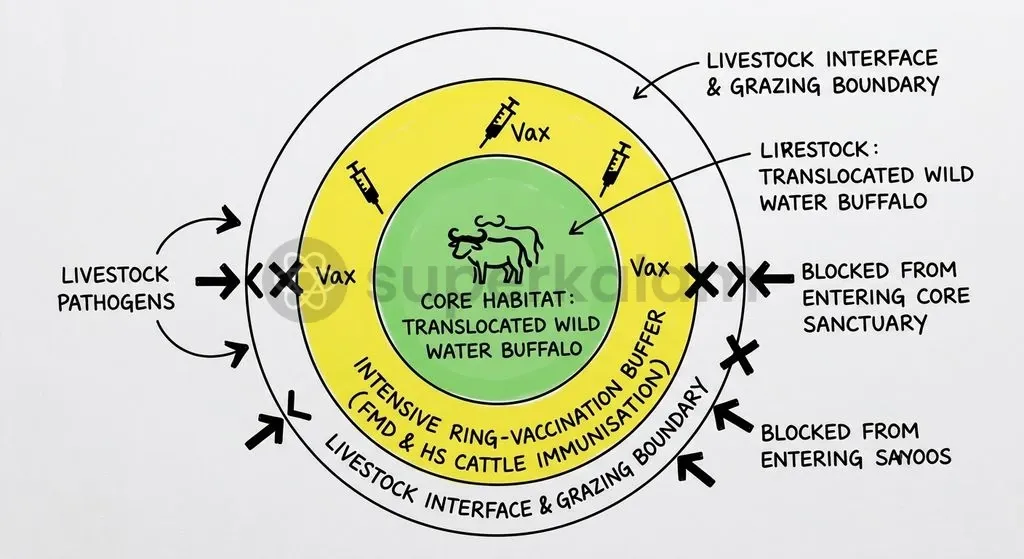
To counter infections, forest teams administer prophylactic vaccines and deworming to fringe village cattle, creating an immune buffer zone. Meanwhile, soft-release pens shield the buffaloes until they form unified antipredator defence groups. Introducing unrelated breeding bulls from Assam in subsequent phases will protect long-term heterozygosity.
Discuss with Superkalam
Compare the ecological advantages and operational limitations of in-situ soft-release enclosures versus direct hard-releases into the wild for translocated ungulates.
Ask NowBeyond Kanha: Policy Lessons for Wildlife Reintroduction in India
The Kanha project applies the IUCN Guidelines for Reintroductions and Other Conservation Translocations (2013) to Indian field administration. It establishes a clear framework for long-term rewilding:
- Multi-Year Planning: Translocations require phased releases, multi-year disease monitoring, and post-release tracking.
- Inter-State Coordination: Joint execution under Section 12 of the Wildlife (Protection) Act, 1972 shows how states can coordinate to rescue extirpated species.
- Genomic Integration: Pairing molecular profiling with active habitat management creates a rigorous standard for reintroducing megafauna.
Securing cattle-free buffer zones and connecting river corridors will determine the herd's permanent establishment. Kanha demonstrates that science-led translocation can restore extirpated species to their historic ranges.
Key Takeaways
- On 11 October 2026, Madhya Pradesh released eight wild water buffaloes (Bubalus arnee) into a 17-hectare soft-release enclosure in Kanha's Supkhar range.
- The current initiative marks the return of the species to Madhya Pradesh after approximately 100 years of local extinction driven by hunting and disease.
- The translocated group of six females and two males completed a 2,200 km road transit from Kaziranga National Park in Assam.
- Scientific translocations of Schedule I endangered species are legally authorized under Section 12 of the Wildlife (Protection) Act, 1972.
- Genetic analysis by CSIR-CCMB verified mitochondrial genome homology between Assamese and Central Indian herds, legitimising donor selection.
- The recovery model draws on Kanha's proven grassland interventions that previously rescued the Hardground Barasingha from under 66 individuals.
Mains Question
"Translocation of endangered herbivores is not merely a logistical transport exercise, but an integrated continuum of habitat manipulation, genetic validation, and disease buffering." In the context of the wild water buffalo reintroduction in Kanha Tiger Reserve, examine the institutional and ecological safeguards necessary for successful species recovery. (15 Marks)
Evaluate NowMains Question
Highlighting the demographic collapse of the wild water buffalo in the Udanti-Sitanadi Tiger Reserve, evaluate enclosure breeding and assisted reproduction as tools for preventing the local extinction of critically depleted wildlife populations. (10 Marks)
Evaluate NowPractice MCQs
QUESTION 1
With reference to the Wild Water Buffalo (Bubalus arnee), consider the following statements:
- It is accorded legal protection under Schedule I of the Wildlife (Protection) Act, 1972.
- Genetic swamping through interbreeding with domestic water buffaloes is a primary conservation threat to pure wild herds.
- The species is currently classified as Critically Endangered on the IUCN Red List. Which of the statements given above are correct?
QUESTION 2
Consider the following statements regarding the translocation of wild water buffaloes to Kanha Tiger Reserve:
- The inter-state movement of the founder herd was carried out under statutory permission granted under Section 12 of the Wildlife (Protection) Act, 1972.
- The founder individuals were sourced from Manas National Park to establish an insurance population in Madhya Pradesh.
- Kanha was selected over Satpura Tiger Reserve partly due to its perennial grasses and suitability for swamp ecology. Which of the statements given above is/are correct?
QUESTION 3
Consider the following statements regarding species recovery and management techniques mentioned in wildlife conservation in India:
- The African boma technique utilizes funnel enclosures to capture and load wild herbivores while minimizing tranquilization stress.
- In Udanti-Sitanadi Tiger Reserve, hand-guided cloning was used to produce a female clone named 'Khushi'.
- Kanha Tiger Reserve utilized predator-proof breeding exclosures to facilitate the recovery of the Hardground Barasingha. Which of the statements given above is/are correct?
QUESTION 4
With reference to disease threats affecting translocated wild ungulates in Central Indian protected areas, consider the following diseases:
- Foot-and-Mouth Disease (FMD)
- Haemorrhagic Septicaemia
- Black Quarter Which of the diseases given above pose transmission risks from domestic livestock to wild water buffaloes?
QUESTION 5
Which institution conducted microsatellite and DNA marker profiling to certify zero domestic cattle hybridization in the wild water buffaloes translocated to Kanha Tiger Reserve?