Tuvalu Climate Crisis: Rising Seas, Coral Loss, and Sovereign Statehood
When rising oceans threaten to erase a sovereign nation, international law must redefine the boundaries of statehood, maritime rights, and climate justice.
Oct, 2026
•7 min read
Overview
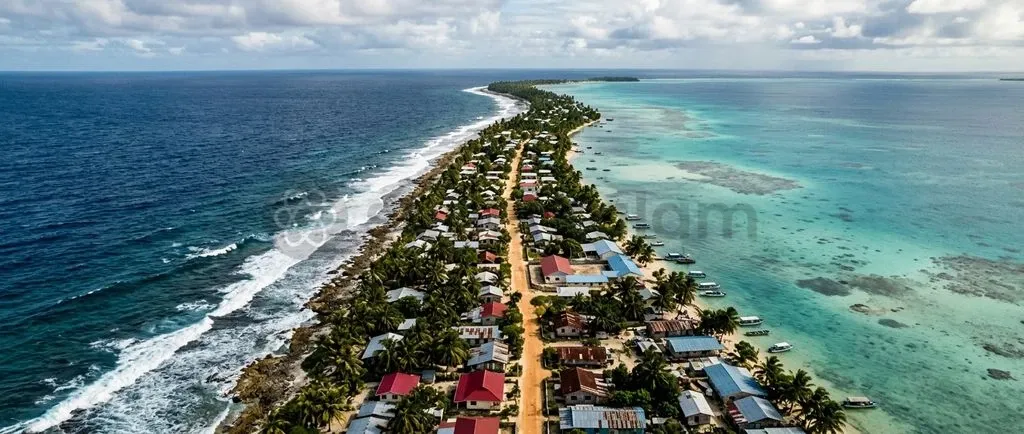
Tuvalu faces an existential climate threat as rapid sea-level rise and coral reef degradation threaten to submerge its low-lying atolls. With an average elevation below 2 metres, oceanic warming drives rapid land loss and subterranean saltwater contamination.
This physical displacement challenges established criteria for sovereign statehood under the 1933 Montevideo Convention and tests maritime baseline permanence under the UN Convention on the Law of the Sea. Tuvalu has responded by amending its domestic constitution, signing landmark bilateral treaties, and digitising its national heritage in cyberspace. Resolving this crisis requires global legal recognition of enduring sovereignty alongside the prompt operationalisation of international loss and damage finance mechanisms.
Why in the News: Tuvalu on the Frontline of the Climate Crisis
Tuvalu is the primary global case study for climate-induced state vulnerability as accelerating oceanic warming threatens its atoll territory. As of April 2024, the confirmation of the fourth global coral bleaching event by the National Oceanic and Atmospheric Administration has compounded local environmental hazards across the South Pacific.
Climate models from NASA and the Intergovernmental Panel on Climate Change project that under high emissions pathways, over 50 percent of Funafuti, Tuvalu's capital island, will experience regular tidal flooding by 2050. This expands to up to 95 percent by 2100. Tuvalu is among the first sovereign states facing complete territorial inundation within this century.
Discuss with Superkalam
What are the four objective criteria of sovereign statehood laid down by the 1933 Montevideo Convention?
Ask NowGeography of an Atoll: How Tuvalu Formed and Why It Sits So Low
Tuvalu is an archipelagic nation in the South Pacific Ocean comprising nine low-lying coral atolls and reef islands. The country spans a total land area of roughly 26 square kilometres, with an average elevation resting below 2 metres above mean sea level according to NASA Earth Observatory and Landsat 8 records.
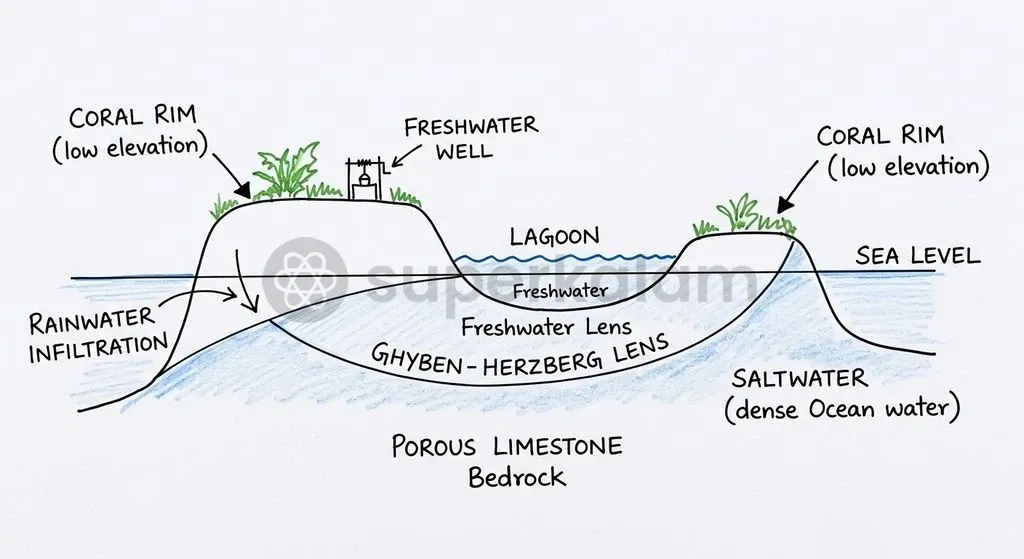
Coral atolls develop across geological epochs through the subsidence of volcanic islands ringed by fringing reefs. As the volcanic core sinks, coral grows upward toward sunlight to form a ring-shaped reef around a central lagoon. These formations lack deep continental bedrock, remaining entirely dependent on living biogenic coral sand and limestone deposits.
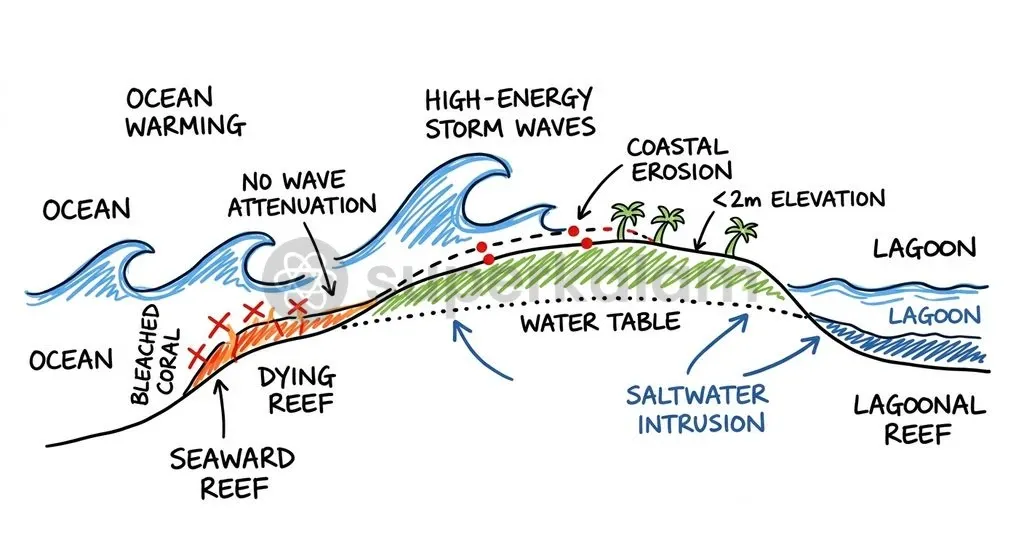
Subterranean hydrology on atolls relies on the Ghyben-Herzberg lens, a convex freshwater layer floating over denser seawater. Rising seas and severe storms cause subterranean saltwater intrusion into this freshwater lens. This contamination destroys traditional pit-cultivated crops such as pulaka (swamp taro), triggering severe food and water insecurity across the archipelago.
| Geographic Feature | Coral Atoll (e.g. Tuvalu) | Continental Coastal Plain |
|---|---|---|
| Geological Origin | Biogenic coral accumulation on submerged volcanoes | Tectonic uplift and continental river sedimentation |
| Mean Elevation | Less than 2 metres above sea level | Variable, often tens to hundreds of metres |
| Freshwater System | Fragile floating Ghyben-Herzberg freshwater lens | Extensive aquifers, rivers, and deep groundwater tables |
| Natural Wave Defence | Living fringing and barrier coral reef systems | Coastal dunes, extensive mangrove belts, and estuaries |
| Vulnerability to Sea Rise | Complete territorial inundation and saltwater intrusion | Localised shoreline retreat and manageable inland buffers |
The Triple Climate Threat: Sea-Level Rise, Marine Heatwaves, and Dying Coral
Tuvalu confronts compounding oceanographic pressures driven by warming waters and severe weather events:
- Accelerated Sea-Level Rise: Local sea levels rose by approximately 0.15 metres over three decades, reflecting a rate of 5 mm per year since 1993 that outpaces the global average.
- Loss of Natural Breakwaters: Intact coral reefs dissipate up to 97 percent of incoming wave energy, buffering low-lying atolls from destructive open-ocean swell, king tides, and storm surges.
- Thermal Stress and Reef Collapse: NOAA confirmed the fourth global coral bleaching event in April 2024, recording extensive thermal stress across the South Pacific. Reef structural collapse allows high-energy waves to drive severe coastal erosion and overwash directly onto inhabited settlements.
Discuss with Superkalam
How does the degradation of coral reefs accelerate coastal erosion and land loss on low-lying atolls?
Ask NowCan a Country Exist Without Land? The Legal Riddle of Sinking States
International law faces a novel dilemma as sea-level rise threatens the physical territory required for sovereign statehood. Article 1 of the 1933 Montevideo Convention establishes four objective criteria: a permanent population, a defined territory, an effective government, and the capacity to enter into relations with other states.
The prospective total submergence of an atoll nation creates major legal questions regarding whether statehood survives physical unhabitability:
- The Ambulatory Baseline Problem: Under Article 5 of UNCLOS, maritime baselines are measured from coastal low-water lines, functioning as ambulatory baselines that shift landward as waters rise.
- Threat to Maritime Zones: Landward baseline retreat risks shrinking territorial seas and the Exclusive Economic Zone, endangering vital sovereign fishing rights and marine resource jurisdiction.
- The Presumption of Continuity: The International Law Commission concluded that international law supports a presumption of continuity for existing states, permitting nations to retain fixed baselines regardless of shoreline retreat.
- Regional Declarations: The Pacific Islands Forum declared in 2021 and 2023 that member states' maritime boundaries and sovereign rights remain permanent and unreduced despite climate-induced sea-level rise.
Discuss with Superkalam
Weigh the legal viability of maintaining maritime baselines permanently fixed against the traditional ambulatory baseline approach of UNCLOS.
Ask NowFighting for Survival: The Falepili Union, Digital Twins, and Adaptation
Tuvalu is deploying legal, diplomatic, and technological measures to protect its sovereignty and cultural identity:
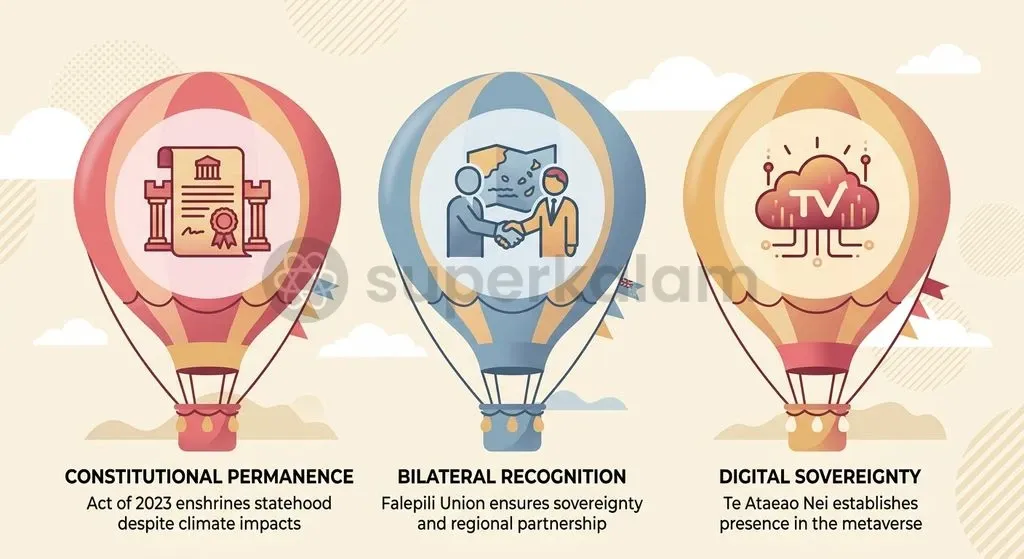
- Constitutional Continuity: The nation enacted the Constitution of Tuvalu Act 2023, declaring that the State of Tuvalu, its maritime zones, and its sovereignty exist in perpetuity regardless of land inundation.
- Bilateral Recognition: On 28 August 2024, the Australia-Tuvalu Falepili Union Treaty entered into force, establishing the first bilateral treaty recognising Tuvalu's ongoing statehood notwithstanding sea-level rise. The agreement provides frameworks for mobility with dignity and adaptation support.
- Digital Statehood: Tuvalu launched the Te Ataeao Nei initiative (Future Now Project) at COP27 to build a digital twin in the metaverse. The project archives national topography, cultural rituals, and administrative registries in cyberspace.
Discuss with Superkalam
Propose an international legal framework to protect the rights, culture, and nationality of citizens whose home territories become completely uninhabitable due to climate change.
Ask NowWhat Tuvalu Teaches the World: Climate Justice and Small Island Vulnerability
Small Island Developing States contribute less than 0.03 percent of global greenhouse gas emissions yet face the most immediate existential impacts of global heating. Tuvalu’s situation highlights systemic inequities in international climate governance.
- Protection Gaps: The 1951 Refugee Convention and its 1967 Protocol do not recognise people displaced by environmental disasters as legal refugees, leaving cross-border climate-displaced populations without guaranteed international safeguards.
- Loss and Damage Financing: The COP28 summit operationalised the Loss and Damage Fund under Decision 2/CP.28. The fund creates targeted financing pathways to assist vulnerable developing nations coping with irreversible economic losses, infrastructure damage, and lost cultural heritage.
Way Forward
Ensuring climate justice for sinking island nations requires coordinated multilateral action:
- Codification of Permanent Baselines: The international community should formally adopt the International Law Commission's guidance within UNCLOS bodies, establishing that declared maritime coordinates remain permanently fixed baselines immune to shoreline changes.
- Expansion of Protection Frameworks: Multilateral institutions must develop binding legal mechanisms or regional protocols that grant clear status and human rights safeguards to populations displaced across borders by climate change.
- Capitalisation of Loss and Damage: Developed countries must scale predictable, grant-based financing under the UNFCCC Loss and Damage Fund to support comprehensive coastal adaptation and heritage preservation.
- Targeted Coastal Engineering: Scaled investments in land reclamation, elevated civic infrastructure, and nature-based coral restoration must be prioritised to extend the habitable lifespan of vulnerable atoll communities.
Key Takeaways
- Tuvalu's low-lying archipelagic geography, with a mean elevation under 2 metres, makes it exceptionally susceptible to compounding climate threats.
- Local sea-level rise of 5 mm annually combines with marine heatwaves and coral degradation to eliminate natural wave barriers.
- Saltwater intrusion into subterranean Ghyben-Herzberg freshwater lenses threatens agricultural sustainability and vital food security.
- Traditional criteria of statehood under the 1933 Montevideo Convention are being challenged by potential land submergence, driving legal shifts toward a presumption of permanent statehood.
- Tuvalu is spearheading innovative survival mechanisms through the Constitution of Tuvalu Act 2023, the Australia-Tuvalu Falepili Union Treaty, and the digital twin initiative.
- Existing international frameworks, such as the 1951 Refugee Convention, lack coverage for climate-displaced persons, highlighting the importance of the COP28 Loss and Damage Fund.
Mains Question
"The prospective territorial inundation of Small Island Developing States challenges the traditional Westphalian conception of statehood rooted in the 1933 Montevideo Convention." Examine this statement in light of Tuvalu's constitutional and diplomatic adaptations. (15 Marks)
Evaluate NowMains Question
Highlighting the disproportionate vulnerability of coral atoll nations to marine heatwaves and sea-level rise, evaluate the adequacy of current international climate governance mechanisms in addressing their loss and damage. (10 Marks)
Evaluate NowPractice MCQs
QUESTION 1
With reference to the geological and hydrological characteristics of coral atolls like Tuvalu, consider the following statements:
- Coral atolls are biogenic structures that typically form through the subsidence of volcanic islands ringed by fringing reefs.
- The freshwater lens found beneath atolls is known as the Ghyben-Herzberg lens, which floats directly over denser seawater.
- Intact coral reefs act as natural breakwaters, dissipating over 90 percent of incoming open-ocean wave energy.
Which of the statements given above are correct?
QUESTION 2
Regarding sovereign statehood and maritime law in the context of sea-level rise, consider the following statements:
- The 1933 Montevideo Convention lists a defined territory as one of the essential criteria for sovereign statehood.
- Under Article 5 of the UN Convention on the Law of the Sea (UNCLOS), baselines are fixed permanently and do not shift with the coastal low-water line.
- The International Law Commission concluded that international law supports a presumption of continuity for existing states despite shoreline retreat.
Which of the statements given above is/are correct?
QUESTION 3
Consider the following statements regarding the Australia-Tuvalu Falepili Union Treaty:
- It is the first bilateral treaty to explicitly recognise Tuvalu's ongoing statehood notwithstanding climate-induced sea-level rise.
- It entered into force in August 2024.
- It establishes frameworks for mobility with dignity and climate adaptation support.
Which of the statements given above is/are correct?
QUESTION 4
The 'Te Ataeao Nei' (Future Now) initiative, launched by Tuvalu at COP27, primarily aims to:
QUESTION 5
With reference to global climate justice and international protection mechanisms, consider the following statements:
- The 1951 Refugee Convention explicitly includes people displaced by environmental degradation and climate disasters under the definition of legal refugees.
- The Loss and Damage Fund was operationalised under Decision 2/CP.28 at the COP28 summit to assist vulnerable developing nations.
Which of the statements given above is/are correct?





